A homeowner needs a plumber right now. They open Google Maps and type “emergency plumber near me.” Three results appear at the top. The homeowner calls the first one with the most reviews and the highest rating. They do not scroll further.
That moment repeats itself thousands of times every day across every home improvement category. Roofers, electricians, HVAC technicians, remodelers, painters. The business with the strongest review profile wins the call. Everyone else competes for whatever is left.
Most home improvement pros know reviews matter. However, very few have a system that consistently generates them. They ask happy customers occasionally. They forget most of the time. The review count grows slowly, if at all, while competitors with automated systems pull further ahead every month.
Automated review generation fixes this gap directly. Here is how it works, why it impacts your Google Maps ranking specifically, and how to build a system that runs without you having to remember to ask.
Why Reviews Drive Google Maps Rankings
Google ranks local businesses in the Map Pack based on three core factors: relevance, distance, and prominence. Reviews sit at the heart of prominence.
A business with 150 reviews and a 4.8 average rating signals trust and activity to Google’s algorithm. A business with 12 reviews signals the opposite, regardless of how good the actual work is. As a result, Google ranks the well-reviewed business higher, and that business receives more calls. More calls eventually generate more reviews. The gap widens over time.
According to RankLadder’s 2026 contractor review research, review footprints tie directly to map performance and inbound calls. The research found that review quantity, recency, and a steady flow of new reviews function together as one of the strongest local ranking and conversion signals available to home service businesses.
Furthermore, the same research recommends a specific target. Contractors should aim for 8 to 15 new reviews per month if they can sustain that pace. Most home improvement businesses fall well short of this number because they rely on inconsistent manual requests rather than a structured system.
The Recency Factor Most Pros Ignore
Many contractors believe that accumulating reviews once and then coasting on that total is enough. It is not.
Google weighs recency heavily. A business with 200 reviews from three years ago and nothing recent looks less active than a competitor with 80 reviews, where 15 arrived in the last month. Therefore, consistent review generation matters more than a one-time push.
According to Shapo’s 2025 Google review statistics, responding to reviews within 24 to 72 hours, and within 7 days at the latest, produces stronger trust signals than delayed responses. Speed matters on both sides of the review relationship: speed in requesting the review and speed in responding to it.
This recency requirement is exactly why automation matters so much for home improvement businesses. A solo contractor or a small team running multiple jobs per week simply does not have the bandwidth to manually track every completed job, send a personalized request, and follow up if there is no response. Automation handles that consistency without depending on memory or available time.
What Automated Review Generation Actually Does
An automated review generation system removes the manual steps that cause most home improvement businesses to under-collect reviews.
Here is what a properly built system handles without manual input.
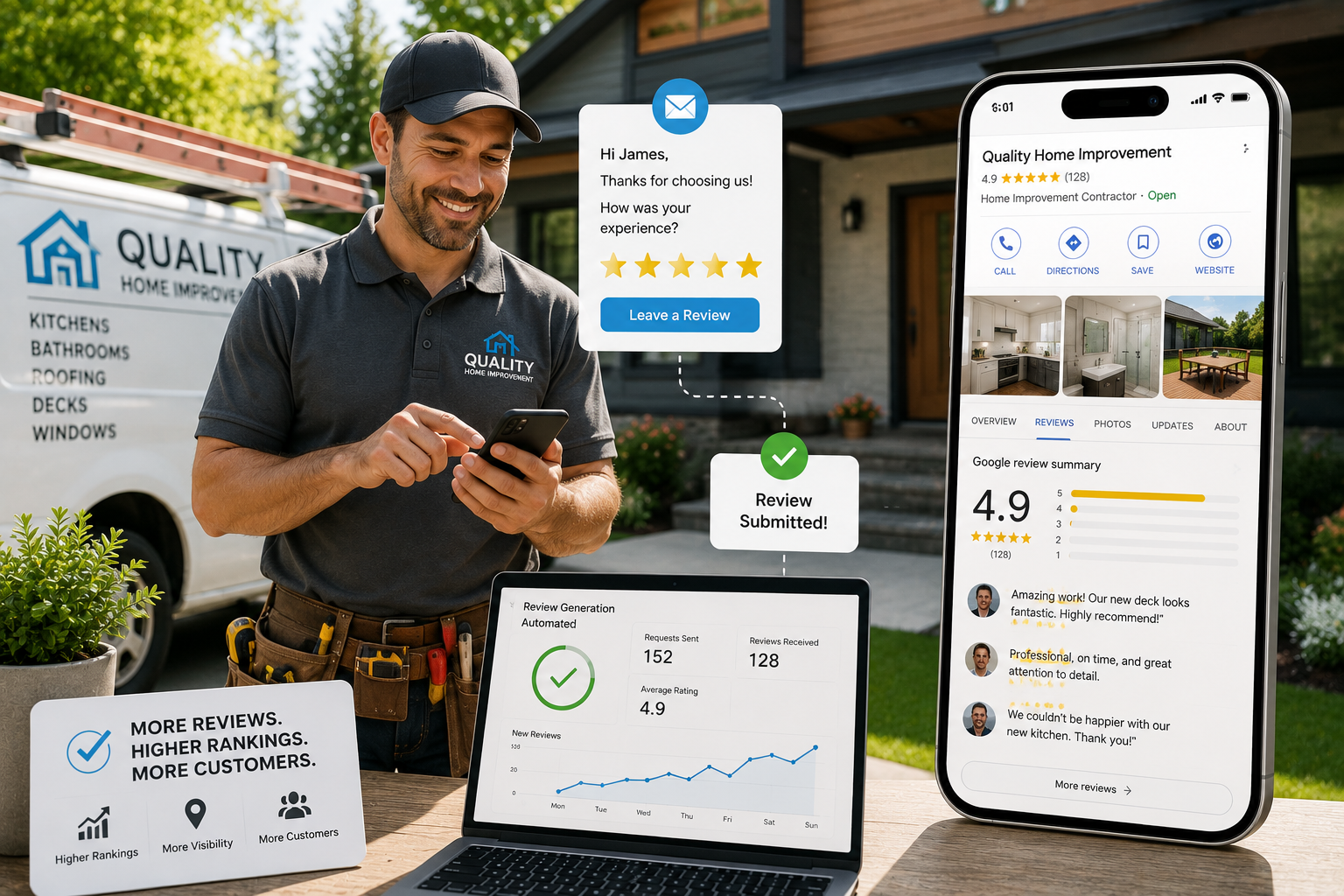
Automatic trigger after job completion. The moment a job is marked complete in your CRM or scheduling software, a review request fires automatically. No technician needs to remember. No office manager needs to follow up manually. The trigger is built into the workflow itself.
Multi-channel delivery. The request goes out by SMS, email, or both, depending on what the customer prefers and what historically performs best for your business. Text messages typically produce higher response rates for home improvement customers because the request arrives while the job is still fresh in their mind.
Direct links to the right platform. Rather than asking customers to search for your business and find the review button themselves, automated systems provide a direct link that takes the customer straight to the review form. This single change removes the largest source of friction in the entire process.
Smart filtering before the request goes public. The strongest systems ask a quick satisfaction question first. A customer who indicates a positive experience gets routed straight to the public review request. A customer who indicates dissatisfaction gets routed to a private feedback form instead, giving your team a chance to resolve the issue before it becomes a public one-star review.
Automated follow-up for non-responders. If a customer does not leave a review within a few days, a gentle follow-up reminder goes out automatically. This single step recovers a meaningful percentage of reviews that would otherwise never get submitted.
Our marketing automation service at Trigacy builds these review generation workflows for home improvement and service businesses, connecting the trigger to your existing job management system so the entire process runs without manual oversight.
Why the Sentiment Filter Step Matters So Much
The smart filtering step deserves extra attention because it solves two problems simultaneously.
First, it protects your public rating. Sending every customer directly to a public review request means some unhappy customers will leave negative reviews that could have been resolved privately. The filter step catches dissatisfaction before it becomes public.
Second, it actually increases your overall review volume. Customers who would have ignored a generic request often respond to the initial satisfaction question because it feels lower-effort. Once they answer that question positively, they are already engaged and more likely to follow through with the actual review.
Consequently, businesses using this two-step approach typically see both a higher review volume and a higher average rating compared to businesses that send a single direct request to everyone.
What Most Home Improvement Pros Get Wrong
Knowing how to respond to a bad review is just as important as generating good ones. Here is a practical approach to handling negative feedback the right way.
Asking only the customers who seem happiest. Many contractors only request reviews from customers who explicitly praised the work on-site. This creates a biased, low-volume sample. A systematic approach that requests a review from every completed job, filtered through the sentiment check described above, produces far more reviews without sacrificing rating quality.
Sending requests too late. A review request sent two weeks after job completion performs significantly worse than one sent within 24 to 48 hours. The experience is fresh, the satisfaction is high, and the customer has not moved on to thinking about other things. Automation ensures the timing is consistent every single time.
Treating all platforms equally. Google Maps reviews carry the most weight for local search visibility specifically. However, many home improvement businesses spread their review requests evenly across Google, Yelp, Facebook, and Angi without prioritising the platform that drives the most map ranking impact. Directing the majority of requests to Google, while still maintaining a presence elsewhere, produces better local search results.
No response strategy for negative reviews. A single negative review is not fatal. However, an unanswered negative review signals to future customers that the business does not engage with feedback.
According to the Shapo research cited earlier, responding professionally, acknowledging the specific issue, and offering to resolve it offline meaningfully changes how potential customers perceive the business, even when reading a negative review.
Ignoring the photo and detail prompt. Reviews that mention specific services and locations carry more SEO weight than generic one-line reviews.
According to RankLadder’s research, encouraging customers to mention the actual service and city, rather than simply writing “Great service,” produces reviews that are both more natural and more useful for local search ranking. A well-designed review request can include a gentle prompt suggesting what details to mention.
How Automated, Multi-Channel Follow-Up Generated Over 1,000 Customer Interactions
AP Guru, a test preparation firm, faced a structurally similar challenge to home improvement businesses. Every completed consultation or session represented an opportunity for feedback and follow-up engagement, but manual tracking meant most of those opportunities were missed.
We built an automated workflow that triggered immediately after key touchpoints. A WhatsApp message went out the moment a consultation was booked. Follow-up sequences are activated automatically after sessions. Feedback collection ran without requiring staff to remember or manually initiate contact.

The result was more than 1,000 qualified interactions handled entirely through automated workflows, available 24 hours a day. Manual administrative work dropped substantially because the trigger-based system replaced what previously required someone to remember and act manually.
The same mechanism applies to home improvement review generation. The trigger fires the moment a job completes. The follow-up runs without anyone needing to track it. Consistency replaces memory, and consistency is precisely what drives review volume and Google Maps ranking improvement over time.
Talk to our team to discuss building an automated review generation system for your home improvement business, specifically, or get to know us.
The Bottom Line
The home improvement business with the most consistent, recent, and well-managed review profile wins the call on Google Maps. That is not a matter of opinion. It is how the ranking algorithm works, and it is how customers actually choose between options when they search.
Manual review requests will always be inconsistent because they depend on someone remembering to ask at the right moment, every single time, across every completed job. Automated review generation removes that dependency entirely. The trigger fires automatically. The request goes out at the optimal moment. The follow-up happens without anyone needing to track it.
For home improvement pros competing in crowded local markets, this is one of the highest-return investments available. It directly improves Google Maps ranking, increases call volume, and builds the kind of trust signal that turns searchers into customers before a single conversation happens.
That is the infrastructure we help home service businesses build through our marketing automation service, retargeting campaigns, sales funnels, and full-funnel demand generation programs.
Let us build it for your business.
– Blog written by Sarah Joshi