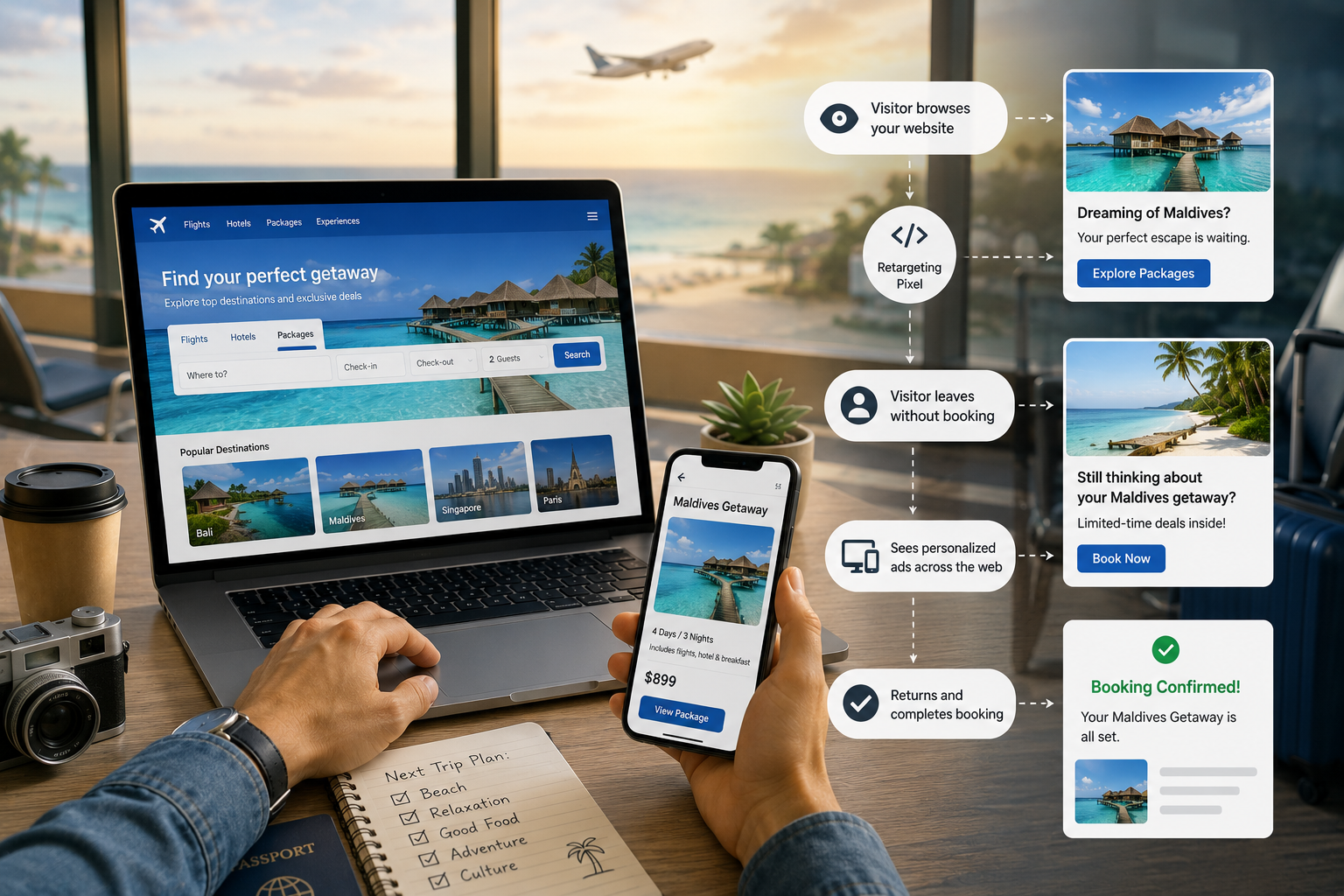
A traveler spends 40 minutes browsing a Bali villa, checking dates, comparing rooms, and reading reviews. Then they close the tab. Dinner, a phone call, or simply the size of the decision gets in the way. They do not book.
This happens constantly in travel. According to Champ Internet Solutions’ 2024 travel marketing research, the typical traveler visits a website 38 times before finalizing a booking. Furthermore, the average conversion rate for travel websites sits at just 4.7%, while top performers reach as high as 23%.
That gap between 4.7% and 23% is not luck. It is largely the result of behavioral retargeting. The travel brands hitting the higher number are not getting more visitors. They are converting the same visitors more effectively by staying present throughout that long, 38-visit decision journey.
Here is what behavioral retargeting pixels actually do, why travel specifically benefits from them, and how to build a system that brings window shoppers back to finish the booking.
Why Travel Bookings Take So Long to Close
Travel purchases are emotional, expensive, and rarely impulsive. A family choosing a two-week European trip is comparing flights, accommodation, activities, and dates simultaneously across multiple tabs and platforms. The decision involves more variables than almost any other consumer purchase category.
According to Mitto’s 2024 data cited by Champ Internet Solutions, more than 90% of travelers research online, and 82% book online. However, research and booking rarely happen in the same session. A traveler might research destinations on a Monday, compare hotel prices on a Wednesday, and finally commit two weeks later after checking with a travel companion.
This extended consideration window is exactly where retargeting earns its value. Without it, every one of those 38 visits represents a missed opportunity to bring the traveler back. With it, every visit becomes a data point that improves how and when you re-engage them.
What Behavioral Retargeting Pixels Actually Do
A retargeting pixel is a small piece of code placed on your website. It tracks visitor behavior and allows you to serve targeted ads to that specific visitor after they leave your site.
However, behavioral retargeting goes further than basic retargeting. Rather than showing the same ad to everyone who visited any page, it tracks what the visitor actually did. It distinguishes between someone who browses your homepage for ten seconds and someone who views a specific resort, selects dates, and reaches the payment page before abandoning.
That distinction matters enormously. The first visitor needs a broad awareness ad. The second visitor needs a specific, urgent message about the exact property and dates they were considering. Treating both visitors identically wastes the most valuable retargeting opportunity available: the near-converted prospect.
According to Rocking Web’s 2025 Google Ads benchmark analysis, retargeted users show a 43% higher likelihood to convert than first-time visitors. Furthermore, cart abandonment retargeting specifically increases conversion rates by 6.5% to 26%. For travel, where the booking value often runs into thousands of dollars, that conversion lift represents significant recovered revenue.
How Segmentation Multiplies Retargeting Performance
High-ticket purchases need a different ad approach than impulse buys. Here is how we think about running ads for products where the decision takes time.
The real power of behavioral retargeting in travel comes from segmentation. Different behaviors signal different stages of intent, and each stage needs a different message.
Homepage and destination browsers. These visitors are in the research phase. They have not committed to a specific property or date. Retargeting ads at this stage should focus on inspiration: destination highlights, unique experiences, and broad value propositions rather than specific pricing.
Specific property viewers. A visitor who spent meaningful time on a single hotel or tour listing has moved past general browsing. They are evaluating a specific option. Retargeting at this stage should reinforce that exact property with social proof, reviews, and availability urgency.
Date selectors and cart abandoners. This is the highest-value segment. A visitor who selected dates, entered guest details, or reached checkout was seconds away from booking. According to YouAppi’s 2024 travel app trends report, dynamic retargeting that shows personalized ads based on incomplete bookings significantly increases conversion rates by reminding travelers of their specific travel intentions.
Returning researchers. Some visitors return multiple times without converting. They may be comparing options across several brands simultaneously. For this segment, price-match messaging, limited-time offers, or a direct incentive to book now can break the comparison loop.
Our retargeting campaign service at Trigacy builds exactly this kind of behavioral segmentation for travel and hospitality clients, ensuring every retargeted ad reflects the specific stage of the traveler’s decision journey rather than treating all visitors the same.
Why Mobile and Cross-Device Tracking Matter So Much in Travel
Travel research happens across multiple devices more than almost any other purchase category. A traveler might browse on their phone during a commute, compare options on a laptop during lunch, and finally book on a tablet at home.
According to YouAppi’s research, 63% of global travel bookings happen via app, with an additional 10% completed on mobile web. Consequently, a retargeting strategy that only tracks desktop behavior misses the majority of the actual booking journey.
Cross-device retargeting solves this by recognizing the same user across devices through login data, email matching, or device graph technology. As a result, a traveler who browses a specific tour package on their phone sees a consistent, relevant ad when they later open their laptop. This consistency reinforces brand recall and keeps the specific travel intent visible regardless of which device the traveler picks up next.
The Role of AI and Personalization in Modern Travel Retargeting
Retargeting has evolved well beyond simple “you looked at this, here it is again” messaging. Modern systems use AI to predict what will actually move a specific traveler closer to booking.
According to Amra and Elma’s 2026 travel marketing statistics, AI-personalized travel emails are generating open rates above 41% and boosting direct booking revenue by an average of 29%, particularly among luxury hotel and airline loyalty campaigns using predictive customer behavior data.
Furthermore, AppsFlyer’s 2025 travel app data shows that marketers using AI-powered personalization and campaign automation saw measurable improvements in retention, with purchases per paying user increasing from 1.89 to 2.13 year over year. This confirms that personalization is not a marginal optimization. It produces a measurable lift in actual revenue per traveler.
For travel brands, this means retargeting messages should adapt based on traveler-specific signals: whether they tend to book last-minute or plan months ahead, whether they prioritize price or experience, and what type of trip they have shown interest in previously.
What Most Travel Brands Get Wrong With Retargeting
Showing the same ad to everyone who visited the site. Generic retargeting that does not distinguish between a casual browser and a near-converted booker wastes the highest-value retargeting opportunity. Segmentation by behavior, not just by visit, is essential.
Stopping retargeting too soon. Given that travelers visit a site an average of 38 times before booking, a retargeting campaign that stops after a week or two abandons the traveler exactly when they are getting closer to a decision. Travel retargeting windows should extend significantly longer than typical ecommerce retargeting, often 60 to 90 days, to match the actual length of the consideration period.
Ignoring last-minute and spontaneous travel intent. According to YouAppi’s research, 78% of travelers report seeking spontaneous trips. Retargeting campaigns that only promote pre-planned packages miss a significant segment of travelers who would respond well to last-minute deals and flexible booking options.
No cross-device strategy. As covered above, a retargeting approach limited to one device misses the majority of the actual travel research and booking journey. Building cross-device tracking into the retargeting setup from the start avoids this gap entirely.
Not pairing retargeting with a strong booking funnel. A perfectly targeted retargeting ad that leads back to a slow-loading, confusing booking page loses most of its value at the click. Our sales funnel buildouts at Trigacy ensure the destination page continues the narrative of the retargeting ad and removes friction from the actual booking process.
How Demand-Responsive Promotion Helped a Hospitality Brand Reach 134,492 Accounts Organically
Platesman Everyday Eatery, a restaurant brand we manage at Socinova, demonstrates the underlying principle behind effective retargeting even outside the travel category. Rather than running identical promotions regardless of audience response, we built a system that read engagement signals and adjusted the promotional approach accordingly.
When specific content generated stronger-than-average engagement, we extended its reach immediately. When the response was slower, we adjusted the creative angle before scaling further. This is the same logic that drives effective behavioral retargeting: read the signal, then respond with the message that matches where the audience actually is.

The results over 90 days show what consistent, signal-responsive engagement can achieve. The brand reached 134,492 accounts with only 331 followers. Total views hit 78,543, with 97.2% coming from non-followers. None of this required treating every viewer identically. It required reading behavior and adjusting accordingly, which is exactly what behavioral retargeting pixels do at a more granular, individual level for travel bookings.
For a travel brand, the same principle scales precisely. Rather than reading social engagement signals, the system reads booking funnel behavior. The response, however, follows an identical logic: match the message to the visitor’s actual demonstrated intent.
Talk to our team to discuss how behavioral retargeting would work for your specific travel or hospitality business, or get to know us.
The Bottom Line
The traveler who closed your tab after 40 minutes of browsing did not lose interest. They simply needed more time, more reassurance, or a better moment to commit. Behavioral retargeting pixels exist precisely to bring that traveler back at the right time with the right message.
Given that the average traveler visits a site 38 times before booking, the brands winning in this category are not the ones generating the most traffic. They are the ones with the most precise system for re-engaging that traffic across the full, extended decision journey.
That precision makes the difference. Segmenting by behavior, tracking across devices, and personalizing the message to match actual intent is exactly what separates a 4.7% conversion rate from a 23% one.
That is the infrastructure we help travel and hospitality businesses build through our retargeting campaigns, marketing automation, sales funnels, and full-funnel demand generation programs.
Let us build it for your travel business.
– Blog written by Sarah Joshi