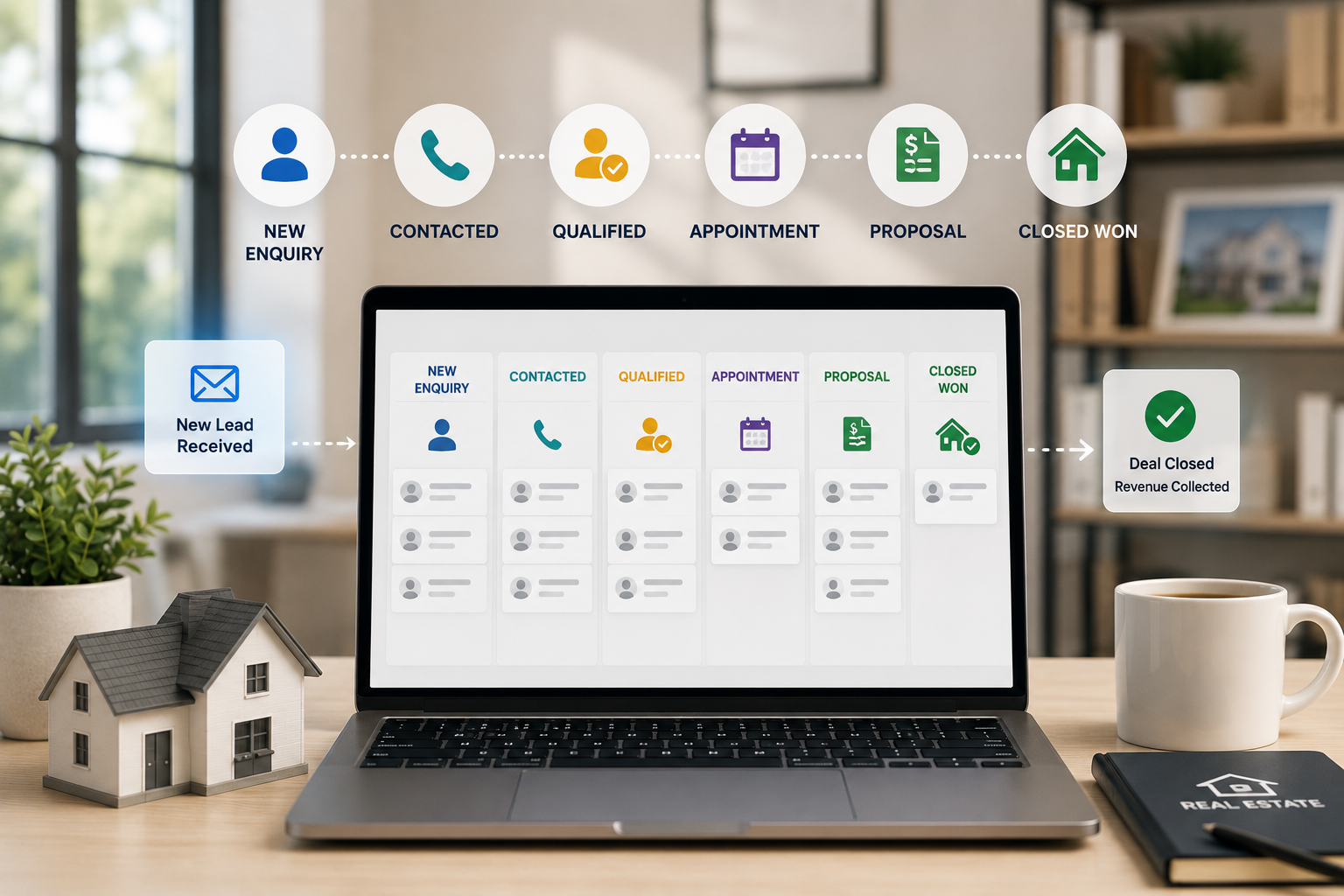
Three weeks ago, a couple browsed six property listings, filled in an enquiry form, and waited to hear back. The agent saw the notification, meant to call that afternoon, and then got pulled into a viewing that ran three hours long. The sticky note got buried. By the time the agent called four days later, the couple had already signed with another agency.
That is lead leakage. Incompetence is not the cause. Neither is understaffing. The cause is a systems gap. Without automation tracking every lead and triggering every follow-up, the pipeline depends entirely on human memory. Human memory under pressure makes exactly this kind of mistake.
CRM pipeline automation removes that dependency. Every lead gets captured, routed, and followed up with according to a defined system, regardless of what else is happening at the agency that day. Here is what the data shows about how much leakage is happening, where it occurs in the pipeline, and what a properly automated system looks like.
What Lead Leakage Actually Means in Real Estate
Lead leakage is the loss of a potential buyer or seller who showed genuine interest but never converted because of a breakdown in the follow-up process. The key distinction is that the loss was avoidable. These are not prospects who decided the property was wrong for them. They are prospects who were never reached effectively.
According to Goliath Data’s 2026 real estate CRM analysis, 78% of real estate leads are lost due to slow follow-up. Furthermore, the same research puts 87% of lost deals down to poor follow-up rather than price, competition, or market conditions. The leads were there. The system failed to convert them.
Pintox’s CRM lead leakage guide describes the mechanism clearly. Lead leakage is rarely one mistake. It is a stack of small gaps. Those gaps compound across the sales cycle. The pipeline looks weaker than it should. Yet the underlying problem is not a shortage of leads. It is a shortage of consistent follow-up.
The Numbers That Show the Scale of the Problem
The performance gap between teams with and without CRM automation is measurable and significant in real estate.
ConvergeHub’s 2025 real estate CRM data shows that agents who respond within five minutes are 21 times more likely to qualify a lead than those who wait 30 minutes. Furthermore, according to NAR and Zillow’s joint research, 78% of homebuyers end up working with the first agent who responds to their enquiry.
The average agent is nowhere near meeting that standard. Inman’s 2025 Real Estate Technology Survey found that the average agent takes over 15 hours to respond to a new lead. That is not a response time problem individual agents can solve through effort alone. A systems gap drives that number. Fifteen hours versus five minutes cannot be closed through better time management. Only automation closes it.
The market reflects this recognition. Goliath Data’s market analysis puts the real estate CRM market at $4.73 billion in 2025 and projects it to reach $14.97 billion by 2035. Additionally, 89% of top-performing real estate professionals are expected to use AI-powered CRM systems by 2026. The industry has already made its assessment of where competitive advantage lies.
Where Leakage Happens in the Real Estate Pipeline
Leakage does not happen in one place. It happens at multiple points throughout the sales cycle, and each gap compounds the one before it.
At the point of enquiry. Leads arrive from multiple sources simultaneously: property portals, Google Ads, Facebook campaigns, referrals, and direct website forms. Without a CRM centralising every inbound contact, leads from different sources live in different places.
Some get actioned quickly. Others get missed entirely. Goliath Data documents a four-person team whose duplicate follow-up rate dropped 60% and close rate improved from 12% to 19% within six months of centralising all lead sources into a single CRM view.
During routing. When a lead arrives and it is unclear which agent should handle it, it often sits unassigned. Without automated routing rules that assign leads based on agent specialisation, location, or availability, the question of who owns the lead creates a delay that can last hours or days.
According to NextCTL’s 2025 CRM automation research, a Chicago brokerage with 28 agents reduced its lead-to-first-contact time from 2 to 8 hours to under two minutes by implementing automated routing. The result was $1.3 million in additional annual revenue.
During follow-up. Most buyers and sellers do not convert after a single contact. They need multiple touchpoints across an extended consideration period. Without automated follow-up sequences, later-stage nurture depends on agents manually tracking who needs a callback, when, and with what message.
This is where the most leakage accumulates. Every lead that slips through a follow-up gap is a potential deal lost to a competitor who happened to reach out at the right moment.
At re-engagement. Leads that go cold are often not dead. They are simply further back in the timeline. A buyer who enquired six months ago and then went quiet may have just received their mortgage approval and re-entered the market. Without a CRM that tracks cold leads and triggers re-engagement sequences at defined intervals, those contacts never get reached again.
How CRM Pipeline Automation Prevents Leakage
A well-built real estate CRM automation system addresses each of these leakage points systematically.
Centralised lead capture. Every inbound lead, regardless of source, enters the same CRM pipeline immediately and automatically. No manual data entry. No leads are sitting in email inboxes waiting to be transferred. The system captures data from portals, social ads, website forms, and landing pages in real time. Each lead gets a unified record from the first touchpoint.
Instant automated response. Within seconds of a lead arriving, the system triggers an automated response. A personalised email acknowledges the enquiry. An SMS goes out immediately. A task appears in the assigned agent’s dashboard with the lead’s details.
Our marketing automation service at Trigacy builds these instant response workflows for property businesses, ensuring every lead hears from the agency before they have time to contact an alternative.
Automated routing. Rules assign each lead to the right agent based on predefined criteria. Property type, budget range, location, and current agent workload all feed into the routing decision automatically. Ownership is clear from the moment the lead arrives. No lead sits unassigned.
Follow-up sequences. Multi-step sequences run across email, SMS, and WhatsApp at defined intervals after the initial contact. The sequence content evolves through the pipeline stages. An early-stage buyer receives market education content.
Mid-stage prospects who have attended a viewing receive specific property comparisons. Those who have submitted an offer receive contract process updates. Each stage reflects where the prospect actually is, not where the system assumes they might be.
Re-engagement automation. Leads that go quiet after a defined period enter a re-engagement sequence automatically. They receive market updates, new listing alerts relevant to their stated criteria, and a direct prompt to book a call. Our retargeting campaigns at Trigacy run in parallel with these sequences, keeping the agency visible through paid ads during the re-engagement window.
What Most Real Estate Teams Get Wrong
No single source of truth for leads. Leads from different portals stored in different systems create blind spots. An agent might not know a prospect also enquired through a different channel, leading to duplicate or contradictory communications. Centralisation is the foundation on which everything else depends.
Routing based on proximity rather than fit. Assigning leads to the nearest available agent without considering specialisation or current workload creates mismatches that reduce conversion. A buyer interested in commercial property assigned to a residential specialist will not receive the best service. Routing rules should incorporate expertise alongside availability.
Generic follow-up sequences. A sequence that sends the same property newsletter to every lead regardless of their enquiry type or stage feels impersonal and is easy to ignore. Segmented sequences that reflect the buyer’s or seller’s specific situation outperform generic nurture campaigns consistently.
Treating cold leads as lost leads. According to Wifi Talents’ real estate lead statistics, 70% of consumers expect a response within one hour of enquiring. However, the same data shows that companies using CRM automation improve lead conversion rates by 10% or more across the full pipeline, including leads that initially went cold. Re-engagement automation recovers a meaningful percentage of deals from leads that manual systems abandoned.
Measuring pipeline volume instead of conversion. Many real estate teams track how many leads enter the pipeline but not how many of those convert at each stage. Without stage-by-stage conversion tracking, it is impossible to identify where leakage is highest. Our sales funnel reporting at Trigacy builds this visibility into every client’s pipeline so leakage points are identified and addressed systematically.
How an Automated Pipeline System Generated 2,697 Leads With Zero Leakage
GTO Florida, an architectural outdoor living solutions business, had a high-volume lead environment where manual pipeline management would have created exactly the leakage problems described above. Leads arrived from multiple paid channels simultaneously.
Each needed routing to the right follow-up sequence based on the specific product they expressed interest in. Every touchpoint needed to be tracked, and every non-response needed to trigger a follow-up.
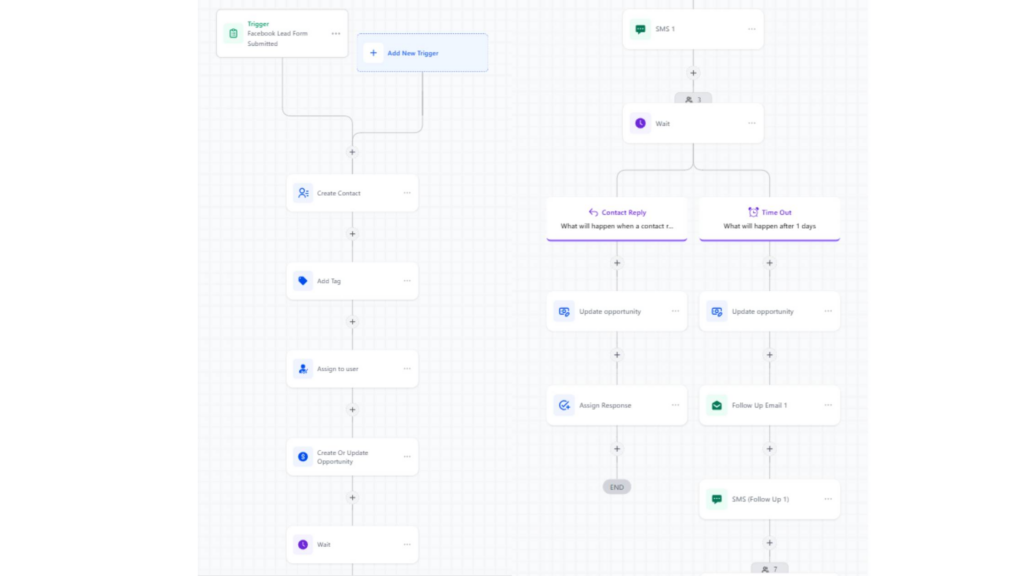
The CRM pipeline we built centralised every inbound lead instantly. Routing rules assign each contact to the appropriate sequence based on their enquiry type. Automated follow-ups fired at defined intervals without manual input from the team.
When a contact went quiet for 48 hours, a re-engagement trigger fired automatically. The system tracked every touchpoint, every open, and every reply, giving the team complete visibility into where each lead sat in the pipeline at any given moment.
The outcome was 2,697 qualified leads at $6.79 per lead, with a 36.30% email open rate across follow-up sequences and over $1.36 million in tracked pipeline opportunity. Those numbers reflect a pipeline with no leakage. Every lead that entered was tracked, every follow-up was triggered, and no contact fell through a gap because a team member was busy elsewhere.
Book a call with our team to discuss how a CRM pipeline automation system would work for your specific real estate team or get to know us.
The Bottom Line
More leads into a broken pipeline is just more wasted budget. Before scaling your lead generation, here is the conversation every real estate team should have first.
Real estate teams are not losing leads because of bad properties or bad agents. They are losing them because the follow-up system is not fast enough, consistent enough, or comprehensive enough to convert every interested prospect before a competitor does.
CRM pipeline automation solves this structurally. Leads get captured without gaps. Routing decisions happen immediately. Follow-ups fire on schedule. Cold leads get re-engaged before they are written off. The pipeline becomes a system that works consistently, regardless of how busy the team is that week.
For any real estate team running paid lead generation, the return on building this automation is often larger than the return on increasing the ad budget. The leads are already coming in. The question is how many are being lost before they ever speak to an agent.
That is the work we help property businesses do through our marketing automation service, retargeting campaigns, sales funnels, email outreach, and full-funnel demand generation programs.
Let us build your pipeline automation system.
– Blog written by Sarah Joshi