A homeowner searches for emergency AC repair. They click your Google Ad, which says “Emergency AC Repair — Same Day Service Available.” They land on your homepage. The headline reads “Your Trusted Home Service Partner Since 2008.” There is a banner of a smiling family, links to every service you offer, and a phone number buried in the footer.
Five seconds of scrolling produce nothing useful. The back button gets clicked. The next result gets the call.
That gap between what the ad promised and what the landing page delivered just cost you a lead. The homeowner was ready to book. The landing page failed them.
This is the home service conversion problem. Ad budgets go toward getting the click. Landing pages then treat every visitor identically, regardless of what they clicked on, where they came from, or what they need right now. Personalization fixes this by matching what the visitor sees to what they actually came for.
Here is what landing page personalization means for home service brands, why it directly increases quote requests, and how to build it without requiring a complete technology overhaul.
What Landing Page Personalization Actually Means for Home Services
Landing page personalization is the practice of showing different content to different visitors based on what is known about them. That knowledge can come from the traffic source, the specific ad they clicked, their geographic location, the time of day, or their behaviour on a previous visit.
For a home service brand, this means a visitor who clicked an ad for roof repair sees a page dedicated entirely to roof repair. Furthermore, a visitor from a zip code known for older housing stock sees messaging that acknowledges the specific challenges of older roofs.
A visitor clicking a “same-day emergency” ad sees urgency-focused messaging and a phone number prominently above the fold. A visitor coming from a retargeting ad who previously visited the HVAC page sees HVAC-specific content and a quote form, not a general homepage.
According to Marketing LTB’s 2026 personalization statistics, personalized landing pages convert 20 to 50% better than generic ones when aligned with ad creative. Furthermore, 76% of consumers are frustrated when they do not get personalized experiences from brands. In home services, where the decision to call or submit a quote often happens within seconds of landing on a page, that frustration translates directly into lost revenue.
The Numbers That Justify the Investment
The performance data for landing page personalization is consistent across every source.
HubSpot’s research cited by Fibr.ai found that personalized CTAs convert 202% better than generic ones. That is not a 20% improvement. It is three times the conversion rate from a single change to the most prominent element on the page.
Unbounce’s AI personalization benchmarks cited by Genesys Growth show that AI-powered personalization delivers a 40% average lift in landing page conversion rates. Dynamic pages perform approximately 25% better than static pages among mobile visitors specifically. Given that 82.9% of landing page traffic now arrives on mobile, according to Involve.me’s 2026 analysis, mobile-optimised personalisation is not optional.
For home services specifically, Inner Spark Creative’s 2025 home service marketing benchmarks put the conversion rate target at 7 to 8% for high-intent campaigns with strong landing pages. Many home service brands sit well below this. The gap between their current rate and that benchmark is largely a landing page quality and relevance problem, not a traffic problem.
McKinsey research cited by Fibr.ai estimates that personalization cuts customer acquisition costs by up to 50% and boosts revenue by 5 to 15%. For a home service brand spending $5,000 per month on paid search, a 50% reduction in CAC from better landing pages is a $2,500 monthly saving with no reduction in lead volume.
The Personalization Signals Home Service Brands Should Use
Not all personalization signals produce equal results. These four produce the most reliable conversion improvements for home service brands.
Traffic source and campaign match. This is the single highest-impact personalization lever. Every ad campaign should have a dedicated landing page that matches the ad’s specific promise. An ad for gutter cleaning should go to a gutter cleaning page, not the homepage. An ad for emergency plumbing should go to a page that opens with emergency availability and a phone number.
This is called message match. According to Genesys Growth’s benchmarks, poor message match is the most common cause of conversion rate underperformance on landing pages.
Service-specific content and imagery. A roofing landing page should show roofing work, use roofing terminology, and answer the questions a homeowner specifically considering roof repair would ask. Generic home service imagery and copy that could apply to any trade signals to the visitor that the page was not made for them.
Personalised pages for each core service vertically outperform a single generic service page consistently.
Geographic personalisation. Showing the visitor’s city or suburb in the headline creates an immediate local trust signal. “HVAC Repair in [City Name] — Same Day Service” performs better than “HVAC Repair — Same Day Service Available.” Furthermore, referencing local landmarks, service area coverage, or local licensing and accreditation builds credibility for a category where trust and proximity both matter to the purchase decision.
Multi-location home service brands face a specific challenge when it comes to keeping messaging consistent and locally relevant across every service area. Here is how a unified marketing approach solves it.
Urgency signals. Home service purchases often involve an urgent need. A burst pipe, a failed heater in winter, a roof leak during rain. Pages that acknowledge the urgency of the situation, display immediate availability, and make the contact action impossible to miss convert faster than pages that treat every enquiry as a planned purchase. Dynamic content that shows real-time availability or same-day booking slots amplifies urgency further.
How to Build a Personalised Quote Request Flow
A high-converting personalized home service landing page has a consistent structure, regardless of the specific service.
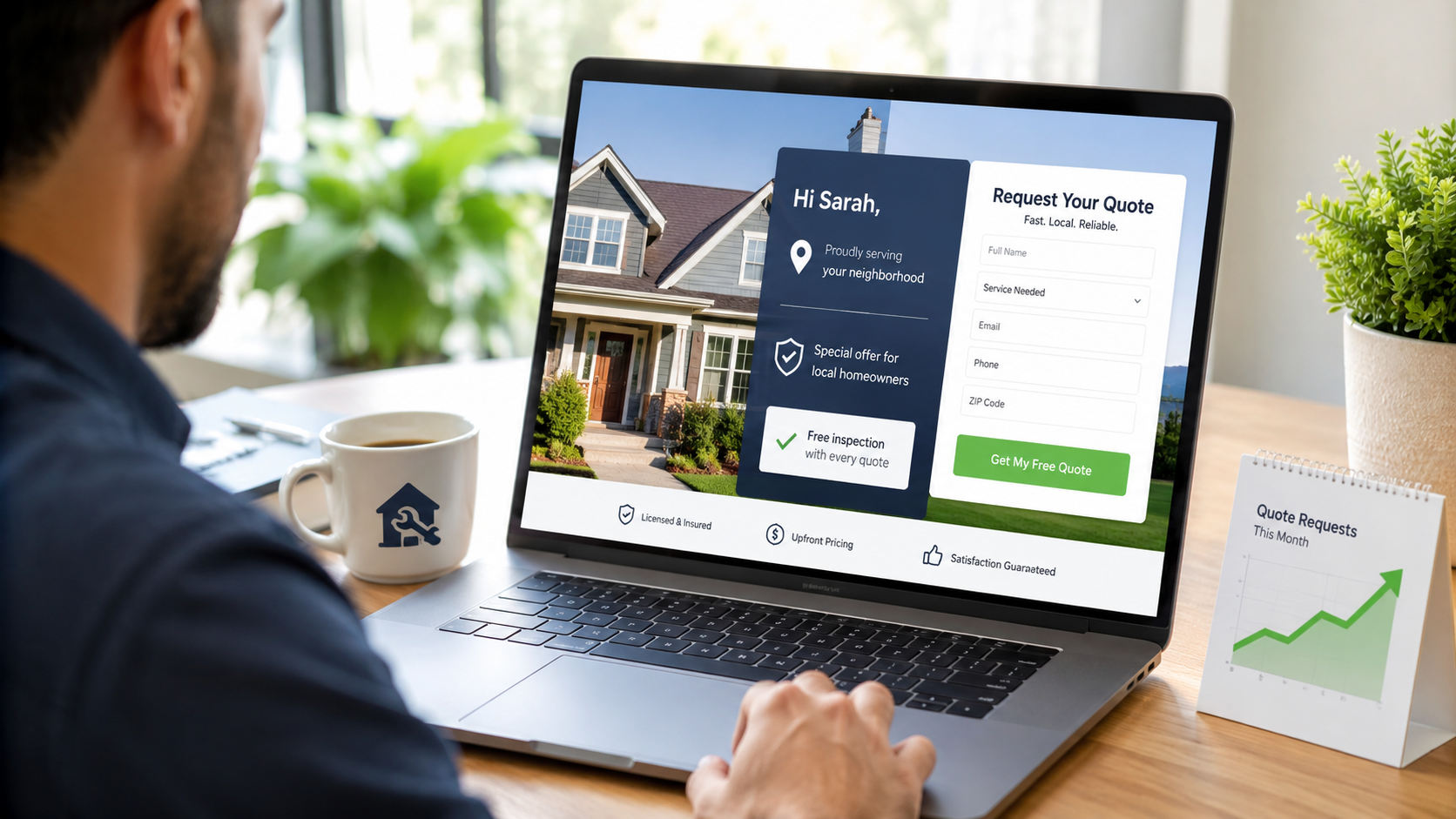
Above the fold: urgency and clarity. The visitor should be able to confirm within two seconds that they are in the right place. The headline states the service and the promise. A phone number appears prominently for callers. A short quote form sits adjacent to the headline for form submitters. Nothing competes for attention with these two elements.
Social proof immediately below. Home service decisions involve significant trust. A stranger is coming to the home and doing work that costs hundreds or thousands of dollars. Three to five reviews from local customers, a Google rating badge, and any licensing or accreditation logos reduce this trust barrier immediately. According to Fibr.ai’s benchmarks, landing pages with social proof convert 34% better than those without.
Service-specific content in the middle section. Answer the two or three questions the visitor is most likely to have about this specific service. What does it cost? How quickly can you come? What does the process involve? Addressing these questions directly on the page reduces friction at the quote request stage.
A single, clear CTA. Multiple CTAs on a landing page compete with each other and reduce conversion. One action, either a phone call or a quote form, performed significantly better than offering both with equal visual prominence. Our sales funnel buildouts at Trigacy design this decision deliberately for each home service client, based on whether their customer base skews toward phone-first or form-first contact.
Fast load speed. Pages loading in under three seconds have a 32% higher conversion rate than slower pages. For mobile home service searchers who are often in urgent situations, a slow page is a page they will not wait for.
What Most Home Service Brands Get Wrong
Sending all ad traffic to the homepage. The homepage is designed to serve every type of visitor. A landing page is designed to serve one specific visitor with one specific intent. Sending paid traffic to the homepage is the most common and most costly home service landing page mistake. Every visitor who has to navigate from the homepage to find what they were searching for is a visitor who is more likely to leave.
Using the same landing page for every campaign. A local SEO campaign, a Google Search campaign for emergency services, and a Facebook awareness campaign all bring different types of visitors with different levels of intent. Each deserves its own landing page. Our retargeting campaigns at Trigacy always connect to dedicated landing pages that match the specific retargeting audience being served, not a generic page.
Asking for too much information in the quote form. Every additional field in a form reduces the probability of completion. For an initial quote request, name, phone number, service type, and zip code are sufficient. Additional information can be gathered during the follow-up call. Genesys Growth’s benchmarks confirm that reducing form fields to five or fewer doubles completion rates.
No mobile optimisation. More than 80% of home service search traffic is mobile. A landing page that looks clean on desktop but requires pinching and scrolling on a phone loses the majority of its potential leads before they even reach the quote form.
Not testing variations. A landing page that performs well can almost always be improved. Testing different headlines, different social proof placement, and different CTA copy continuously improves conversion over time. Our marketing automation infrastructure at Trigacy supports this testing cycle, ensuring every home service landing page is optimised based on real conversion data rather than assumption.
How a Campaign-Matched Landing Page and Funnel Generated 2,697 Leads at $6.79 Each
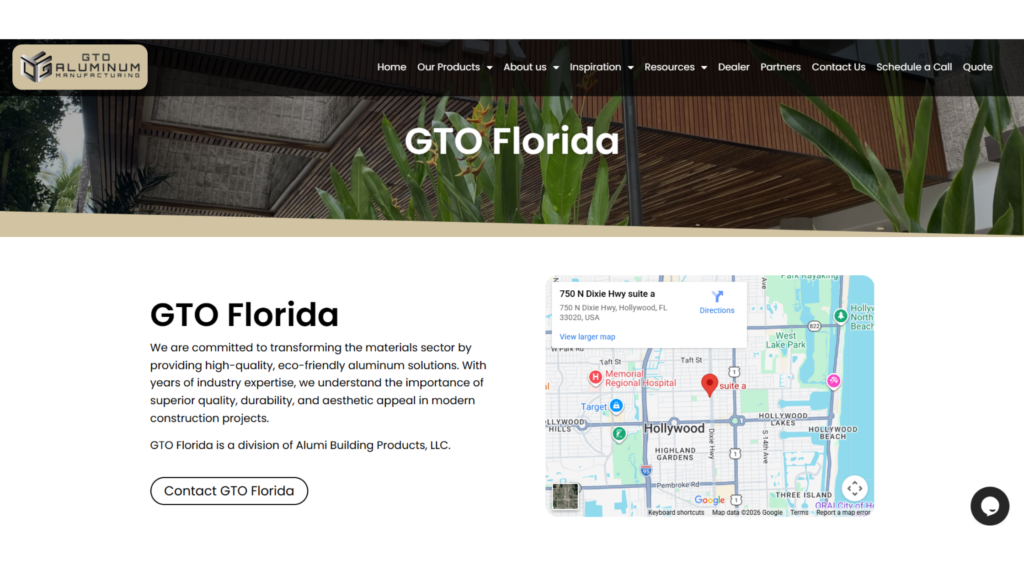
GTO Florida, an architectural outdoor living solutions brand, operates in a home improvement category where the purchase involves significant investment and a trust-dependent sales process. Homeowners searching for pergolas, shade structures, or outdoor living installations need to see relevant imagery, credible social proof, and a clear path to a consultation quickly.
Generic landing pages showing the full product range without matching specific search intent were converting poorly. Homeowners arrived with a specific need and found a page that required too much navigation to confirm the brand could meet it.
The campaign system we built matched each ad’s specific promise to a dedicated landing page that reflected that exact service, that exact messaging, and that exact CTA. Pergola-specific ads went to pergola-specific pages. Shade structure campaigns landed on shade structure pages. Each page converted the specific intent of the visitor arriving on it, not the average intent of all visitors.
The outcome was 2,697 qualified leads at an average cost of $6.79 per lead, with over $1.36 million in tracked pipeline opportunity. That cost efficiency reflects not just strong ad targeting but landing pages that converted the traffic those ads delivered. A perfectly targeted ad campaign sending visitors to a generic homepage would have produced a fraction of those results.
Book a call with our team to discuss how personalized landing pages would work for your specific home service campaigns.
The Bottom Line
Every home service brand has a version of the AC repair problem. Ads that make a specific promise. Landing pages that fail to deliver on it. Quote requests that never materialise from clicks that were paid for.
Landing page personalisation closes that gap. The visitor sees what they came looking for. Friction between a high-intent click and a submitted quote request disappears. The page feels like it was built for the person reading it, because it was.
For home service brands running paid search, paid social, or local campaigns, personalised landing pages are where the next meaningful conversion improvement is hiding. The traffic is already arriving. The question is whether the landing page is converting it.
That is the work we help home service businesses do through our sales funnel buildouts, retargeting campaigns, marketing automation, paid social advertising, and full-funnel demand generation programs.
Let us build it for your brand.
– Blog written by Sarah Joshi