A personal injury attorney blocks two hours for consultations on a Tuesday morning. One prospect has a case clearly outside the statute of limitations. Another has a dispute that would generate less in fees than the time required to pursue it. Both consumed an hour of billable time the attorney could have spent on active cases. Neither should have made it into the consultation calendar.
This is the dual intake problem law firms face. On one side, qualified leads do not receive fast enough responses and go to competitors. On the other, unqualified leads consume attorney time that should be protected for revenue-generating work.
AI chatbots address both problems simultaneously. They respond instantly to every enquiry, around the clock, and screen for case qualification before any attorney time is involved. Here is what the data shows, how AI chatbots specifically differ from basic intake forms, and what a properly built system looks like for a law firm in 2026.
Why Legal Intake Loses Money at Both Ends
Most law firms understand that slow response loses clients. Fewer have measured how much unqualified consultations cost on the other side.
The speed problem is severe. According to FastBots’ 2026 AI chatbot for lawyers guide, lead-to-consultation conversion is 21 times higher when a firm responds within five minutes compared to thirty minutes. Push the response past an hour and the prospect is effectively gone. For mid-market personal injury firms, missed calls alone cost an average of $250,000 annually.
The qualification problem is equally costly. According to Perspective AI’s 2026 legal intake analysis, at $300 per hour, ten unqualified consultations per month represent between $3,000 and $6,000 in lost productivity. Furthermore, conversational AI intake reduces unqualified consultations by 40 to 60% by capturing richer qualifying information before the consultation is booked.
AI chatbots fix both problems from one system. Speed to response improves to under a minute. Qualification quality improves because the AI gathers significantly more relevant information than a web form. According to the same Perspective AI analysis, conversational AI intake delivers three to five times more qualifying information per lead interaction compared to traditional web forms. Dialogue surfaces context that static fields miss.
What Makes AI Chatbots Different From Scripted Intake Bots
This distinction matters. A scripted intake bot follows a fixed decision tree. It asks the same questions in the same order regardless of what the prospect says. When a prospect gives an unexpected answer, the scripted bot either ignores the nuance or falls back to a generic response.
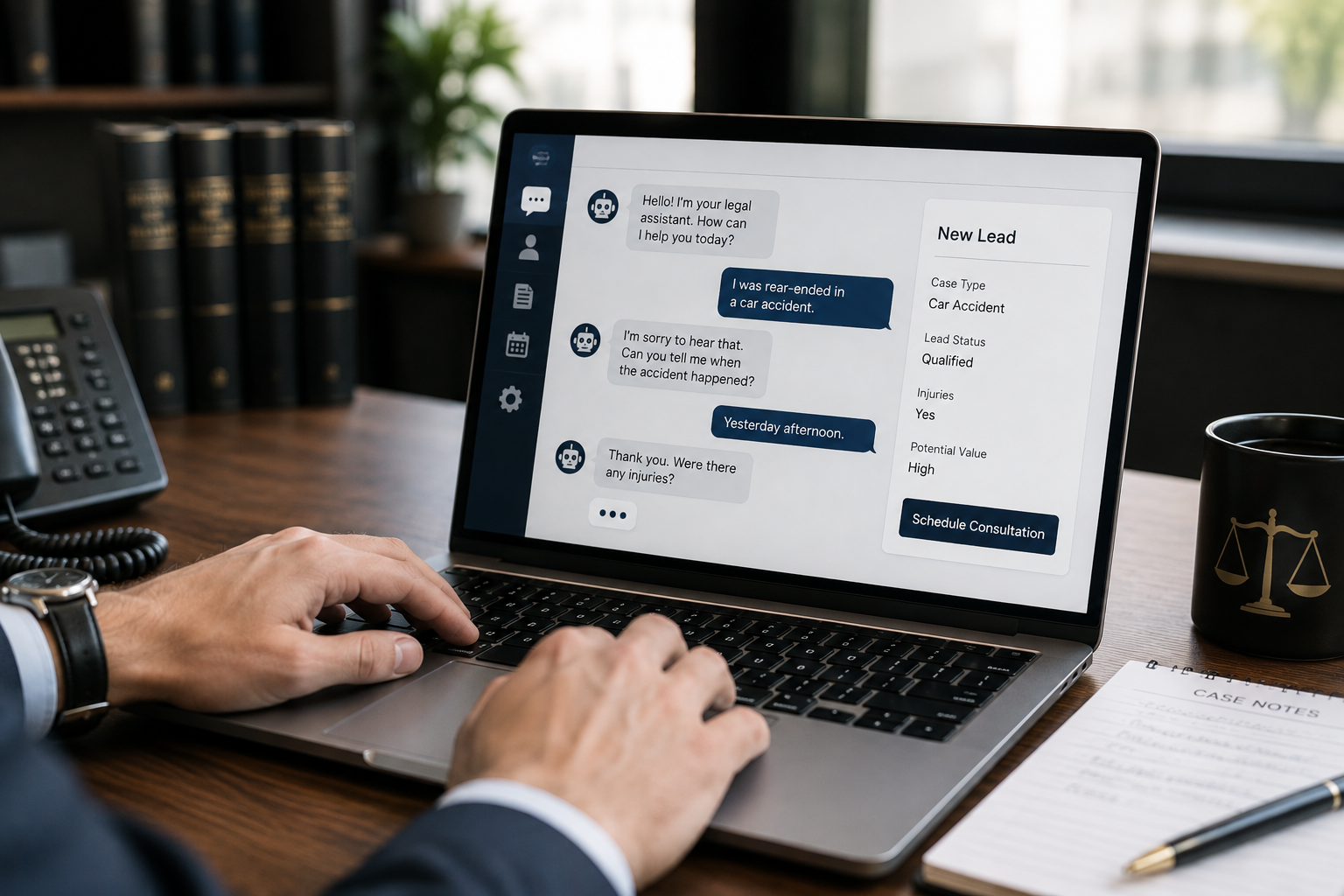
An AI-powered chatbot conducts an interview. It asks open-ended questions, follows up on ambiguous answers, and adapts its line of questioning based on what it learns. According to FastBots’ 2026 legal intake playbook, the 2026 version of a legal AI chatbot is closer to a domain-trained intake associate at the front of the funnel.
It draws from the firm’s actual content, practice area pages, fee disclosures, intake forms, and FAQs, and answers only from that source.
Consider the difference in practice. A scripted bot handling immigration intake asks “What type of visa are you seeking?” and offers a dropdown. An AI chatbot handles the prospect who says, “Actually, it’s complicated. My landlord is also my employer.” It follows the complexity, asks relevant follow-up questions, and gathers the information the attorney would need rather than forcing the prospect into a category that does not fit.
That intelligence gap is the core reason AI chatbots outperform scripted intake systems for law firms dealing with complex case types.
The Numbers Behind AI Intake in Legal
The performance data for AI-powered legal intake in 2026 is strong across every metric.
Hyperleap AI’s 2026 legal intake statistics show that firms using client intake technology see 51% more leads and 52% higher revenue on average, citing the Clio Legal Trends Report. Furthermore, law firms increased technology spending by 9.7% in 2025, the fastest real growth rate ever recorded in the legal industry, according to Thomson Reuters 2026 data.
By the end of 2025, law firms were spending nearly 40% more on technology than before generative AI emerged.
Additionally, Walker Advertising’s 2026 AI chatbot intake guide found that law firms using always-on intake solutions combining chat and phone see 20 to 30% more signed cases from the same website traffic. Consequently, the investment in AI intake technology recovers itself not through cost reduction alone but through conversion improvement on traffic the firm already paid to acquire.
The median response time across the legal industry is currently 13 minutes, according to Hennessey Digital 2025 data cited by Hyperleap. An AI chatbot reduces that to under one minute at any hour. For firms operating in competitive practice areas where multiple attorneys are bidding for the same case leads, that speed advantage translates directly to signed cases.
How AI Chatbots Qualify Cases by Practice Area
Different practice areas require different qualification criteria. A well-built legal AI chatbot adapts its intake flow based on the type of case the prospect describes.
Personal injury. The AI collects information about the incident date (to assess the statute of limitations), the type of incident, medical treatment received, the presence of a third-party liability, and insurance status. Leads that do not meet the firm’s minimum liability threshold receive a polite explanation and, where appropriate, a referral. Leads that do qualify receive an immediate consultation booking.
Family law. The AI screens for jurisdiction, the presence of children (which affects urgency and complexity), asset levels relevant to division questions, and whether any existing orders or agreements are in place. Family law intake requires particular sensitivity in tone. An AI chatbot trained on the firm’s preferred communication approach handles this more consistently than an overstretched intake team.
Employment law. The AI gathers information about the nature of the claim, the size of the employer, whether EEOC or equivalent filing has already occurred, and the employment termination date. Each of these factors affects case viability and statute of limitations differently. A scripted form can collect these fields. An AI chatbot can probe when the answers suggest a timeline issue or an unusual circumstance worth flagging.
Criminal defense. Speed is the primary requirement for criminal defence intake. A person facing charges often calls at unusual hours in a distressed state. An AI chatbot that responds immediately, confirms the type of charge, jurisdiction, and whether arraignment has occurred, and then books the earliest available consultation, delivers a meaningfully better client experience than a voicemail or contact form.
Our marketing automation service at Trigacy builds these intake workflows connected to the firm’s CRM and calendar system so every qualified lead moves from chatbot to booked consultation without any manual coordination.
What AI Chatbots Can and Cannot Do Under Legal Ethics Rules
This is an area where many law firms hesitate, and the hesitation is understandable. Attorney-client relationships carry specific duties that automated systems must not compromise.
The 2026 ethical consensus across most state bars, as documented by FastBots’ legal compliance guide, is that AI-mediated client communication is permissible when disclosed. Specifically, the chatbot must identify itself as an AI intake assistant, not an attorney.
Legal advice and case merit assessments are off limits. Promised outcomes, fee amounts, or case strength assessments are equally prohibited. Any time a prospect asks “do I have a case,” the AI redirects to a consultation.
What the AI can do within these limits is substantial. It collects qualifying information efficiently, quotes published fee structures, and explains practice areas and processes clearly. It books consultations and sends confirmations. Furthermore, it runs conflict checks by collecting the names of involved parties and flagging cases that require attorney review before the consultation proceeds.
The practical boundary is the legal advice line. On one side of it, the AI is a highly capable intake assistant. On the other side is attorney-only territory. A correctly configured AI chatbot stays entirely on the intake side without the firm needing to police every conversation manually.
What Most Law Firms Get Wrong With AI Chatbots
Getting leads through your marketing is only half the job. Here is why the system that handles those leads matters just as much as the campaigns that generate them.
Deploying a generic chatbot without legal training. A general-purpose AI chatbot placed on a law firm website without legal-specific training produces unreliable responses. The AI answers questions about practice areas using its general knowledge rather than the firm’s specific information.
This creates compliance risk and delivers a poor client experience. Train the chatbot on the firm’s content, fee structures, practice areas, and geographic limitations.
No integration with the booking calendar. An AI chatbot that qualifies a lead and then tells them to call the office to schedule is a missed opportunity. The booking must happen inside the chatbot conversation. Connecting the chatbot to the firm’s calendar so the prospect selects an available slot and receives a confirmation in the same session is the difference between a useful system and one that adds a step without removing friction.
Treating all qualified leads with the same priority. Not all leads that pass the initial qualification screen carry equal case value. A personal injury firm should rank cases with clear liability and significant damages above those where liability is disputed, and damages are modest.
An AI system that ranks qualified leads by likely case value allows the intake team to prioritise follow-up on the highest-value cases first, not simply the most recent.
No multilingual capability in mixed-language markets. According to Rankings.io’s 2026 chatbot for lawyers guide, leading legal AI chatbots now offer bilingual intake in English and Spanish. In markets with significant non-English-speaking populations, a chatbot that cannot engage prospects in their preferred language loses a meaningful percentage of qualified leads at the first interaction.
Stopping at qualification without follow-up automation. A lead that completes the chatbot intake and does not immediately book a consultation is not lost. However, they require a follow-up within minutes to remain warm. An automated follow-up sequence that fires immediately after an incomplete chatbot session recovers a significant percentage of these near-converts.
Our sales funnel and automation infrastructure at Trigacy connects chatbot completion events to follow-up sequences so no qualified lead exits the chatbot flow without a next step being triggered.
How AI-Powered Intake Screening Generated 25 Qualified Leads Per Month for a Healthcare Practice
CGA Weight Loss operates in a medical specialty where case viability screening is as critical as in legal practice. Not every patient who enquires qualifies for the procedures offered. BMI range, medical history, previous attempts, and health conditions all determine whether a patient is a suitable candidate.
Putting unqualified patients in front of a physician’s consultation time is as wasteful as putting unqualified legal leads in front of an attorney.

The intake system we built for CGA applied qualifying criteria at the point of first contact. Only patients who met the profile criteria were advanced to a consultation booking. The screening happened automatically, before any physician or medical staff involvement, and at any hour the patient reached out.
The result was 25 or more qualified leads per month at a consistently lower cost per acquisition. Qualified is the keyword here. Volume was not the goal. Leads that met the clinical and commercial criteria the practice needed to operate profitably were. Physician time was protected for consultations that had genuine conversion potential.
For law firms, the same principle applies exactly. Attorney time is the most valuable and most finite resource in the practice. An AI chatbot that screens for case viability before any attorney involvement protects that time structurally, not just operationally.
Book a call with our team to discuss how an AI chatbot intake system would work for your specific practice areas.
The Bottom Line
Law firms lose revenue from two directions in intake. Qualified leads go to competitors because the response was too slow. Unqualified leads consume attorney time because nothing screened them out.
AI chatbots address both problems from a single system. Response time drops to under a minute. Qualification quality improves because conversational AI captures three to five times more relevant information than a web form. Unqualified consultations decline by 40 to 60%. Moreover, the system runs continuously, including at 9pm on a Sunday when many urgent legal needs first arise.
For law firms competing in high-volume practice areas, AI-powered intake is no longer a technology experiment. It is the infrastructure that separates firms capturing their available case lead volume from those handing it to competitors with faster, smarter intake systems.
That is the capability we help legal and professional services businesses build through our marketing automation service, sales funnels, email outreach, retargeting campaigns, and full-funnel demand generation programs.
Let us build it for your firm.
– Blog written by Sarah Joshi