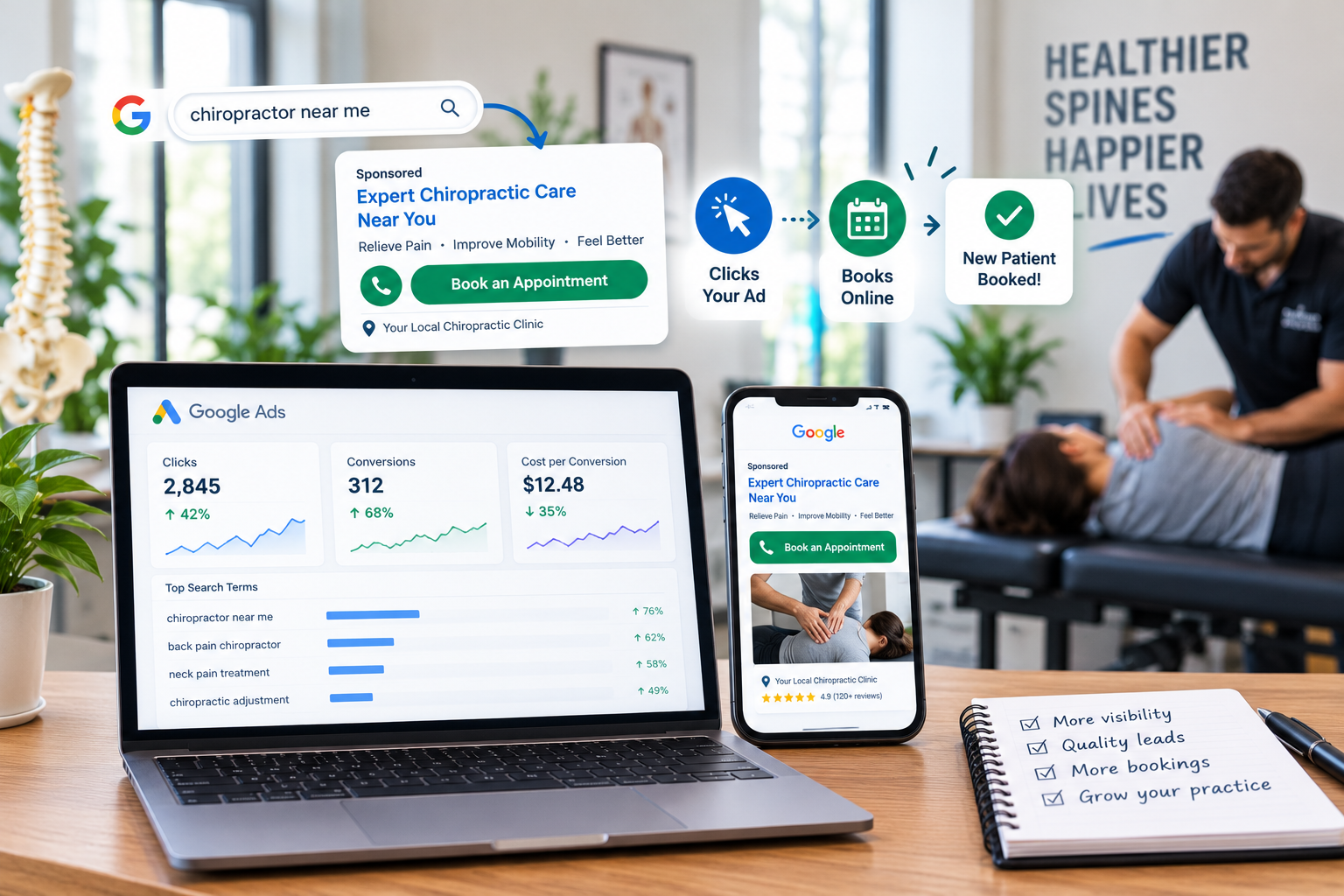
Picture someone who woke up this morning with a back that would not cooperate. They cannot turn their neck without wincing. By lunchtime, they have grabbed their phone and typed “chiropractor near me” into Google. That person is not browsing. They are not researching for someday. They want relief today, and they are ready to book the first clinic that makes it easy.
This is the single most valuable moment in chiropractic marketing. The question is whether your practice shows up in it, or whether a competitor two miles away gets the call instead.
High-intent Google Ads exist to win exactly that moment. Unlike social media, which interrupts people who were not thinking about their spine at all, Google Ads meet patients at the precise second they are searching for care. Below, we will break down why that difference matters, what the numbers actually show, and how to run campaigns that fill your schedule instead of draining your budget.
What High-Intent Google Ads Actually Mean for Chiropractors
Not all advertising is created equal. The term “high-intent” refers to reaching people who are actively searching for the service you offer, rather than people who merely fit a demographic profile.
Think about the difference. A Facebook ad might reach a 40-year-old woman who lives nearby and follows wellness accounts. She may or may not have back pain. She may or may not be thinking about a chiropractor. Your ad is an interruption, and most interruptions get scrolled past.
A Google Search ad works the opposite way. When someone types “sciatica treatment near me” or “chiropractor open today,” they have already raised their hand. They have a problem, and they are looking for a solution right now. Your ad is not an interruption. It is an answer.
That distinction changes everything about how these campaigns perform. Here is what high-intent targeting looks like in practice for a chiropractic clinic:
- Search terms tied to immediate need, such as “back pain relief near me” or “walk-in chiropractor”
- Condition-specific keywords like sciatica, herniated disc, or auto accident injury
- Local modifiers that signal someone wants a nearby provider
- Time-sensitive phrases such as “same day appointment” or “chiropractor open now”
Every one of these searches comes from a person who is closer to booking than almost any audience you could build on social platforms.
Why Google Ads Convert Better Than Social for Chiropractors
Social media has its place. It builds familiarity, keeps your clinic visible, and nurtures people over time. However, when it comes to turning a stranger into a booked appointment this week, search intent wins.
The reason is psychological. On social media, you chase attention from people who didn’t ask for it. On Google, people are chasing you. They have a need, and your ad appears as the shortest path to solving it.
Consider how a patient actually moves through a decision. First, something hurts. Next, they search. Then, they compare a few clinics that appear at the top of the results. Finally, they call or book online, usually within minutes of searching. That entire journey can happen in a single afternoon, and search ads are the only channel positioned to catch it at every step.
There is a cost angle too. Because high-intent searchers convert at a higher rate, your cost per booked patient tends to drop. You are not paying to educate people who were never interested. Instead, you are paying to be visible to people who were already going to book somewhere. The only question is whether that somewhere is your clinic.
Social ads still matter for retargeting and brand recall. But as the engine that fills next week’s schedule, a well-built Google Ads campaign is hard to beat for a local chiropractic practice.
Supporting Data and Real-World Examples
The case for high-intent search becomes clearer when you look at what chiropractic campaigns actually produce.
According to chiropractic Google Ads benchmark data, the average cost per lead across chiropractic accounts sits around $84. However, practices that segment their campaigns by condition, rather than running one broad campaign, consistently bring that cost down to the $40 to $50 range. That is nearly half the cost for the same booked patient, simply by being more precise about who the ad speaks to.
The results from real clinics make the point even sharper. In a set of documented chiropractic Google Ads case studies, one Michigan sports and wellness center generated 176 new patient leads in a single 30-day window at a 24.24% conversion rate and a cost per lead of just $60.36. A smaller family practice in the same program produced 28 new patient leads at a 24.78% conversion rate while filling the schedules of five associate doctors. These are not theoretical projections. They are what happens when the right keywords, the right ad copy, and the right landing page work together.
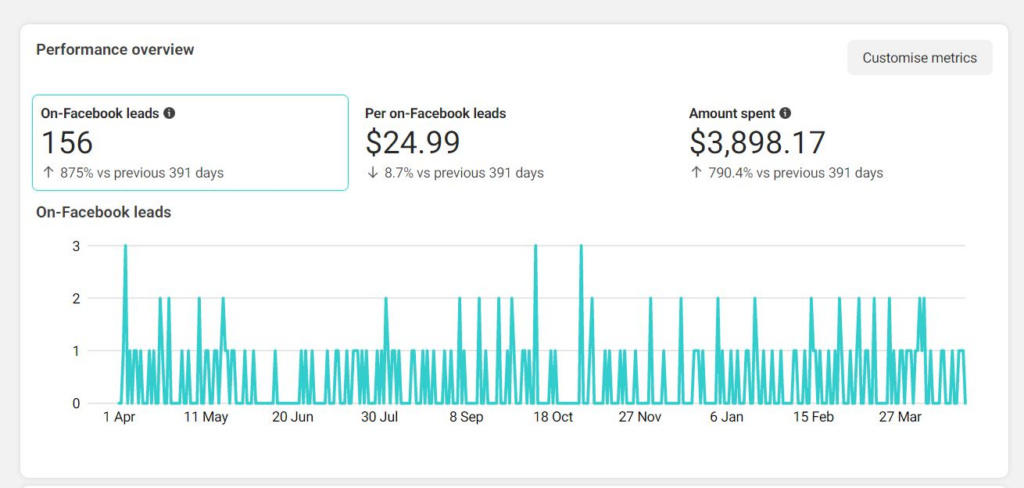
We have seen the same dynamic in our own healthcare work. For CGA Weight Loss, a specialized surgical provider, we paired high-intent Google and Meta ad campaigns with content and marketing automation to generate 25 or more qualified consultation leads every month. The procedure is not chiropractic, but the mechanism is identical. You reach people who are actively searching for a solution, and then you make booking effortless. That is what turns ad spend into a full schedule.
A few patterns stand out across these results:
- Conversion rates above 22% are common when campaigns target high-intent search terms, far higher than typical social media benchmarks
- Condition-segmented campaigns cut cost per lead dramatically compared to broad, one-size-fits-all setups
- Clinics running these campaigns consistently were able to add locations and associate doctors on the back of steady new-patient flow
The throughline is simple. When you reach people at the moment of need and remove friction from booking, the math works in your favor.
What Separates Campaigns That Book Patients From Campaigns That Waste Budget
Running Google Ads is easy. Running them profitably is not. We have audited plenty of chiropractic accounts where the clinic was spending real money and getting almost nothing back. The gap almost always comes down to a handful of fixable mistakes.
The keywords are too broad. Bidding on “chiropractor” alone puts you in front of everyone, including people researching careers, insurance questions, or school programs. Narrow, high-intent terms cost more per click but convert far better, which is what actually matters.
The ad copy ignores intent. Someone searching “lower back pain relief” does not want a generic “Welcome to our clinic” headline. They want to know you treat their exact problem, you are nearby, and they can get in soon. Matching the message to the search is half the battle.
The landing page leaks patients. This is where most budgets quietly die. A searcher clicks your ad, lands on a slow or cluttered page, cannot find the booking button, and leaves. You already paid for that click. Losing them at the final step is the most expensive mistake in the funnel.
There is no fast follow-up. When a high-intent patient submits a form, every minute matters. A clinic that calls back in five minutes books far more of those leads than one that responds the next day. Speed is a competitive advantage most practices leave on the table.
We talked about why speed-to-lead makes or breaks your return on ad spend. Here is the same point in under a minute:
Fixing these issues is exactly the kind of work our team handles day to day. If you want a clear picture of what a properly structured campaign costs and includes, our advertising packages lay it out plainly, with no guesswork about where your budget goes.
The Bottom Line
High-intent Google Ads are not about shouting louder than your competitors. They are about being present at the one moment that matters most, when a patient in pain is actively searching for someone to help.
That is a fundamentally different game than social media. You are not convincing people to want care. You are making sure that the people who already want it find you first and find it easy to book.
The clinics that win their local market over the next few years will not necessarily be the ones with the biggest budgets. They will be the ones whose campaigns are precise, whose ad copy answers real searches, and whose booking process removes every ounce of friction. Get those three things right, and your schedule fills itself.
If you are a chiropractic practice that wants more of those ready-to-book patients walking through your door, that is exactly the kind of system we build.
– Blog written by Sarah Joshi