Most ecommerce brands treat their email list like a megaphone. One message, blasted to everyone, every time. The new-customer discount goes to loyal repeat buyers. A win-back email lands in the inbox of someone who just ordered yesterday. Predictably, people tune out, unsubscribe, or quietly stop opening.
Segmentation fixes that by sending the right message to the right slice of your list. And when you get it right, the payoff shows up where it matters most, in repeat purchase revenue from customers you already paid to acquire.
Here is the short answer. Email segmentation increases repeat purchases because it matches your message to where each customer actually is in their buying cycle. That relevance lifts open rates, click rates, and the revenue each email generates. Below, we will walk through why that works, what the data shows, and how to build segments that actually move the needle.
What Email Segmentation Actually Means for Ecommerce
Segmentation is the practice of dividing your email list into smaller groups based on shared traits or behavior, then tailoring your messaging to each group. It sounds basic. In practice, most brands never do it well.
A generic list treats a first-time buyer and a ten-time VIP as the same person. They are not. They have different needs, different objections, and different reasons to buy again. When your email speaks to everyone, it speaks to no one.
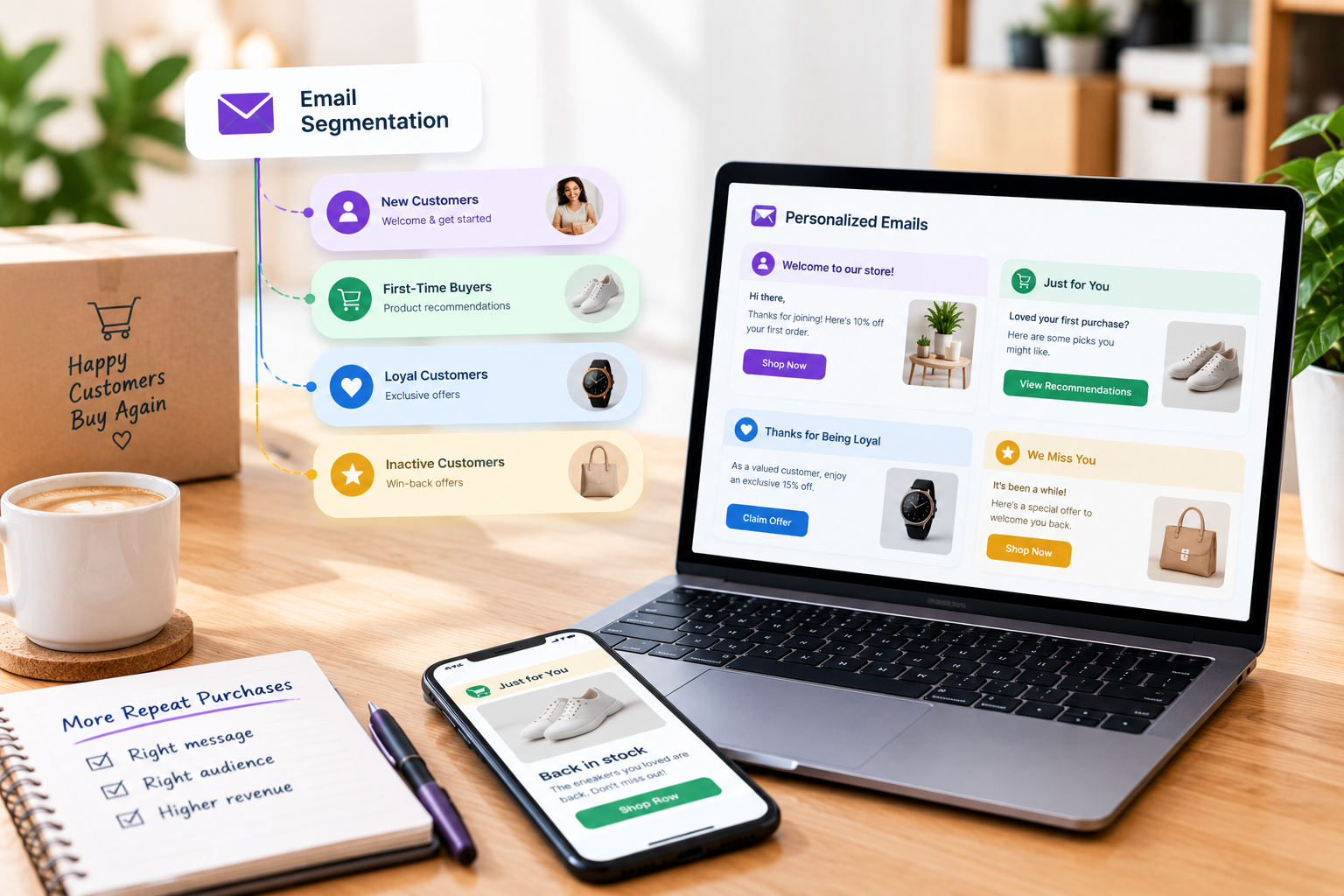
For an ecommerce brand, the segments that drive repeat revenue usually look like this:
- First-time buyers who need a reason to come back for a second order
- Repeat customers who are due for a reorder based on their last purchase
- High-value customers who deserve early access, perks, or loyalty rewards
- Lapsed buyers who have not purchased in 60, 90, or 120 days
- Cart and browse abandoners who showed intent but did not complete
Each of these groups responds to a different message. A reorder reminder works for the customer whose supply is running low. It is useless for someone who just checked out. Segmentation is simply the discipline of not sending the wrong email to the wrong person.
Why Segmentation Drives Repeat Purchases Specifically
Acquisition gets all the attention, but repeat purchases are where the margin lives. You already paid to bring that customer in once. Getting them to buy again costs a fraction of that, and segmentation is the lever that makes it happen consistently.
Consider how a repeat purchase actually gets triggered. A customer buys a 30-day supply of something. Around day 25, a well-timed reorder email lands, reminding them before they run out. That email converts because it arrived at the exact moment of need. You cannot send that to your whole list, because only a slice of it is at day 25. Segmentation is what lets you reach just that slice.
The same logic applies across the board. Lapsed buyers need a different nudge than loyal ones. A VIP wants to feel recognized, not handed the same 10% code a stranger gets. When each group receives a message built for their stage, they open more, click more, and buy more. Relevance is the engine, and segmentation is how you deliver it at scale.
Customer journeys are rarely a straight line to checkout. People buy, drift, and come back weeks later, which is exactly why staying relevant across those touches matters. Here’s more on that:
There is a retention compounding effect too. A second purchase makes a third far more likely. By using email to convert that first-time buyer into a repeat buyer, you are not just winning one more order. You are moving them onto a path that tends to keep paying off over their entire lifetime with your brand.
Supporting Data and Real-World Examples
The numbers behind segmentation are hard to argue with.
According to behavioral segmentation benchmarks, segmented email campaigns earn 14.31% higher open rates and 100.95% higher click rates than non-segmented campaigns, based on Mailchimp data. That is not a rounding error. More than double the clicks means more than double the traffic back to your store from the same send.
The same research shows that behavioral triggers tied to cart abandonment, browse history, and repeat purchase timing drive 15 to 30% higher ecommerce revenue.
The gap widens when you look at the brands doing it best. Klaviyo’s benchmark data across a large base of ecommerce accounts shows that top-performing brands earn roughly 7x more revenue per email recipient than average performers, and the difference comes down to segmentation, automation, and timing working together.
Notably, the brands pulling the highest share of total revenue from email, around 36.7%, are the ones sending to smaller, more targeted segments rather than blasting their whole list.
We have proven this mechanism in our own work. Centasource, a brand sitting on a large and growing prospect list, was sending the same broad message to everyone. So we rebuilt the system around segmentation. Every new contact gets tagged by profile the moment they arrive. From there, they flow into automated email sequences matched to their interest rather than one generic blast.
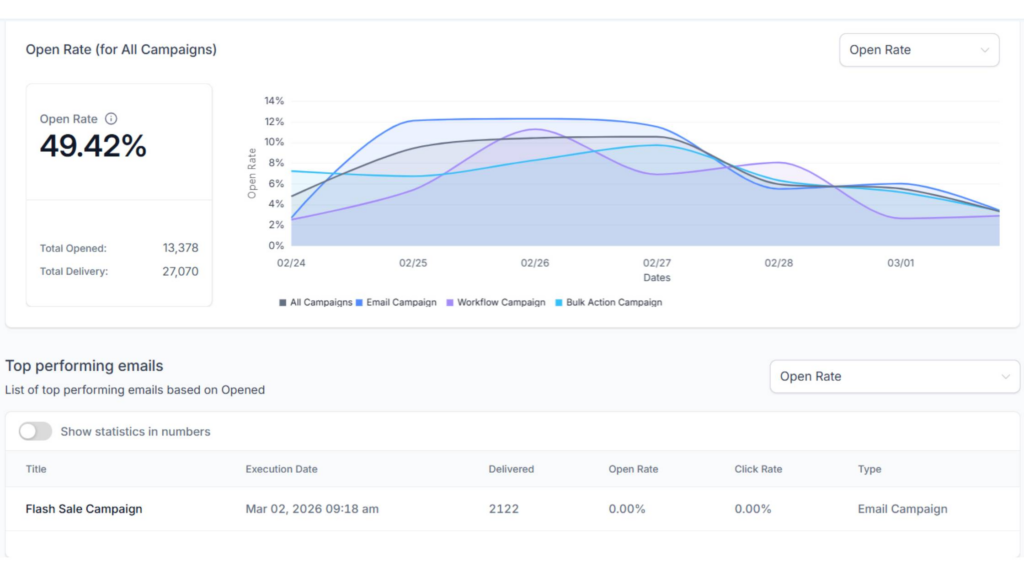
The payoff showed up right in the inbox, with a 49.42% average open rate across more than 27,000 emails. That is the kind of number most ecommerce brands only dream of, and it comes from the same discipline. You tag people by what they want, send email built for that group, and they actually open and act on it.
A few patterns stand out across this data:
- Relevance beats reach. Smaller, well-targeted segments consistently outearn large untargeted blasts
- Timing is a revenue driver. Emails tied to behavior, like a reorder window or an abandoned cart, convert because they arrive at the moment of intent
- The best brands do not send more email. They send more relevant email, and it compounds into a meaningful share of total revenue
The throughline is simple. When your emails reflect where each customer actually is, they stop being noise and start being revenue.
How to Build Segments That Actually Move Revenue
Knowing segmentation works is easy. Building it so it pays off is where most brands stall. Here is where the real value gets created, and where the common mistakes quietly cost money.
Start with purchase behavior, not demographics. Age and location rarely predict a second purchase. What someone bought, how much they spent, and when they last ordered tell you far more. Build your first segments around order history and recency, because that is what actually signals readiness to buy again.
Time your reorder emails to the product cycle. If a product lasts roughly 30 days, the reorder reminder should land before day 30, not weeks after the customer already ran out and bought elsewhere. Matching the email to the consumption cycle is one of the highest-return moves in ecommerce email.
Treat your VIPs differently. Your top 10 to 20% of customers generate an outsized share of revenue. Sending them the same acquisition discounts you send cold leads trains them to wait for deals and erodes your margin. Give them recognition, early access, and loyalty perks instead.
Do not let lapsed buyers go silent. A customer who has not purchased in 90 days is not gone, but they are slipping. A dedicated win-back segment with a specific, compelling reason to return recovers revenue you would otherwise write off entirely.
Building and maintaining these segments takes the right tools and ongoing attention, which is exactly the kind of work our team handles for ecommerce brands day to day. If you want this set up and managed properly, our marketing automation services are built to turn your existing customer list into a repeatable revenue channel.
The Bottom Line
Email segmentation is not about sending more email. It is about sending email that matches where each customer actually is, so the message feels useful instead of intrusive.
For ecommerce brands, that distinction is the difference between a list that quietly decays and a list that generates repeat revenue month after month. You already did the hard, expensive work of acquiring these customers. Segmentation is how you earn the second, third, and tenth purchase without paying acquisition costs all over again.
The brands that win on retention are not the ones with the biggest lists. They are the ones whose emails are relevant enough that customers actually want to open them. Get that right, and your existing customers become your most profitable growth channel.
If you want to turn your email list into a genuine repeat-purchase engine, that is exactly the kind of full-funnel system we build.
– Blog written by Sarah Joshi