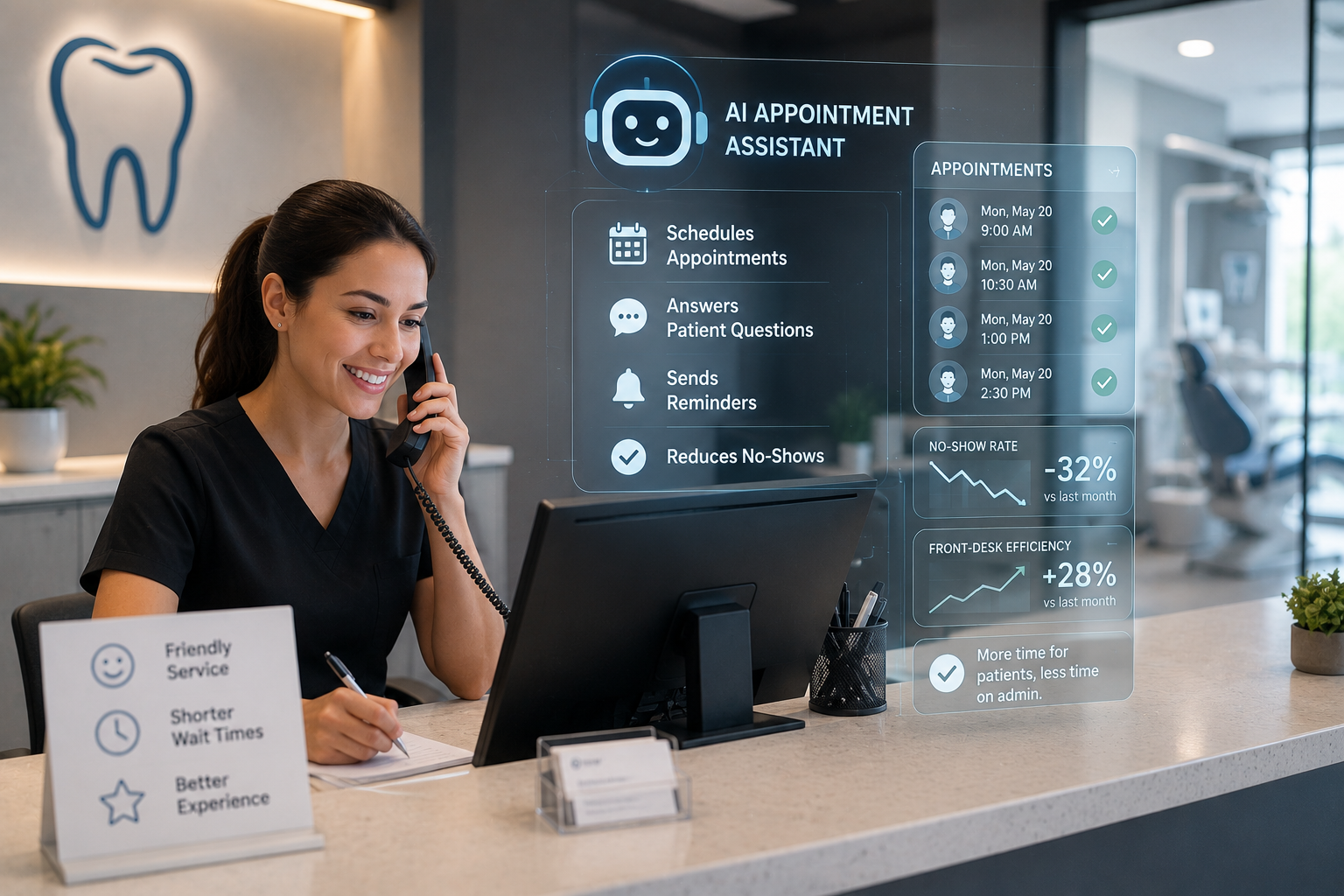
At 9:47 PM, a patient with a toothache searches for a dentist nearby. They find your website. They try to book an appointment. Nobody answers. So they move on to the next clinic.
That is not a hypothetical. It happens dozens of times per week at dental practices that rely entirely on front-desk staff to handle bookings. According to TensorLinks’ 2025 AI dental receptionist research, 20 to 30% of inbound calls are missed even during business hours. After hours, that number climbs further. Every missed call is a patient who booked somewhere else.
AI-powered appointment setting solves this problem at the root. Here is why dental clinics are adopting it at an accelerating pace and what it actually does for front-desk efficiency.
The Front-Desk Problem No Hiring Solves
The dental front desk is one of the most operationally demanding roles in any service business. In a single hour, a receptionist might handle incoming calls, confirm upcoming appointments, chase no-shows, process insurance queries, manage the walk-in queue, and answer the same five questions about parking, pricing, and hours.
The result, predictably, is that things get dropped. Calls go unanswered. Follow-up messages do not go out on time. Booking windows sit empty because the recall system depends on someone remembering to make the call.
Hiring more front-desk staff reduces the pressure but does not fix the underlying problem. The work is inherently reactive and volume-dependent. During a busy Monday morning, even three staff members cannot simultaneously handle every inbound interaction. Furthermore, turnover in dental front-desk roles is high, meaning any investment in a person carries attrition risk.
According to research published by Group Dentistry Now, 62% of patients switch dentists due to a poor experience. Overwhelmed front-desk staff are directly cited as a key driver of that dissatisfaction. In other words, the front-desk capacity problem is not just an operational issue. It is a patient retention issue.
What AI-Powered Appointment Setting Actually Does
AI appointment setting is not a chatbot that answers FAQs. It is an integrated system that handles the full booking workflow, inbound, outbound, and follow-up, across multiple channels simultaneously.
Specifically, a well-built AI appointment system handles:
- Inbound call and message responses at any hour
- New patient booking through website, SMS, and WhatsApp
- Appointment confirmation and reminder sequences
- Cancellation and rescheduling workflows
- Recall campaigns for patients due for check-ups or follow-up treatments
- No-show follow-up sequences
Every one of these tasks currently sits on the front-desk team’s plate. Moreover, every one of them follows predictable, rule-based logic that an automated system can execute consistently and without fatigue.
The key distinction from older booking software is intelligence. AI systems handle natural language, understand context, adapt responses based on patient history, and route complex queries to human staff when necessary. As a result, the front desk handles fewer routine interactions and more meaningful patient conversations.
The Numbers Behind the Shift
The adoption data for AI in dental practices tells a clear story about where the industry is moving.
According to SME Advantage’s dental AI report, 73% of dental practices are now switching to AI appointment systems. Practices implementing AI receptionists are seeing 15 to 25% increases in bookings and 85% reductions in missed calls. One multi-location clinic reported adding over $56,000 in booked treatments within 30 days of implementation.
Additionally, research compiled by Open and Affordable found that practices using AI-powered systems for administrative tasks save up to 25% in operational costs. The global dental practice management software market was valued at $2.4 billion in 2024 and is projected to reach $6.4 billion by 2034, with scheduling software holding the largest single market share segment at 19.4%.
Furthermore, practices that implement AI scheduling systems are reporting 300 to 500% return on investment within the first year. At those numbers, the question is not whether AI appointment setting is worth the investment. It is how quickly you can get it running.
Where Front-Desk Efficiency Gains Are Largest
Not all tasks are equal in terms of time cost. The biggest efficiency gains from AI appointment setting come from four specific areas.
After-hours booking. A significant share of appointment requests happens outside business hours. Patients with a dental concern at 10 PM either book somewhere else or forget by morning. An AI system that accepts bookings 24/7 captures that demand without any additional staffing cost. As a result, practices see immediate gains in new patient acquisition simply from being reachable when competitors are not.
Reminder and confirmation sequences. Manually confirming appointments and sending reminders is time-consuming and inconsistent. Automated reminder sequences sent via SMS and email reduce no-show rates significantly. Studies consistently show that automated reminders cut no-show rates by 30 to 40%, which is directly recoverable revenue for any dental practice.
Recall campaigns. Most dental patients are overdue for their next check-up. The recall process, identifying who is due and reaching out across multiple touchpoints, is one of the most revenue-generating yet frequently neglected front-desk tasks. AI handles this at scale, automatically triggering recall sequences based on appointment history and treatment notes.
Handling repetitive inbound queries. A substantial portion of every front desk’s daily call volume consists of the same questions. Hours, location, parking, pricing, insurance acceptance, and what to bring to a first appointment. An AI system handles all of these instantly and consistently, freeing staff for interactions that genuinely require a human.
What This Looks Like When Connected to Your Marketing System
AI appointment setting works hardest when it is connected to the rest of your patient acquisition system rather than operating in isolation.
For example, when a patient clicks a Google ad and lands on your booking page, the AI handles the booking instantly. When a retargeting ad brings a past website visitor back, the AI picks up the conversation from where it left off. When a recall campaign triggers and a patient responds via WhatsApp, the AI confirms the appointment without any staff involvement.
This is where marketing automation infrastructure becomes the backbone that makes all of it work together. Campaigns generate the traffic. The AI converts that traffic into booked appointments. The CRM tracks the patient journey from first contact to treatment completion. Each part of the system feeds the next.
Here is a closer look at how marketing automation handles the workflows that keep a dental practice running without manual intervention.
Additionally, retargeting campaigns targeting patients who visited your website but did not book are significantly more effective when the destination is an AI-powered booking flow rather than a static contact page. The conversion rate difference between the two is material.
Our healthcare marketing services at Socinova and demand generation programs at Trigacy are built to work with your appointment systems, ensuring the marketing side and the operational side are aligned from the first patient touchpoint through to the booked chair.
What Most Dental Clinics Get Wrong
Treating AI as a replacement for the front desk. The most effective implementations use AI to handle routine, predictable tasks while freeing staff to focus on complex queries, patient comfort, and relationship building. Clinics that try to eliminate front-desk staff tend to create patient experience problems that outweigh the operational savings.
No integration with the practice management system. AI booking tools that operate separately from the clinic’s core practice management software create double-entry work and data gaps. The appointment booked by the AI needs to land directly in the calendar with all relevant patient information attached. Integration is non-negotiable.
Running AI in parallel with manual processes. Some clinics implement an AI booking tool but keep manual confirmation calls running alongside it. The result is confusion for patients and no actual reduction in front-desk workload. The system needs to replace the process, not add to it.
No follow-up for incomplete bookings. A patient who starts the booking process and drops off midway is a warm lead. AI systems that identify abandoned bookings and trigger a follow-up sequence recover a meaningful percentage of those interactions. Clinics that do not build this into the workflow are leaving bookings on the table.
How We Built a 24/7 Automated Booking System That Eliminated Manual Scheduling
AP Guru, a professional services firm handling high volumes of consultation requests, faced the same core challenge that dental practices face daily. Enquiries arrived across multiple channels at all hours. Manual handling caused slow response times and missed opportunities. The team spent hours each day on scheduling logistics rather than delivering their core service.
We built a multi-channel automated system that connected all inbound touchpoints into a single CRM pipeline. WhatsApp acknowledgements went out the moment an enquiry arrived. Consultation briefs followed automatically. Appointment reminders, reschedule handling, and post-appointment follow-up all ran without manual input. Bookings became available 24 hours a day.
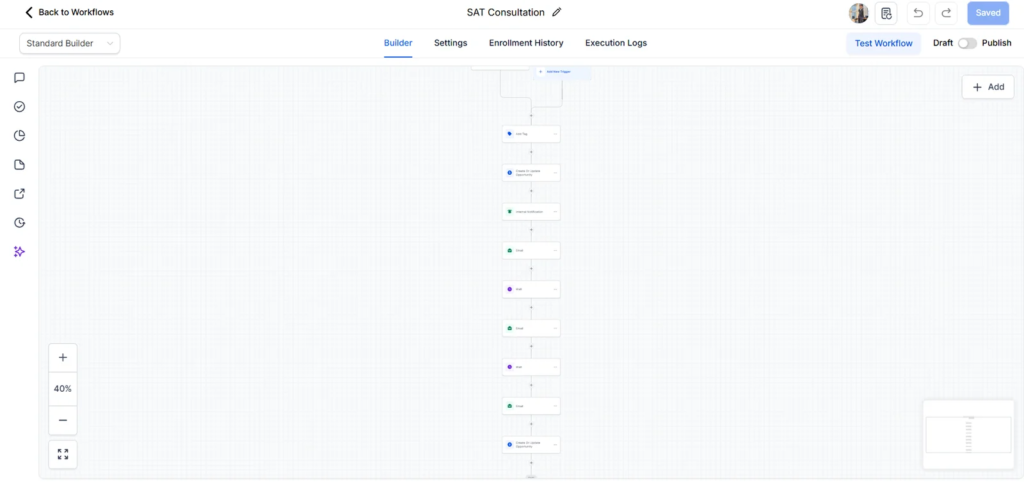
The result was over 1,000 qualified appointments handled through automated workflows, with manual scheduling work for the team reduced dramatically. Faster response times improved the experience for new patients without adding a single additional staff member.
The infrastructure behind this is directly applicable to dental clinic appointment setting. The channels differ slightly. The outcome is the same: more bookings, less manual work, no gaps in coverage.
Talk to our team or get to know us here to see how we would build this for your specific clinic setup.
The Bottom Line
AI-powered appointment setting does not replace the people who make a dental practice work. It replaces the repetitive tasks that consume those people’s time and limit the capacity of the practice to grow.
The front desk becomes more efficient not because it is smaller but because it is focused on higher-value interactions. Moreover, the practice becomes more accessible because it is reachable at any hour, on any channel, without additional overhead.
For independent clinics and dental chains alike, the combination of 24/7 availability, automated recall, and no-show reduction creates an immediate and measurable impact on both revenue and patient satisfaction.
That is the system we help healthcare and service businesses build through our marketing automation service, sales funnels built for high-consideration bookings, retargeting campaigns, and full-funnel demand generation.
Let us build it for your clinic.
– Blog written by Sarah Joshi