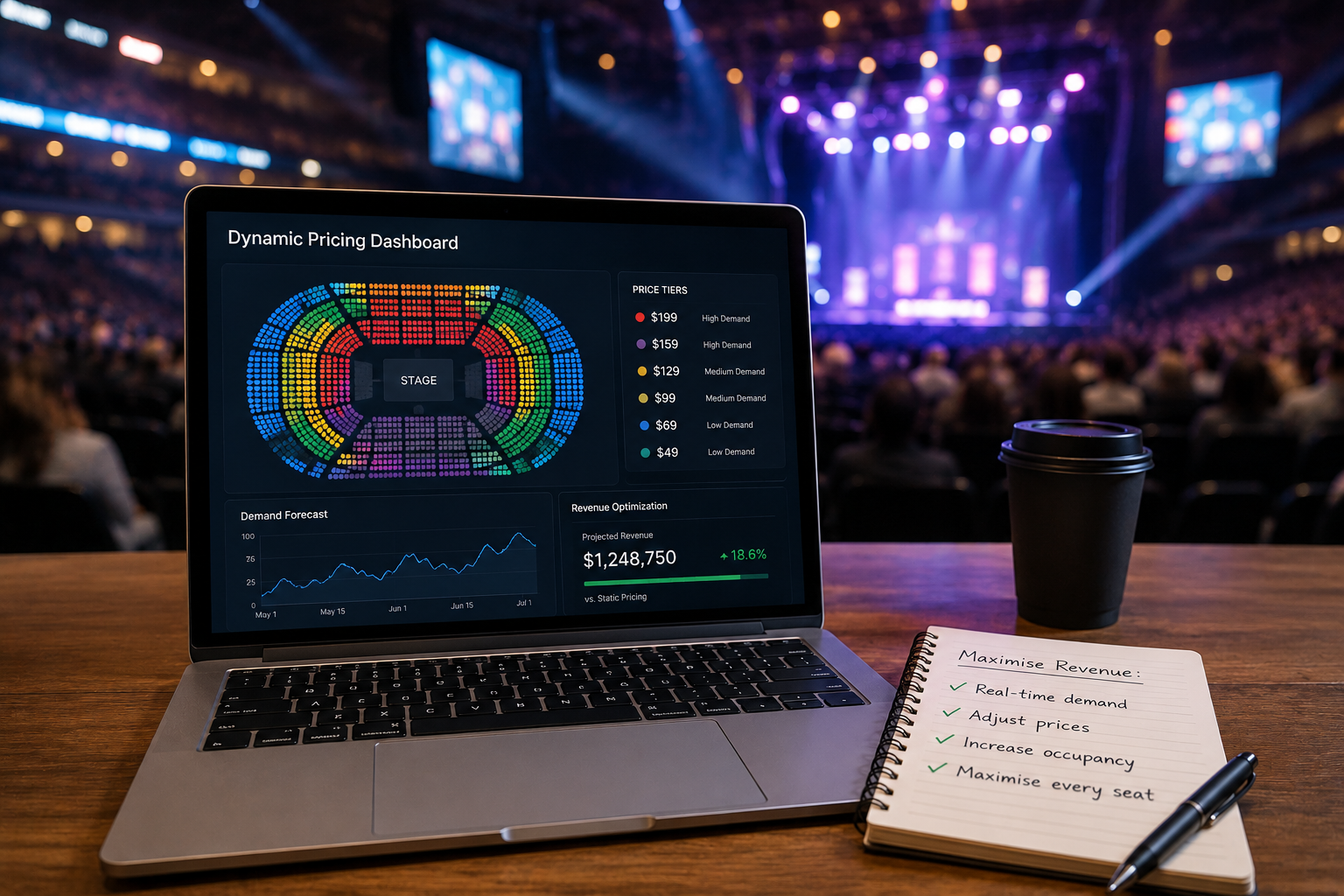
A concert sells out in ten minutes. The promoter is delighted. However, they should not be. A sell-out in ten minutes is proof that every ticket was priced below what fans were willing to pay. The revenue was left on the table, not collected.
The same logic works in reverse. A venue with rows of empty seats on event night did not just lose ticket revenue. It lost food and beverage sales, merchandise, parking, and every other secondary spend that those absent attendees would have made.
Fixed ticket pricing fails both ways. It undercharges for high-demand events and overcharges for low-demand ones. Dynamic pricing algorithms correct both errors by continuously adjusting prices based on real-time demand signals.
Here is what dynamic pricing actually does for event revenue, why the industry is adopting it at an accelerating rate, and how to implement it without turning your audience against you.
What Dynamic Pricing Algorithms Actually Are
Dynamic pricing is a system that automatically adjusts ticket prices based on supply, demand, and a range of external signals in real time. It is the same logic airlines use when a seat costs $200 three months out and $600 the week before departure.
For event ticketing specifically, the algorithm monitors how fast tickets are selling, how many seats remain, what comparable events in the market are charging, and what historical data shows about price sensitivity for similar events. Based on those inputs, it raises or lowers prices continuously to maximise total revenue across all available inventory.
Furthermore, modern dynamic pricing tools use machine learning to improve their predictions over time. The more data they process, the more accurate their demand forecasts become. An algorithm that has processed ticket sales data from 500 similar events in the same venue will outperform a human pricing manager working from intuition every time.
According to Egocentric Systems’ 2025 analysis, dynamic pricing achieves three outcomes that fixed pricing cannot: it maximises revenue per seat when demand is high, fills gaps with strategically discounted tickets when demand is low, and replaces gut-feel decisions with clear KPIs and sales trends. Consequently, both the upside and downside revenue scenarios improve simultaneously.
The Market Data Behind the Shift
The event ticketing industry is growing fast, and dynamic pricing is a central driver of that growth.
According to Softjourn’s 2026 event ticketing statistics, total ticketing transaction value reached $1.47 trillion in 2025 and is projected to hit $3.37 trillion by 2030. That is 128.6% growth in five years. Additionally, the online event ticketing market will expand from $50.97 billion in 2024 to $69.25 billion by 2029 at a 6.7% CAGR, driven specifically by dynamic pricing adoption alongside mobile ticketing and hybrid events.
The dynamic ticket pricing software market itself reflects the same momentum. According to Market Intelo’s 2025 research, the market was valued at $1.2 billion in 2024 and is forecasted to reach $4.5 billion by 2033, growing at 15.8% CAGR. Sports events currently lead adoption with 35% of total market revenue, followed closely by concerts and theatre.
The consumer side of the equation is equally clear. The average concert ticket now costs $135.92 in 2025, representing a 75% increase since 2015, according to FreshTix. Despite higher prices, demand for live events remains extremely strong. Concert promotion revenue has grown at 20% annually over the past five years, reaching $62.7 billion in 2025. Furthermore, fans are continuing to buy. Higher prices have not suppressed demand in the categories that matter most.
How Dynamic Pricing Works in Practice
The algorithm does not operate as a single lever. Rather, it balances multiple inputs simultaneously and adjusts prices accordingly.
Sales velocity. The speed at which tickets are selling is the primary signal. If a venue with 500 seats sells 200 tickets in the first hour, the algorithm recognises higher-than-expected demand and raises prices for the remaining inventory.
If sales are slower than projected, it holds or reduces prices to stimulate conversions. As a result, the price at any given moment reflects the actual market-clearing rate, not an estimate made weeks earlier.
Days to event. Demand patterns for events follow predictable curves. There is typically a spike at announcement, a lull in the middle, and a surge in the final 48 hours. Dynamic pricing accounts for these patterns and adjusts accordingly. Prices in the final hours before an event often represent the highest demand point for a specific seat category, because late buyers are typically the most motivated.
Seat category and location. Not all seats are equal. Premium seats near the stage, floor sections, and corporate boxes carry different demand curves from upper-tier seating. Dynamic pricing applies different algorithms to each seat category rather than moving all prices together. Therefore, premium inventory can be priced aggressively while general admission pricing remains accessible.
External demand signals. Advanced dynamic pricing systems pull in signals beyond internal sales data. Social media conversation volume, search interest trends, weather forecasts for outdoor events, and competitor event scheduling all influence the demand picture. An event that unexpectedly generates social media buzz can have its pricing updated within minutes to reflect the changed demand environment.
Inventory thresholds. Most systems include floor and ceiling prices that prevent algorithmic pricing from producing results that damage brand perception. A floor prevents tickets from dropping to prices that devalue the event. A ceiling prevents prices from rising to levels that generate public backlash. The algorithm operates freely within that range.
The PR Challenge: Implementing Dynamic Pricing Without Alienating Your Audience
Dynamic pricing has a perception problem. The Oasis reunion announcement in 2024 generated significant public backlash when fans discovered that ticket prices had risen substantially between clicking “add to cart” and completing checkout. That incident is the cautionary tale that every event organiser considers when evaluating dynamic pricing.
However, as Ticket Fairy’s 2026 theatre pricing analysis points out, artists like Ed Sheeran and Taylor Swift have consciously chosen not to implement dynamic pricing in order to prioritise fan accessibility. The lesson is not that dynamic pricing is wrong. It is that implementation and communication matter enormously.
Several practices reduce fan friction significantly. First, transparency helps. When fans understand that prices will change over time and that buying early locks in lower prices, they are less likely to feel deceived when late purchases cost more. Second, early-bird pricing is a positive framing of the same mechanism.
Fans who act early are rewarded, rather than those who act late being punished.
Third, dynamic pricing should never change the price once a ticket is in the cart. Updating prices at checkout is the specific behaviour that generated the most anger with Oasis and related controversies.
Done correctly, dynamic pricing is simply demand-based pricing with full transparency. The consumer knows the rules. Furthermore, it benefits fans who are organised and attentive by rewarding early purchase with lower prices.
What Most Event Organisers Get Wrong
Dynamic pricing works hardest when paired with a demand generation system that keeps filling the funnel throughout the event lifecycle. Here is how that looks in practice.
No floor or ceiling on the algorithm. Letting the algorithm run without constraints produces occasional pricing that looks absurd. A $15 ticket for an undersold show or a $4,000 ticket for the last seat at a sold-out concert both damage the brand in different ways. Setting sensible boundaries is not a limitation. It is how the tool is used responsibly.
Not segmenting seat categories. Applying a single pricing model to the entire venue misses significant revenue. Premium seating has different demand elasticity from general admission.
Running separate pricing models for each section captures more revenue from the sections where fans are willing to pay more, while keeping accessible pricing in sections where price sensitivity is higher.
Ignoring the secondary market. When primary ticket prices are below secondary market prices, the difference flows to ticket resellers rather than to the event organiser. Dynamic pricing that closes the gap between primary and secondary market prices recovers that revenue directly. This is one of the strongest financial arguments for implementing dynamic pricing for high-demand events.
Not using historical data to calibrate the algorithm. Dynamic pricing works best when it is trained on historical event data from similar events at the same venue. Organisers who implement dynamic pricing without feeding historical sales patterns into the system get less accurate demand forecasts. Consequently, the algorithm’s adjustments are less precise and less revenue-optimised.
Treating dynamic pricing as a standalone tool. Dynamic pricing maximises revenue on the tickets you were already going to sell. However, it works best when paired with targeted marketing that drives demand from the right audiences at each stage of the event’s lifecycle.
Retargeting campaigns that serve reminder ads to people who visited the ticket page but did not purchase are a natural complement. Marketing automation sequences that trigger price-drop notifications to interested prospects who abandoned the purchase flow convert fence-sitters without requiring manual outreach.
How Demand-Driven Promotion Helped a Hospitality Brand Reach 134,492 People Organically
Platesman Everyday Eatery runs promotional events, themed nights, and special menus that function similarly to ticketed events in terms of capacity and demand management. Rather than setting a fixed promotional budget and running identical campaigns regardless of response, we built a demand-responsive promotion system around their social media presence.

When content around a specific event or menu item generated higher-than-average engagement, we immediately amplified that content to extend its reach and create urgency.
When response was slower, we adjusted the creative angle and tested new hooks before scaling spend. The strategy mirrored exactly what a dynamic pricing algorithm does: it read real-time demand signals and adjusted the promotional response accordingly.
Moreover, we used creator collaboration content to generate authentic social proof at scale. As engagement compounded, the organic reach grew without a corresponding increase in paid spend.
The result over 90 days: 134,492 accounts reached with 331 followers, 78,543 total views, with 97.2% reaching non-followers. Individual creator collaboration reels hit 39.7K, 31.4K, and 22.7K views, respectively. None of this required a paid advertising budget. It required a system that responded to demand signals intelligently.
Furthermore, the same principle applies directly to event ticketing. Pairing dynamic pricing with demand-responsive marketing means you are not just adjusting what you charge. You are also adjusting how aggressively you promote based on where real-time demand sits relative to targets.
Talk to our team to discuss how we would approach demand-responsive marketing for your events specifically or get to know us.
The Bottom Line
Fixed ticket pricing is a compromise. It accepts underpricing in high-demand scenarios and overpricing in low-demand ones. Dynamic pricing eliminates both compromises simultaneously.
For event organisers serious about maximising revenue per seat, dynamic pricing algorithms are no longer optional infrastructure. They are standard practice across sports, music, theatre, and live entertainment globally.
Furthermore, the combination of dynamic pricing on the revenue side and data-driven marketing on the demand side creates a compounding revenue system that fixed pricing and manual marketing cannot replicate.
The technology exists. The data support it. The only question is how quickly your organisation builds the capability to use it.
That is work we help event and hospitality businesses approach through our demand generation programs, marketing automation systems, retargeting campaigns, sales funnels, and fractional CMO engagements.
Let us talk about your events strategy.
– Blog written by Sarah Joshi