A customer orders your last unit on Amazon. Thirty seconds later, someone else orders the same item on your Shopify store. You only have one. Now you have a problem.
You cancelled one order. That customer leaves a bad review. Amazon flags your account for cancellation. You spend an hour on customer service emails. And you still lost the sale.
This is overselling. It happens every day to sellers running more than one sales channel without a proper inventory sync system. Furthermore, it does not just happen once. It compounds. Every flash sale, every holiday season, every time a product goes viral, the gaps in your inventory data multiply the damage.
The good news is that this is an entirely preventable problem. Here is what causes it, what it costs, and how real-time inventory syncing fixes it for good.
What Overselling Actually Costs You
Most sellers think of overselling as an inconvenience. The real numbers tell a different story.
According to Nventory’s 2026 multi-channel guide, every single oversold unit costs a business between $25 and $150. That range accounts for refund processing fees, customer service time, shipping costs on returned items, and lost goodwill. On a $50 product, the cost of one oversold unit can wipe out the profit margin entirely.
Moreover, the damage goes beyond individual orders. Overselling-driven cancellations on Amazon and Walmart directly hurt your seller metrics. Walmart has been suspending underperforming sellers with increasing frequency since 2025. Amazon’s account health system treats cancellation rates as a key performance indicator. A pattern of overselling can therefore get your listings suspended or your account restricted, cutting off an entire revenue channel overnight.
Additionally, research cited by Webgility shows that running out of stock costs retail businesses in the US and Canada approximately $349 billion in a single year. A significant portion of that is driven by inventory data that simply does not reflect reality across channels.
Why Overselling Happens: The Sync Gap
Understanding the problem makes the solution obvious. So let us break it down simply.
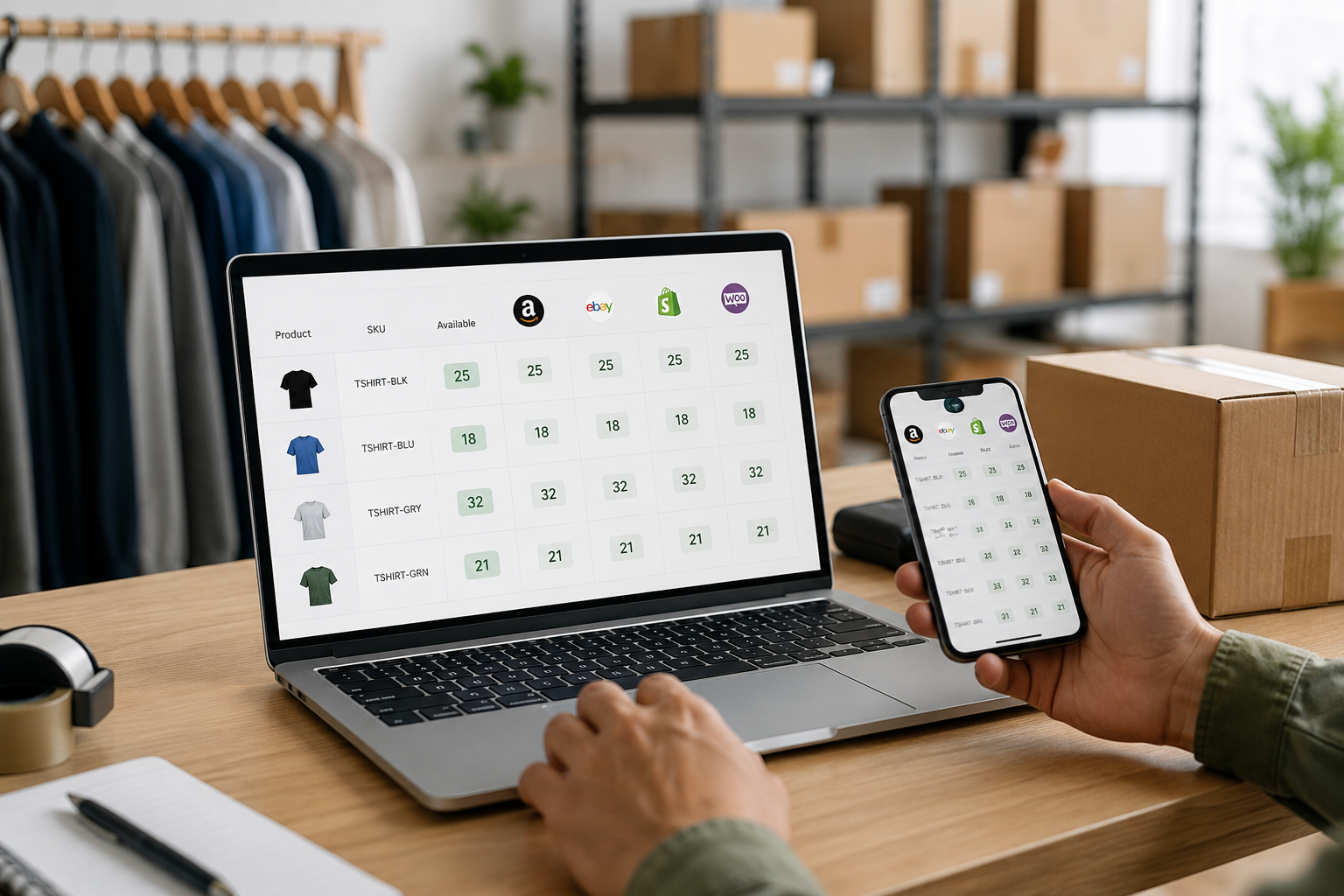
When you sell on multiple platforms, each one has its own record of how much stock you have. Your Shopify store thinks you have 12 units. Amazon thinks you have 12 units. eBay thinks you have 12 units. In reality, you have 12 units total across all three.
The moment one platform sells a unit, the other two platforms still show 12. Unless something updates all three simultaneously, they will happily keep selling stock that no longer exists.
Most basic inventory tools update on a schedule, every 15 minutes, every 30 minutes, or even once a day. However, as Nventory points out, if your system syncs every 15 minutes, there is a 15-minute window where any channel can sell a unit that has already been sold elsewhere. During a busy sales day, that window is all it takes.
Real-time API syncing closes that window entirely. The moment an order is placed on any channel, the stock count updates everywhere else instantly. No lag. No window. No double-selling.
What API-Driven Inventory Syncing Actually Means
Let us simplify the technical language because the concept itself is straightforward.
An API (Application Programming Interface) is essentially a communication bridge between two software systems. When your Shopify store and your Amazon seller account are connected via an API, they can talk to each other in real time. One sells a unit, and the other immediately knows about it.
API-driven inventory syncing is, therefore, just a system where all your sales channels are connected through these bridges, and they all read from and write to one central stock count. When Amazon sells a unit, the central count goes from 12 to 11. Shopify and eBay immediately update to 11 as well. The whole process takes milliseconds.
The keyword is real-time. That is what separates API-driven syncing from older batch-update tools that run on a schedule. According to NRF 2025 data cited by US Tech Automations, brands with synchronized multi-channel inventory reduce oversell incidents by 85 to 95% and cut order processing time by 40 to 60%. Those are not marginal improvements. Those are business-changing numbers.
How It Works in Practice
The automation infrastructure behind real-time inventory sync works the same way as any other workflow automation system. Here is a quick look at how we build these systems for businesses.
A real-time inventory sync system has three core components working together.
One central inventory record. All your stock data lives in one place. Whether that is your Shopify backend, a dedicated inventory management tool, or a warehouse management system, the central record is the single source of truth. Every channel reads from it. Every sale updates it.
Real-time connections to every channel. Each sales platform, Shopify, Amazon, eBay, Walmart, your own website, and your retail POS, is connected to the central record via an API integration. As a result, any change in stock is reflected everywhere immediately.
Automated rules for low stock. When stock drops below a threshold, the system automatically pauses listings on lower-priority channels, switches a product to “out of stock” status, or triggers a reorder alert. This means your best-performing channels stay live the longest, and you never accidentally sell from empty shelves.
The setup sounds technical, but in practice, it is largely invisible once it is running. Orders come in across multiple channels. Stock counts stay accurate. Oversells stop happening. The marketing automation infrastructure that connects these systems is the same type of workflow automation that runs email sequences, CRM updates, and customer journeys, with rules-based logic that executes without anyone pressing a button.
The Growth Angle: More Channels, More Revenue
Fixing overselling is not just about protecting existing revenue. It is also about unlocking growth.
Sellers who are afraid of overselling often hold back from expanding to new channels. They stick to one or two platforms because managing more feels too risky. As a result, they leave significant revenue on the table.
According to Mirakl’s 2025 multi-channel data via API2Cart, brands selling on three or more marketplaces achieve 104% growth in gross merchandise value. That is not a small uplift. It is roughly double the revenue from expanding to additional channels with proper integration in place.
Furthermore, real-time inventory sync reduces order cancellation rates by 30 to 50% across connected channels. Fewer cancellations mean better seller ratings, better visibility in marketplace algorithms, and lower customer acquisition costs because your existing customers are more likely to return.
In other words, a good inventory sync system pays for itself not just by preventing losses but by enabling growth that was previously too risky to pursue.
What Most Multi-Channel Sellers Get Wrong
Relying on scheduled syncs during high-volume periods. A sync that runs every 15 minutes is fine on a quiet Tuesday. It is completely inadequate during a Black Friday sale when you might process 50 orders in a single minute. Real-time event-driven sync is the only reliable solution during peak periods.
Treating each channel as a separate inventory pool. Some sellers hold back stock specifically for Amazon or specifically for their website, managing each channel as a separate bucket. This approach seems safe, but is actually inefficient and expensive. It ties up capital in siloed stock that cannot move fluidly to wherever demand is highest. A unified inventory pool with smart allocation rules performs significantly better.
Not connecting returns to the live count. When a customer returns a product, that unit needs to re-enter the sellable inventory immediately and update across all channels. Many sellers handle returns manually, creating delays and gaps in the stock count. Automated returns sync is an essential part of a complete inventory system.
Expanding channels without fixing the sync first. The most common mistake is adding a new sales channel, say, listing on Walmart after already being on Amazon and Shopify, without ensuring the sync infrastructure can handle it. Each new channel multiplies the overselling risk if the foundation is not right. Therefore, fixing the sync before expanding is always the right sequence.
How We Helped a Business Connect Multiple Channels Into One Seamless System
Ennoble, a B2B services company, faced a version of the same problem that multi-channel sellers encounter with inventory. They were operating across multiple outreach channels simultaneously, email, LinkedIn, and direct calls, each running independently with no shared data. As a result, the same contacts were being reached through multiple channels at the same time with no coordination between them. It created confusion, duplicate effort, and wasted outreach budget.
We built a unified system that connected all three channels into a single pipeline. Every contact touchpoint updated the central record in real time. Sequences were triggered based on where a contact was in the journey, not on which individual channel had last interacted with them. Duplication stopped. Response rates improved. The team’s outreach effort became significantly more efficient.
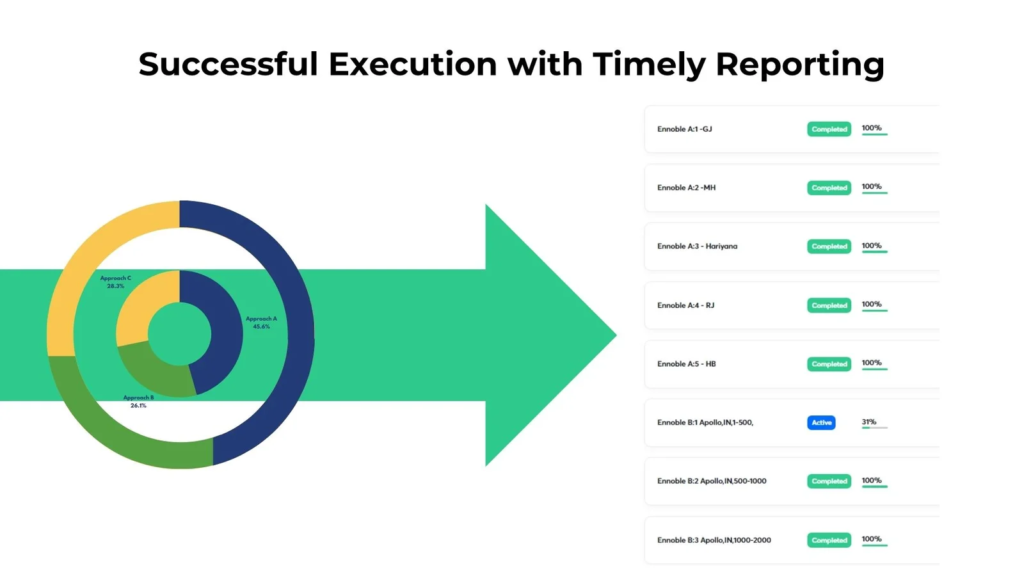
The outcome: 30 or more positive replies and 10 new business meetings booked within the first month of the integrated system going live.
The principle is identical to API inventory syncing. Multiple channels, one source of truth, real-time updates, and automated rules that prevent conflicting actions. Whether the “inventory” is product stock or outreach contacts, the fix is the same: connect everything to a single synchronized system.
Talk to our team or get to know us better to understand how automation and systems integration can work for your specific setup.
The Bottom Line
Overselling is not bad luck. It is a systems problem with a systems solution.
Real-time API inventory syncing connects all your sales channels to one accurate stock count and updates everything the moment a sale happens. As a result, overselling stops. Cancellations drop. Seller ratings improve. And you can expand to new channels confidently because the infrastructure handles the complexity for you.
For multi-channel sellers at any stage, whether you are on two platforms or ten, inventory sync is foundational. It is the difference between a business that scales confidently and one that caps its own growth out of fear of operational chaos.
We help e-commerce and multi-channel businesses build the automation infrastructure that makes scaling possible, through our marketing automation service, sales funnel buildouts, retargeting campaigns, and full-funnel demand generation programs.
Let us look at your current setup and show you where the gaps are.
– Blog written by Sarah Joshi