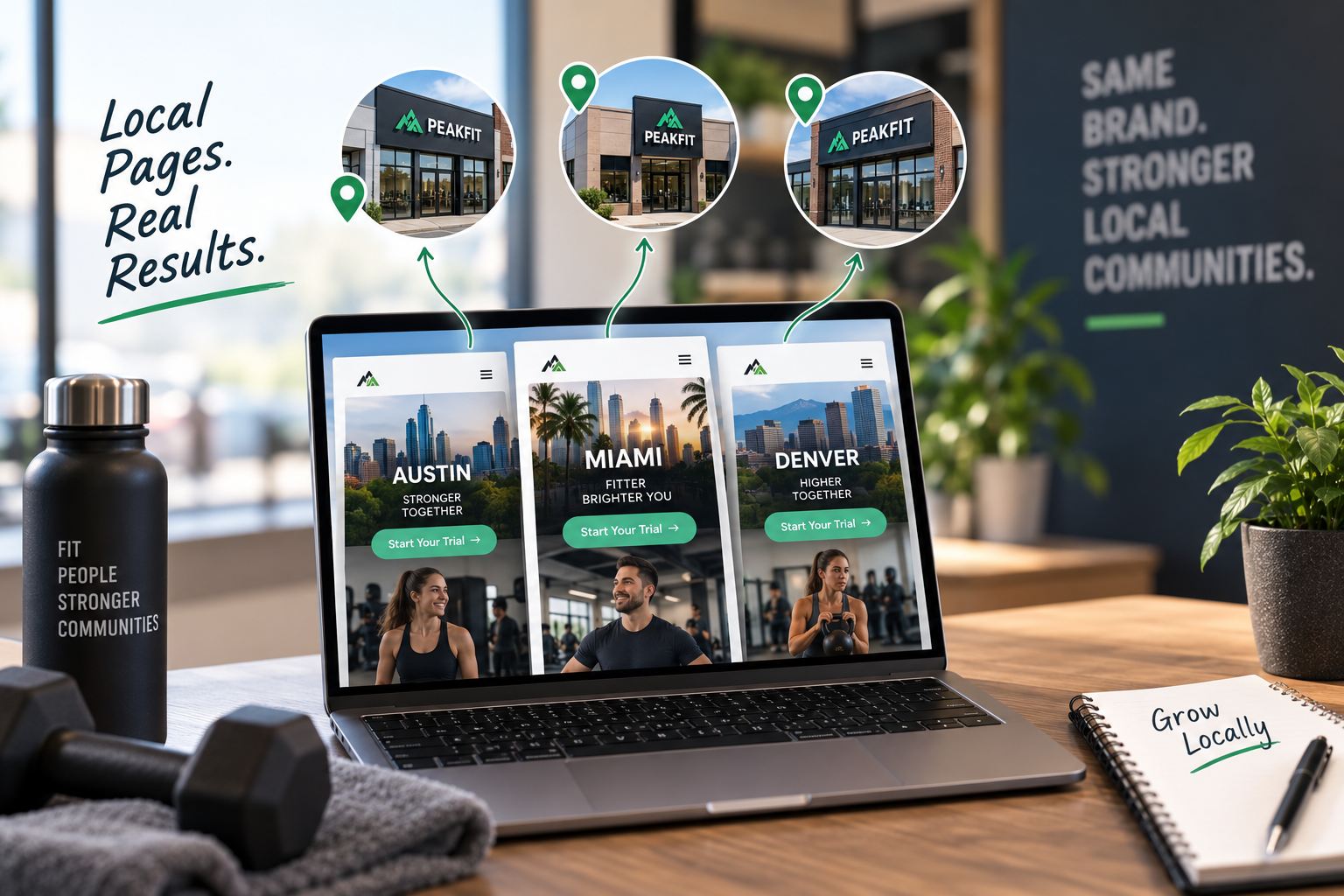
A national franchise runs a beautiful, brand-consistent website. Every location links to the same homepage. A customer in Austin and a customer in Boston see the identical page, the identical offer, and the identical generic message. Neither sees the address of their nearest location, the specific promotion running in their city, or any signal that this brand actually serves their neighbourhood.
This is the franchise conversion problem. National brand consistency and local conversion relevance are pulling in opposite directions. The corporate marketing team wants uniform branding. The individual franchisee needs a page that converts local searchers into local customers. A single generic page serves the brand and fails the franchisee.
Dynamic landing pages resolve this tension. They maintain brand consistency at the template level while automatically adapting the location, offer, and messaging to match each local visitor. Here is what the data shows about why this matters, how dynamic pages work for franchise systems, and what most franchise brands get wrong.
Why Generic Pages Fail Local Franchise Conversion
Franchise businesses are fundamentally local. A customer searching for a service does not want the national brand in the abstract. They want the location near them, the hours of that specific branch, and the offer available in their market. A generic national page cannot provide any of this, which is exactly why generic pages convert so poorly for franchise systems.
The conversion data makes the gap clear. According to Firework’s landing page statistics, well-optimized landing pages can deliver up to a 220% boost in conversion rates compared to generic web pages. Furthermore, Fibr.ai’s 2026 landing page research shows that websites with 10 to 15 landing pages see a 55% higher conversion rate than those with fewer than 10. For a franchise with dozens or hundreds of locations, the implication is significant. Each location deserves its own conversion-optimized page, not a shared generic one.
Additionally, personalization drives measurable lift. According to DigitalApplied’s 2026 landing page data, dynamic personalization that swaps headlines, hero, or testimonials based on traffic source, geography, or industry lifts conversion by 9% to 18% on average when the segments genuinely differ. For franchise brands, geography is the most obvious and highest-impact personalization variable available.
What Dynamic Landing Pages Actually Do for Franchises
A dynamic landing page is built once as a template, then automatically populated with location-specific content based on the visitor. The brand template stays consistent. The local details adapt.
For a franchise, this means a single page template can serve every location while showing each visitor the content relevant to their nearest branch. The location name, address, phone number, and map appear automatically. The specific promotion running in that market displays without the corporate team building a separate page. Local reviews and testimonials from that branch surface instead of generic national ones. Local staff or franchisee information appears where relevant.
This solves the core franchise tension. Corporate maintains brand control because every page uses the approved template, messaging framework, and design system. Franchisees get local relevance because the page adapts to their market automatically. Neither has to compromise. Furthermore, the system scales without the corporate marketing team manually building and maintaining hundreds of individual location pages.
The technical approaches vary. Some franchise systems use geolocation to detect the visitor’s location and adapt the page automatically. Others use dedicated location URLs, one per branch, populated from a central content system. The most sophisticated combine both, using location-specific pages for SEO and dynamic personalization within those pages for individual visitor relevance.
The Numbers Behind Location-Specific Conversion
The performance case for location-specific landing pages is grounded in consistent data across sources.
According to SEO Sherpa’s 2026 landing page statistics, the median landing page conversion rate across all industries sits at 6.6%, while top-performing pages convert at roughly three times the industry median. The gap between a generic page performing at or below median and an optimized location-specific page performing at the top tier is significant. It is the difference between an average franchise location and a high-performing one, using the same ad spend and the same traffic.
Furthermore, Fibr.ai’s data confirms that landing pages with social proof such as customer reviews and testimonials convert 34% better than those without. For franchises, local reviews are significantly more persuasive than national ones. A customer in Denver trusts reviews from the Denver location far more than aggregate national ratings. Dynamic pages that surface location-specific reviews capture this trust advantage automatically.
Additionally, page speed compounds the effect. According to Fibr.ai, pages loading in one second convert three times higher than those loading in five seconds, and a 0.1-second improvement in load time can increase conversions by up to 10.1%. Dynamic landing page systems built on efficient templates load faster than bloated multi-purpose pages, adding a speed advantage on top of the relevance advantage.
How Dynamic Landing Pages Support Local SEO for Franchises
Beyond conversion, dynamic location pages serve a second critical function: local search visibility. A franchise with a dedicated, optimized page for each location can rank in local search results for each of those markets. A franchise with only a national homepage cannot.
When a customer searches for the service plus their city, Google looks for a relevant, local page to serve. A location-specific landing page that references the city, the neighbourhood, the local address, and local customer reviews signals exactly the local relevance that Google’s algorithm rewards. Consequently, the franchise captures local organic search traffic in every market it serves, not just at the corporate level.
This local search advantage compounds with the conversion advantage. The location page ranks for local searches and brings in local traffic. It then converts that traffic at a higher rate because the page is relevant to the local visitor. Our marketing automation and funnel infrastructure at Trigacy connects these location pages to lead capture and follow-up systems so every local enquiry generated is captured and nurtured automatically. Additionally, our social media management service at Socinova helps franchise brands maintain the local content presence that supports these pages across each market.
What Most Franchise Brands Get Wrong
Forcing all traffic to a single national homepage. This is the most common and most costly franchise conversion mistake. A customer who searched for a local service and lands on a national homepage has to find their location, which many will not bother to do. Every local search should lead to a local page.
Letting franchisees build their own inconsistent pages. The opposite extreme is equally damaging. When individual franchisees create their own pages without a central template, brand consistency collapses. Pages vary wildly in quality, messaging drifts from brand standards, and the corporate team loses control of how the brand is represented. Dynamic templates solve this by giving franchisees local relevance within a controlled brand framework.
Fragmentation across locations, whether in agencies or landing pages, is what breaks franchise marketing. Here is why a single unified approach that respects local nuance wins.
No local social proof. A location page that shows national aggregate reviews misses the trust advantage of local ones. A prospective customer wants to see that people in their specific area have used and rated this location. Surfacing location-specific reviews dynamically is one of the highest-impact conversion improvements available to franchise pages.
Ignoring page speed at scale. When a franchise has hundreds of location pages built on a heavy, unoptimized template, the cumulative speed problem hurts both conversion and search ranking across the entire system. A lightweight dynamic template that loads fast delivers compounding benefits across every location.
No conversion mechanism matched to the local action. Different franchise types require different local conversion actions. A restaurant franchise needs a reservation or order button. For a service franchise, a quote request or booking is the priority. Retail franchises need directions and hours front and centre. The dynamic page must present the specific conversion action relevant to that business type and location, not a generic contact form.
The Bottom Line
Franchise brands face a genuine tension between national brand consistency and local conversion relevance. Corporate wants uniform branding. Franchisees need pages that convert their specific local market. For years, most franchise systems resolved this by defaulting to generic national pages that served the brand and failed local conversion.
Dynamic landing pages end that compromise. They maintain full brand control at the template level while automatically adapting location, offer, social proof, and messaging to each local visitor. Corporate keeps consistency. Franchisees get relevance. Both benefit from higher local conversion rates and stronger local search visibility.
For franchise brands operating across multiple markets, dynamic landing pages are the essential infrastructure. Every location can convert its local traffic as effectively as a dedicated local business, while the brand stays consistent across the entire system.
That is the capability we help franchise and multi-location brands build through our sales funnels, social media management, marketing automation, retargeting campaigns, and full-funnel demand generation programs.
Let us build it for your franchise.
– Blog written by Sarah Joshi