There are two types of coffee shop customers. The first type walks in when they happen to be nearby, orders whatever they fancy, and might return in three weeks. The second type opens the app before leaving home, checks their points balance, knows exactly what they are ordering to hit their next reward, and has not bought coffee anywhere else in six months.
The difference between these two customers is not the quality of the coffee. It is the loyalty program.
Building the second type of customer at scale is exactly what loyalty program automation does. It takes the mechanics of a punch card and makes them smarter, faster, and far more consistent than any paper-based or manually managed system can achieve.
Here is what the data says about loyalty in coffee and F&B, how automation makes it work at a chain scale, and what separates the programs that drive genuine repeat behaviour from the ones that collect sign-ups but not second visits.
The Numbers Behind Loyalty in Coffee and F&B
The business case for investing in loyalty programs in the coffee and F&B category is exceptionally strong.
According to U.S. Coffee Shop Industry analysis from MMCGinvest 2025, loyalty members spend an average of 32% more annually than non-members. Digital loyalty platforms achieve retention conversion rates as high as 85%.
Dutch Bros, one of the fastest-growing coffee chains in the US, attributes two-thirds of all its transactions to loyalty program members. Starbucks mobile orders, tied directly to the rewards program, grew from 17% to 26% of total sales within a single year.
Furthermore, Paytronix’s 2023 Annual Loyalty Report, cited by Chowbus, found that loyalty members who provided email addresses visited 25 to 50% more frequently, depending on the segment, and spent approximately 5% more per visit than non-members. That combination of frequency and spend uplift compounds significantly over a customer’s annual relationship with the brand.
Additionally, research from Publicis Sapient, cited by White Label Loyalty, shows that personalised loyalty experiences make consumers 72% more likely to repeat purchases compared to generic rewards. The implication is clear. A loyalty program that treats every member identically performs far below one that delivers personalised rewards and communications based on individual behaviour.
This is where automation becomes essential. Personalisation at scale is not achievable through manual management. It requires a system that reads behavioural data and responds automatically.
What Loyalty Program Automation Actually Does
A manual loyalty program, whether paper punch cards or a basic stamp app, tracks visits and delivers a reward when the threshold is hit. That is the extent of its capability.
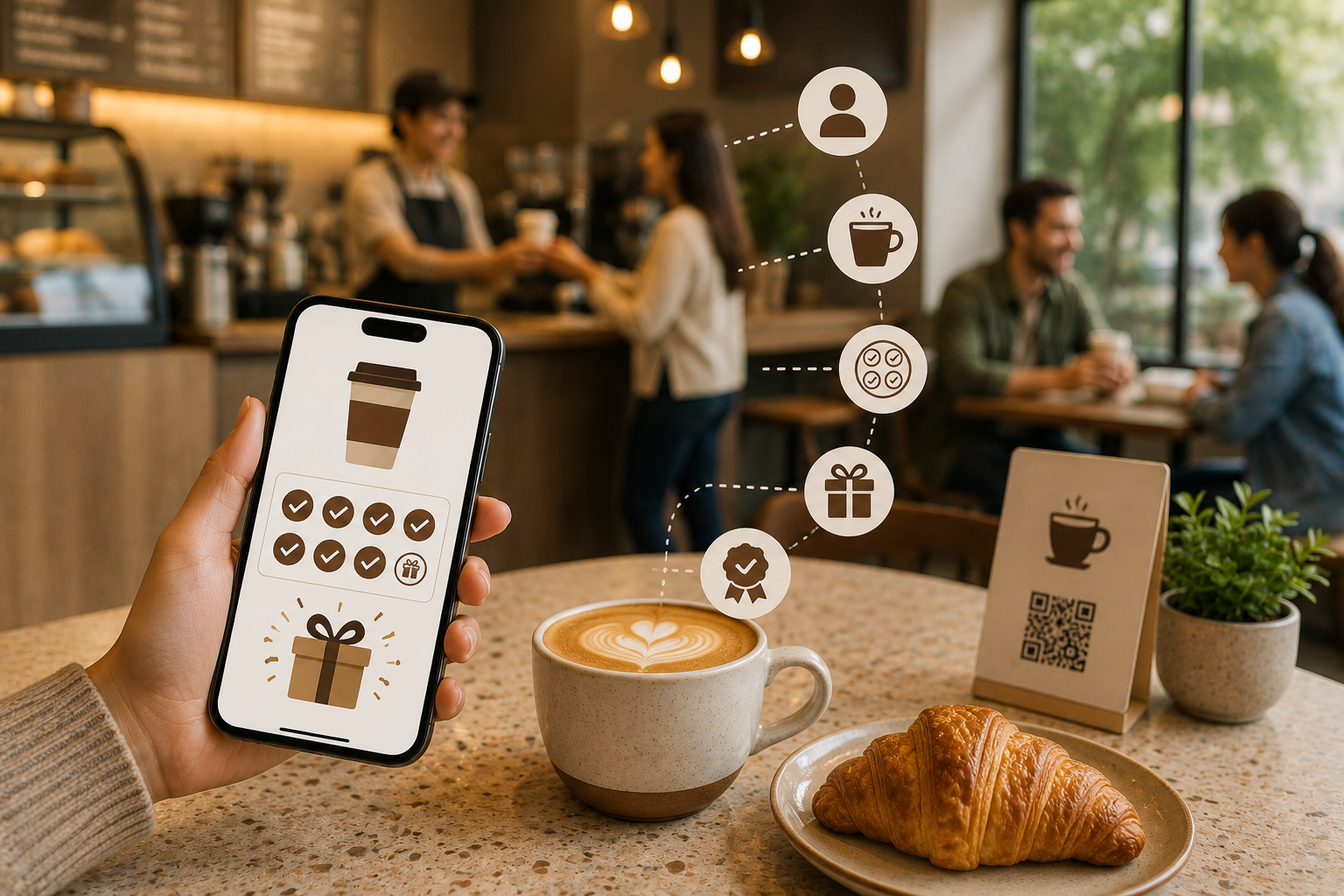
Automated loyalty programs do considerably more. They track every purchase, categorise it by product type, time of day, and frequency, and use that data to trigger personalised communications and rewards automatically.
Specifically, a well-built automated loyalty system handles the following without any manual input from the marketing team.
Birthday and anniversary rewards. The system identifies a member’s birthday and automatically sends a reward, a free drink, a discount, or bonus points, via app notification, SMS, or email, timed to arrive on the day itself. This single touchpoint consistently generates one of the highest redemption rates in any loyalty program because it arrives at a moment of personal relevance.
Points expiry reminders. Research by Milagro Corp found that SMS reminders about expiring loyalty points produced a 15% uplift in repeat visits within a month. Members who would otherwise let their points lapse return specifically to redeem them before the deadline. Furthermore, the expiry trigger creates genuine urgency without requiring a discount.
Lapsing member re-engagement. When a loyalty member has not visited in a defined period, the system automatically triggers a re-engagement sequence. For a coffee chain with weekly visit expectations, that threshold is typically 21 days.
A push notification, an SMS, or an email with a personalised offer brings them back before they drift entirely. This is the F&B equivalent of the churn prevention system used by subscription businesses.
Tier progression nudges. Many F&B loyalty programs use tiered structures where members unlock higher rewards as they reach spending thresholds. Automated messages that tell a member they are 2 visits away from Gold status, or 150 points away from a free item, create meaningful short-term incentives that drive incremental visits.
Post-visit follow-ups. After a transaction, the system sends a message acknowledging the visit and updating the points balance. It then suggests a next step, whether that is a relevant offer or a simple thank-you. This touchpoint reinforces the relationship and keeps the brand present between visits.
Why Coffee and F&B Chains Specifically Need Automation at Scale
For F&B brands looking to grow beyond word of mouth, here is where most marketing improvements should start.
A single-location café can manage a loyalty program manually or through a basic app. A chain with 10, 20, or 100 locations cannot.
The volume problem is straightforward. A coffee chain processing 1,000 transactions per day across 10 locations generates 10,000 data points daily. No marketing team can manually process that data, identify patterns, and send relevant communications to the right members at the right time. Automation handles that entire workflow without delay and without staffing cost.
Moreover, consistency across locations is a significant brand challenge for F&B chains. If one location delivers excellent loyalty communication and another sends nothing after purchase, the member experience becomes unpredictable. Automated systems ensure every location delivers the same programme experience regardless of which staff are on shift or how busy the location is that day.
Toast’s 2024 coffee shop industry analysis identifies technology integration as essential for F&B chains competing against the Starbucks and Dutch Bros of the world.
This includes online ordering, pre-ordering, and loyalty programmes. Chains that integrate their POS, app, loyalty programme, and marketing automation into a single connected system build a structural advantage. That advantage is difficult for less tech-enabled competitors to match.
The Key Integrations That Make It Work
Loyalty program automation only performs at its potential when it connects to the right systems.
POS integration is non-negotiable. The loyalty system needs to read every transaction in real time. When a customer pays, the points update automatically. Any earned rewards become immediately visible in their app based on the updated balance. Without POS integration, members wait for manual updates or rely on staff to scan cards manually, which creates friction and reduces engagement.
CRM and segmentation allow the system to treat different member segments differently. A member who visits every morning for an espresso is a different customer from one who visits fortnightly for a seasonal special. The automated communications, offers, and rewards for each should reflect their actual behaviour rather than treating them identically.
Our marketing automation service at Trigacy builds these behavioural segmentation layers for F&B businesses, ensuring every automated touchpoint is relevant to the specific member receiving it.
Mobile app and push notifications are the highest-engagement delivery channels for loyalty communications. According to the same MMCGinvest analysis, Dutch Bros processed over 2.8 million app orders by late 2024.
For chains running a mobile app, push notifications triggered by loyalty events, a points milestone, an approaching expiry, a birthday reward, deliver open rates far above email and response rates far above any broadcast communication.
Retargeting integration extends the loyalty system’s reach beyond existing members.Retargeting campaigns targeting people who visited the brand’s website or social profiles but have not yet joined the loyalty programme convert prospects into members efficiently.
Additionally, lapsed members who have not responded to the in-app or SMS re-engagement sequence can be reached through paid social ads. This creates a second-chance touchpoint without requiring any additional direct communication.
What Most F&B Chains Get Wrong
Launching the programme before fixing the data infrastructure. Many chains launch loyalty programmes with impressive features and then discover the problems later. Their POS does not integrate cleanly with the loyalty platform. Member data sits fragmented across multiple systems, and automation triggers fail to fire reliably.
Building the data foundation first, even if the launch is delayed, produces a better member experience and fewer operational headaches.
Offering generic rewards to everyone. A free coffee after 10 visits works as a baseline mechanic. However, it treats the member who comes in every morning the same as the one who visits twice a month. Chains that layer personalised rewards on top of the base mechanic see significantly higher engagement and redemption rates.
A free almond milk upgrade for a member who always orders oat milk is one example. A discounted pastry for someone who regularly buys food alongside their drink is another.
Ignoring the lapsed member segment. Many F&B chains focus their loyalty marketing on active members and new sign-ups. The lapsed member segment, people who joined but stopped engaging, is often the highest-return segment to target. They already know the brand, they already trusted it enough to sign up, and they often lapse for reasons that a well-timed personal offer can address.
Not communicating the programme value clearly at the point of sale. Loyalty programme sign-up rates are strongly influenced by how well the value proposition is communicated at the moment of purchase.
Staff who explain the benefits clearly, signage that shows the reward threshold, and a frictionless sign-up process at the till all drive member acquisition. Automation handles the ongoing communication, but recruitment starts with a clear in-store message.
Measuring sign-ups instead of engagement. Sign-up numbers are a vanity metric. The metrics that matter are monthly active members, redemption rate, visit frequency change post-enrolment, and average spend comparison between members and non-members. Chains that optimise for sign-ups rather than active engagement build large databases with low commercial impact.
How Consistent Community Engagement Drove Repeat Behaviour for a Pune Restaurant

Platesman Everyday Eatery, a restaurant in Pune that we manage at Socinova, demonstrates the compounding effect of consistent, personalised engagement on repeat visit behaviour.
Rather than relying on a points-based system, we built Platesman’s community loyalty through systematic social media engagement, creator collaboration content, and consistent brand communication across platforms. Every post, every comment response, and every creator collaboration reinforced the brand relationship with both existing customers and new prospects.
The most recent 90-day data tells the story clearly. With just 331 followers, the account reached 43,426 accounts and generated 32,066 views. Furthermore, 93.3% of those views came from non-followers, meaning the content consistently pulled in new potential customers rather than just circulating within the existing base.
Reels drove 55.8% of all views and 73.1% of all interactions. Additionally, 57% of total interactions came from non-followers. This confirms that the content was actively building new community relationships rather than just engaging an existing audience.
That is a 131x reach multiplier beyond the follower count, driven entirely by consistent, engagement-focused content management.
Moreover, the pattern is not a one-off spike. It reflects a sustained system of community engagement that keeps the brand present, relevant, and worth returning to. That is the behaviour that loyalty programme automation is designed to generate at scale.
For a coffee or F&B chain, the same principle applies with greater precision. Automation adds the points mechanics, the personalised triggers, and the behavioural segmentation that organic social cannot replicate at scale. However, the underlying goal is identical: build a relationship consistent enough that the customer chooses you by default rather than convenience.
Talk to our team to see how we would approach loyalty programme automation for your specific chain, or get to know us.
The Bottom Line
The coffee and F&B categories are among the most competitive in retail. Customers have an abundant choice and limited brand loyalty by default. Loyalty programme automation changes the default by creating a personalised, consistent relationship that makes switching feel like a step down.
The brands winning this category, Starbucks, Dutch Bros, and a growing number of independent chains, all share one characteristic. They treat loyalty as a data-driven system rather than a paper stamp card. They use automation to deliver the right message at the right moment to the right member. As a result, they convert occasional visitors into habitual customers and habitual customers into brand advocates.
That is the infrastructure we help coffee and F&B businesses build through our marketing automation service, social media management, retargeting campaigns, sales funnels, and full-funnel demand generation programs.
Let us build it for your chain.
– Blog written by Sarah Joshi