Most coaches and consultants spend the first 20 minutes of every discovery call answering the same questions. What exactly do you do? How does this work? What results can I expect? What makes you different from everyone else?
A VSL funnel answers all of those questions before the prospect ever reaches your calendar. By the time they book a call, they already know what you do, they already believe you can help them, and they are already partially sold. The call becomes a confirmation rather than a sales pitch.
That shift alone compresses the sales cycle dramatically. And for high-ticket coaching and consulting businesses where every hour of sales time is expensive, it changes the economics of the entire acquisition model.
Here is what a VSL funnel actually is, why it works so well for coaching and consulting specifically, and how to build one that genuinely shortens the path from stranger to paying client.
What a VSL Funnel Actually Is
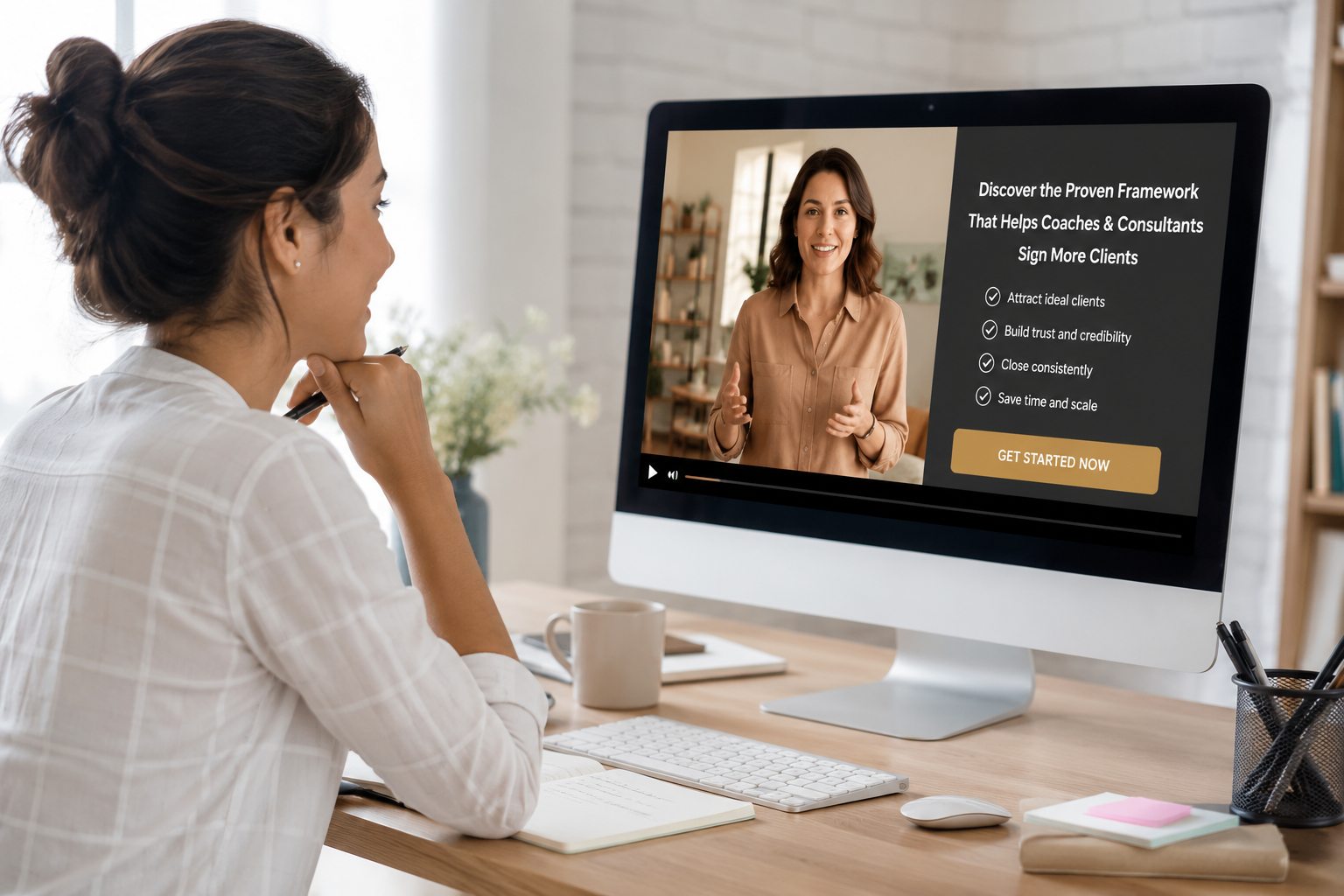
VSL stands for Video Sales Letter. It is a video that does the job a traditional long-form sales page would do, but more efficiently and more persuasively.
Instead of asking a prospect to read thousands of words, it asks them to watch a video that speaks directly to their problem, introduces your solution, builds your credibility, and ends with a clear call to action.
A VSL funnel is simply the structure that surrounds the video. Traffic arrives at a landing page. The VSL plays. A prospect who is convinced books a call or fills in an application form. Automated follow-up sequences handle everyone who does not convert immediately.
According to MyFunnelSecrets’ 2026 VSL funnel guide, 78% of internet users prefer video content when researching products and services. Furthermore, DigitalMarketer’s research cited by Rebel Growth found VSL-optimized funnels converting at 8.2% compared to just 1.9% for text-only equivalents. That is a 331% lift from switching the primary sales medium from text to video.
For high-ticket coaching and consulting, where the prospect needs to trust you before committing thousands of dollars, that difference is not surprising. It is logical.
Why Coaching and Consulting Benefit More Than Most Categories
VSL funnels work across many categories. However, coaching and consulting sit at the intersection of every factor that makes them work best.
The purchase is relationship-dependent. Someone hiring a business coach or a consultant is not just buying a service. They are betting on a person. They need to trust your judgment, your experience, and your ability to understand their specific situation.
A VSL lets them hear your voice, see your face, and experience your thinking before any direct interaction. By the time they book a call, the relationship has already started.
The sales cycle is naturally long. High-ticket coaching and consulting clients typically take days or weeks to decide. They research, compare options, and deliberate. A VSL funnel gives them something compelling to watch at the moment of peak interest, then follows up automatically across email and retargeting during the consideration period.
As a result, momentum is maintained even when the prospect is not actively engaging.
The objections are predictable. Almost every coaching or consulting prospect has the same hesitations. Will this work for me? Can I afford it? Do I have time? Is this person credible? A well-written VSL addresses all of these objections explicitly and in the right sequence, so they are resolved before the prospect gets on a call.
Moreover, this means sales calls become shorter and close rates improve because the heavy objection-handling work has already been done.
Discovery calls are expensive. A 45-minute discovery call with someone who is not qualified is 45 minutes that could have been spent on a client. VSL funnels with application forms filter out unqualified prospects before they reach the calendar.
Consequently, every call becomes a higher-quality conversation with someone who has already watched the video, already resonated with the offer, and already indicated genuine intent.
How a VSL Funnel Works Step by Step
The structure of a high-performing coaching VSL funnel has five connected stages.
Stage 1: Traffic
Prospects arrive from paid ads (Meta, Google, or LinkedIn), organic content, email sequences, or referrals. The traffic source matters less than what happens next. However, paid traffic to a VSL funnel is particularly powerful because it allows you to control volume and scale what works.
Our social media advertising service at Socinova runs traffic specifically to VSL funnels for coaching and consulting clients, targeting audiences by job title, interest, and behavioral signals.
Stage 2: VSL Landing Page
The prospect lands on a simple page. There is minimal distraction. The VSL plays prominently, ideally set to autoplay. Below the video is a clear CTA, either a book-a-call button, an application form, or both.
The page copy does only two things: get the visitor to watch the video and get them to take action after watching it. Nothing else. Our sales funnel buildouts at Trigacy are designed specifically for this stripped-back, conversion-focused approach.
The landing page and funnel structure behind a VSL matters as much as the video itself. Here is a quick look at what high-converting sales funnel design actually involves.
Stage 3: Application or Booking
After watching the VSL, a qualified prospect either books directly on a calendar or fills in an application form. The application form serves a dual purpose. It collects information that makes the sales call more efficient, and it filters out prospects who are not serious.
Someone who is not willing to spend five minutes answering qualifying questions is unlikely to invest thousands of dollars.
Stage 4: Automated Follow-Up
Not everyone watches the VSL in one sitting. Not everyone books immediately after watching. Marketing automation sequences handle the follow-up across email, SMS, and retargeting ads.
A prospect who watched 80% of the video but did not book gets a different follow-up sequence than someone who bounced after 30 seconds. The system stays in contact and moves prospects forward without any manual effort from you.
Stage 5: Retargeting
Retargeting campaigns serve follow-up creative to prospects who visited the VSL page but did not convert. A short testimonial clip from a past client. A reminder about the offer. A social proof post. These touchpoints keep your brand present during the consideration window and bring prospects back to the funnel when they are ready.
What Makes a High-Converting Coaching VSL
The structure of a great coaching VSL follows a consistent pattern. Each element serves a specific purpose.
Hook (first 30 seconds): The hook must immediately identify the specific problem the prospect is experiencing. Not a general problem.
The exact, specific pain point. “If you are a service-based business owner doing $10,000 to $30,000 a month and you cannot figure out why growth has stalled despite working harder than ever, this video is for you.” That level of specificity creates an instant sense of relevance.
Problem amplification: Spend time on the problem before introducing your solution. Describe the consequences of the problem in detail. Show that you understand what it feels like to be in that situation. This builds emotional resonance and establishes empathy, which is the foundation of trust.
Credibility establishment: Introduce yourself and your credentials at this point, not at the beginning. Once the prospect identifies with the problem, they are receptive to the person who claims to have the answer. Before that point, a bio feels self-promotional.
The mechanism: Explain what makes your approach different. Not just what you do, but why your specific method works when others have not. This is the intellectual core of the VSL and the section that most distinguishes one coach or consultant from another.
Social proof: Testimonials, case studies, and client results. Video testimonials are most powerful. Written quotes with full names and photos are second. Numbers are always more persuasive than general claims.
The offer and CTA: Be specific about what you are offering, what the investment looks like (at least directionally), and what happens next. A clear, direct call to action with no ambiguity. “Click the button below to book a 30-minute strategy call.
We will spend the first 15 minutes on your specific situation and the next 15 minutes showing you exactly how we would approach it.”
According to neuroscientist Paul Zak, cited by Rebel Growth, storytelling in video triggers oxytocin, the trust hormone, which primes the brain for action.
Furthermore, viewers retain 95% of a message delivered by video compared to just 10% when reading text. The VSL format is not just a preference. It is neurologically more effective for building the trust required for a high-ticket coaching sale.
What Most Coaches and Consultants Get Wrong
Starting with their credentials. The most common VSL mistake is opening with who you are and what you have achieved. The prospect does not care about you yet. They care about their problem. Start there. Earn the right to your bio.
Making the VSL too long without earning the time. A VSL that is 45 minutes long only works if every minute earns the next. Most coaching VSLs lose the audience around the 10 to 15 minute mark because they have not created enough tension or delivered enough value to justify the viewer’s continued attention. Build in open loops. Tease what is coming. Give small moments of insight early.
No application filter. Coaches who send VSL viewers directly to a calendar without an application form end up with a mix of qualified and unqualified prospects on their calls. An application form that asks about budget, timeline, and specific goals filters the calendar to high-intent prospects only.
Driving cold traffic to a VSL without warming it first. Cold traffic from paid ads converts better when there is a warm-up layer. A short ad that mirrors the hook of the VSL, then leads to the full video, typically outperforms sending cold clicks directly to a long-form VSL page.
Furthermore, retargeting warm video viewers with the VSL performs significantly better than targeting cold audiences.
No follow-up system. Many coaches build a VSL, drive traffic to it, and then rely entirely on immediate conversions. The reality is that most high-ticket decisions take multiple touchpoints. A prospect might watch the VSL three times over two weeks before booking.
Without a follow-up system that maintains contact and builds trust during that window, those prospects disappear. Our demand generation approach at Trigacy ensures the follow-up infrastructure is built before the traffic ever starts.
How We Shortened the Sales Cycle for a B2B Consulting Business
Ennoble, a B2B consulting firm, came to us with a problem familiar to most service businesses. The path from initial contact to a booked meeting was long and inconsistent. Prospects would engage, show interest, and then disappear into a follow-up void where nothing happened until either the prospect reached out again or the opportunity was lost entirely.
The system we built changed the sequence. Instead of relying on manual follow-up and hoping prospects would re-engage, we built a structured outreach and qualification funnel. Targeted messaging reached the right prospects at the right moment.
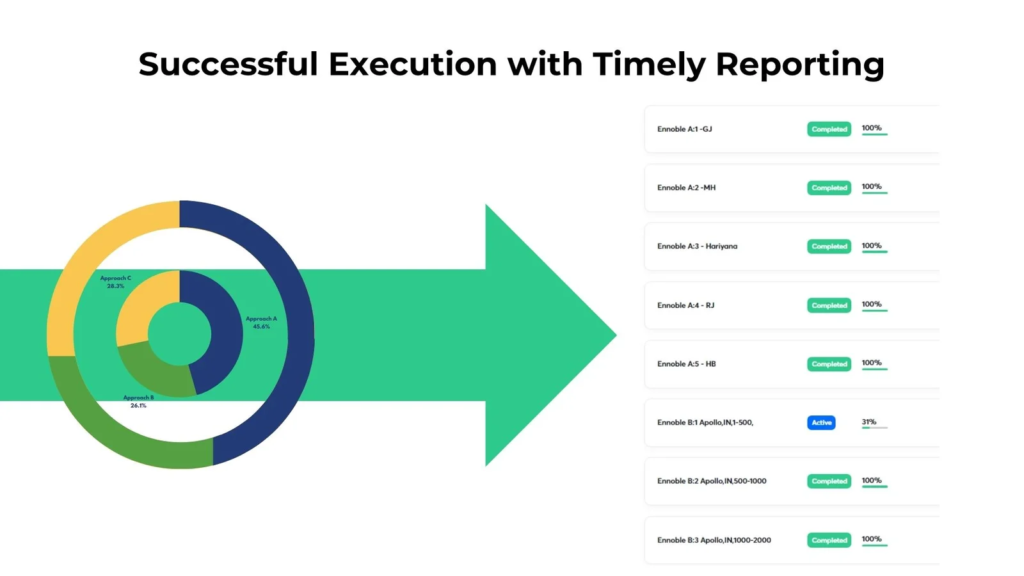
Each touchpoint was calibrated to build credibility and create intent before any meeting request was made. By the time a prospect received a meeting invitation, they already had enough context to decide quickly.
The result was 30 or more positive replies and 10 qualified meetings booked in the first month. The sales cycle shortened not because we pushed harder but because we pre-qualified more effectively. Prospects arrived at the meeting already educated, already aligned, and ready to have a real conversation rather than an introductory one.
That is exactly what a VSL funnel does for coaches and consultants. The video pre-qualifies. The application filter removes noise. The call becomes a closing conversation rather than an exploratory one.
Book a call with our team or get to know us better to map out what a VSL funnel would look like for your specific coaching or consulting offer.
The Bottom Line
A long sales cycle is not inevitable in coaching and consulting. It is usually a symptom of prospects reaching your calendar without enough context to make a confident decision.
A VSL funnel fixes this by moving the education, trust-building, and objection-handling process into a video that prospects watch before they ever speak to you. By the time they book, the heavy lifting is done. The call is shorter. The close rate is higher. The revenue per hour of sales time improves significantly.
For coaches and consultants building a scalable acquisition system, the VSL funnel is one of the highest-leverage investments available.
That is the infrastructure we build through our sales funnel service, marketing automation, retargeting campaigns, paid advertising, and full-funnel demand generation programs.
– Blog written by Sarah Joshi