There is a version of your ad that your target audience will actually stop scrolling for. It does not look like your ad at all. It looks like content from someone they already follow and trust.
That is the core idea behind influencer whitelisting. And for lifestyle brands specifically, it is one of the most powerful paid media strategies available right now.
Traditional brand ads tell people to buy something. Whitelisted influencer ads show people something they already trust, recommending it. That difference in perception changes everything from click-through rates to cost per acquisition.
Here is what influencer whitelisting actually is, why the numbers behind it are compelling, and how to build a campaign that delivers both social proof and measurable ROI.
What Influencer Whitelisting Actually Means
Whitelisting is when an influencer gives a brand advertiser access to run paid ads directly through their social media account. The ad appears to come from the influencer, not the brand. It shows the influencer’s handle, their content, and their voice. The brand controls the targeting, budget, and optimization behind the scenes.
This is different from a standard sponsored post. A sponsored post goes to the influencer’s existing followers and stops there. A whitelisted ad, on the other hand, can be served to any audience the brand chooses, including people who have never heard of that influencer. Furthermore, the brand can A/B test different creatives, adjust targeting mid-campaign, and retarget viewers who engaged without ever publishing anything new.
In short, whitelisting gives brands the authenticity of creator content combined with the full targeting power of paid advertising. For lifestyle brands where trust and aesthetic alignment are everything, that combination is particularly valuable.
The Numbers That Make the Case
The performance data on whitelisted ads is consistently strong across categories.
According to The Cirqle’s 2025 whitelisting research, consumers trust influencers over brands by 65%, and whitelisted ads drive 20 to 40% higher click-through rates as a direct result of that trust. CPMs on whitelisted ads run 25 to 40% lower than equivalent brand-created ads, according to Meta Business Insights 2024. Additionally, CreatorTag’s whitelisting analysis shows influencer-led ads driving 2x higher engagement than brand-led ads, with whitelisted content generating 25% lower cost per acquisition compared to standard brand creative.
Real-world results back these numbers up. Fashion brand About You achieved a 49% lower CPA and a 25% conversion lift after switching to whitelisted influencer ads. A beverage brand whitelisting a lifestyle influencer’s TikTok review on Instagram dropped CPA by 25% compared to their own house creative. A fashion brand using Instagram whitelisting reduced cost per conversion by 30% versus standard Facebook ads.
Moreover, Sprout Social’s 2025 Influencer Marketing Report shows that 86% of consumers make at least one influencer-inspired purchase per year, and the influencer marketing industry is on track to hit $32.55 billion in 2025. The channel is not a niche experiment. It is a mainstream, high-performing acquisition strategy.
Why Lifestyle Brands Benefit More Than Most
Not every category benefits equally from influencer whitelisting. Lifestyle brands, however, sit at the intersection of every factor that makes it work best.
Purchase decisions are driven by aspiration and trust. Whether the product is a wellness supplement, a home decor piece, a fitness brand, or an apparel label, lifestyle purchases are rarely purely functional. People buy because the product fits a version of themselves they want to project. An influencer who already embodies that identity is therefore not just an ad vehicle. They are a social proof endorsement from someone the audience genuinely aspires to.
Visual content is the product. Lifestyle brands live and die by how their products look in context. A professional studio shot of a candle tells you less than a real person lighting it in their beautifully styled apartment. Creator-native content delivers that contextual visual authenticity in a way that brand-produced ads rarely match. Furthermore, that content performs better in feeds because it looks like everything else people are already choosing to watch.
The audience is on the right platforms. According to consumer trust data from Amra and Elma, ages 18 to 34 now rank creator content as their single most trusted source of product information, surpassing search results for the first time. Gen Z averages 3.2 influencer-inspired purchases per month. Instagram and TikTok, where lifestyle brands spend most of their paid media budgets, are precisely where influencer content performs strongest.
How to Run a Whitelisting Campaign That Actually Works
The mechanics of whitelisting are straightforward. The strategy behind it matters more.
Step 1: Choose the right creators
The biggest mistake in whitelisting is choosing influencers based on follower count alone. Engagement rate, content quality, and audience alignment matter far more. A micro-influencer with 25,000 highly engaged followers in your exact lifestyle niche will consistently outperform a macro-influencer with 500,000 loosely relevant followers.
Look for creators whose organic content already looks like the kind of ad you want to run. If their aesthetic, tone, and audience match your brand, the whitelisted ad will feel seamless. If there is a disconnect, the audience will notice.
Step 2: Get whitelisting access
The influencer grants the brand advertiser access through Facebook’s Business Manager or TikTok’s Creator Marketplace. This gives the brand the ability to create ad campaigns using the influencer’s account as the ad origin. The process takes minutes once both parties understand it.
Step 3: Build the campaign structure
Run at least three to five creative variations from the same influencer at launch. Different hooks, different product angles, different calls to action. Let the data identify which version resonates most before scaling the budget. Additionally, build a retargeting layer that serves follow-up ads to people who watched more than 50% of the video or engaged with the post.
Our social media advertising service at Socinova manages exactly this type of campaign structure for lifestyle brands. We handle creator coordination, ad account setup, creative testing, and optimization so the brand focuses on the partnership while we focus on the performance.
Step 4: Expand what works
Once the winning creative is identified, scale the budget on the top performers and use the influencer’s audience data to build lookalike audiences. A lookalike built from people who engaged with an influencer’s whitelisted content is one of the highest-quality audience seeds available on Meta. Furthermore, retargeting campaigns running in parallel ensure that warm prospects from whitelisted content are followed up with conversion-focused creative across multiple touchpoints.
What Most Lifestyle Brands Get Wrong
Treating whitelisting as a one-off campaign. The brands seeing the strongest results from whitelisting are running it continuously with a small roster of two to four aligned creators. Long-term partnerships build compounding trust as the audience sees the same creator using the same product over time. One-off campaigns produce spikes. Ongoing partnerships produce sustained brand credibility.
Not testing enough creative variations. Whitelisting gives brands the ability to run multiple versions of creator content simultaneously. Most brands test one or two. High-performing brands test five to ten. The winning creative emerges from testing, and the margin between the best and worst performers is often significant.
Ignoring the comment section. When a whitelisted ad runs through an influencer’s account, comments appear as if they are on the influencer’s organic post. Real followers may engage genuinely, adding social proof that further reinforces the ad. Brands that monitor and respond to these comments amplify the trust effect. Brands that ignore them miss one of the most valuable authenticity signals in digital advertising.
Choosing influencers whose audience does not match the target customer. An influencer with a beautiful lifestyle aesthetic but a predominantly teenage audience is the wrong partner for a premium home goods brand targeting 30 to 45-year-old homeowners. Audience demographics matter as much as content quality. Furthermore, make sure to verify audience data before committing to any whitelisting agreement.
No funnel below the ad. A whitelisted ad that sends traffic to a generic homepage loses most of the trust built by the influencer’s content the moment the landing page loads. The destination needs to continue the narrative of the ad. If the influencer talked about a specific product benefit, the landing page should lead with that same benefit and make the path to purchase frictionless. Our sales funnel buildouts at Trigacy are designed specifically to close this gap.
How Creator Collaboration Content Gave Platesman 400x Its Follower Reach
Platesman Everyday Eatery, a comfort food restaurant in Pune, is a brand we manage directly. Rather than running traditional brand ads, we built their Instagram presence around creator-collaboration content, featuring local influencers and food creators who visit, film, and post authentic experiences at the restaurant.
The results over 90 days make the case better than any benchmark statistic could. With just 331 followers, Platesman’s creator collaboration reels reached 134,492 accounts. Total views hit 78,543, of which 97.2% came from non-followers. The top-performing creator reel alone hit 39.7K views. Two others crossed 31.4K and 22.7K, respectively. Reels drove 53.4% of all views and 63.4% of all interactions.
That is a 400x reach multiplier beyond the follower base, driven entirely by authentic creator content. Moreover, this is organic reach with no paid amplification.
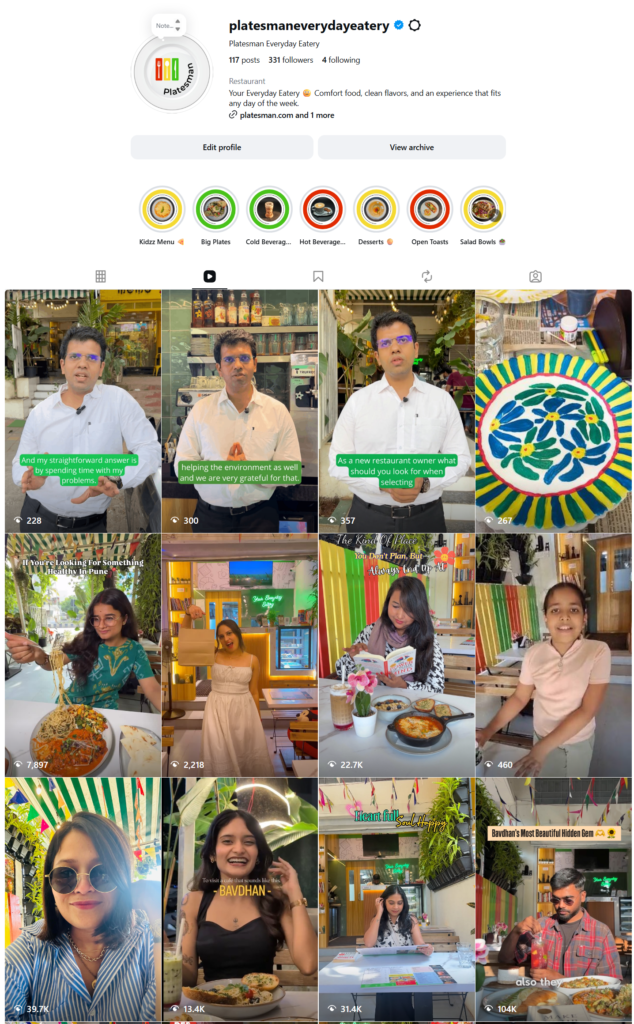
That is exactly the point. Whitelisting takes content that already performs like this organically and runs it as a targeted paid ad from the creator’s account, reaching specific audiences at a controlled scale. The trust that drove those 39.7K views does not disappear when the content becomes a paid ad. It stays intact because the ad still appears as creator content, not as a brand promotion.
Platesman’s numbers show what creator-native content can do without a paid budget behind it. With whitelisting, the ceiling is significantly higher.
Talk to our team or get to know us better to see how this approach would work for your lifestyle brand.nd.
The Bottom Line
Influencer whitelisting is not simply a way to make ads look less like ads. It is a fundamentally more efficient way to run paid social for lifestyle brands because it borrows trust that creators have already built rather than trying to manufacture it through brand-produced creative.
Lower CPMs. Higher CTRs. Lower CPAs. Better social proof. These are not marginal improvements. They are category-level differences that show up consistently across the data and across real brand case studies.
For lifestyle brands, where the purchase decision is driven by aspiration, aesthetics, and trust, whitelisting turns creator relationships into one of the most measurable and scalable acquisition channels available.
That is the kind of paid media strategy we build through our social media advertising packages, retargeting campaigns, sales funnels for lifestyle brands, and full-funnel demand generation programs.
Let us build it for your brand.
– Blog written by Sarah Joshi