
A fitness studio member joins on a Monday with the best intentions. They attend their first two classes and love it. Then a busy week at work gets in the way. Then another. Three weeks later, they have not been back. Two months later, they canceled their membership.
That cycle plays out hundreds of times per year at most fitness studios. The member was not unhappy. They were not dissatisfied. They were simply never reminded to come back.
This is the attendance problem. And it is not solved by adding more classes, hiring better instructors, or redesigning the timetable. It is solved by consistent, timely communication that keeps the studio top of mind and makes it easy for members to show up.
SMS marketing automation is the most effective tool available for that job. Here is why it works, what the data shows, and how to build a system that fills more classes every single week.
Why SMS Is the Right Channel for Fitness Studios
Fitness studios have tried email newsletters, push notifications, and social media posts to drive class attendance. All of these have a role. However, none of them match the immediacy and reach of SMS.
According to RevText’s 2025 automated SMS research, SMS open rates exceed 90% compared to email’s 20 to 30%. Furthermore, most text messages are read within minutes of receipt. For a fitness studio trying to fill a Tuesday morning yoga class or promote a last-minute spot in a popular HIIT session, that immediacy is everything.
Email is ideal for long-form content like monthly newsletters, program updates, and promotional campaigns. Social media is ideal for brand building and community. SMS is ideal for time-sensitive, action-driving communication. Class reminders. Last-minute openings.
Congratulations on your attendance streak. Re-engagement nudges after a member has gone quiet.
Furthermore, SMS requires no app, no algorithm, and no design budget. Every member with a phone number on file can be reached directly. That simplicity is a significant operational advantage for smaller fitness studios without dedicated marketing teams.
The Numbers That Make the Case
The performance data for SMS in the fitness industry is consistently strong.
According to WodGuru’s 2025 SMS marketing research, gyms that implemented regular SMS campaigns saw a 30% increase in class attendance and a 25% improvement in membership renewal rates compared to those relying solely on email. Additionally, IHRSA benchmarks cited by US Tech Automations show that studios with automated member communication retain 18 to 24% more members annually than those without it.
The retention number is particularly important. According to the same IHRSA research, 100 members churning annually represents between $80,000 and $240,000 in lost lifetime value. Reducing churn by even 20% through better SMS communication, therefore, pays for the automation system many times over.
Moreover, the Health and Fitness Association’s 2025 Benchmarking Report puts the US median member retention rate at just 66.4%. That means roughly one in three members leaves every year at the typical fitness business. A significant portion of that churn is driven not by dissatisfaction but by declining engagement, and declining engagement is exactly what SMS automation is designed to prevent.
The Key SMS Sequences Every Fitness Studio Should Build
Building these sequences manually is impossible at scale. Here is a quick look at how marketing automation handles the workflows that keep members engaged without any manual effort.
Not all SMS messages are equal. The studios seeing the strongest results from SMS automation are not sending random blasts. They are building structured sequences triggered by member behavior.
1. Welcome sequence (days 1, 3, and 7 after joining)
A new member’s first week is the most important. This is when habits form and when the decision to keep attending or start drifting gets made. A three-message welcome sequence that introduces them to the schedule, highlights their first class booking, and checks in after their first session creates early momentum.
The tone should be warm and personal. Not corporate. Something like: “Welcome to the studio. We are really glad you are here. Your first class is booked for Thursday at 7 am. We will see you there.” Simple. Human. Direct.
2. Class reminder sequence (24 hours and 2 hours before)
The most effective attendance tool available to any fitness studio is a simple reminder. Many members book class days in advance and then forget. A 24-hour reminder the day before and a 2-hour reminder on the day of the class dramatically reduce no-shows.
According to WodGuru’s research, automated class reminders are one of the highest-ROI SMS applications for fitness businesses. This is precisely because they convert an already-booked member into an actual attendee at essentially zero cost.
Furthermore, since the member has already committed to the class, a timely reminder simply removes the friction of forgetting.
3. Attendance gap re-engagement (after 7, 14, and 21 days of absence)
When a member has not attended for 7 days, a light-touch check-in goes out. “Hey, we have not seen you in a while. Your favourite Wednesday spin class has spots available this week.”
At 14 days, the message gets slightly more direct. At 21 days, it includes an incentive, such as a free guest pass or a complimentary personal training session.
This sequence alone is responsible for a significant portion of the attendance and retention improvement that SMS automation delivers. Members who have drifted are often one well-timed message away from re-engaging. Without automation, that message never gets sent because no staff member is manually tracking who has not attended in three weeks.
4. Last-minute spot filling
When a class has open spots 2 to 4 hours before it starts, a targeted SMS goes to members who have previously attended that class type. “Two spots just opened in tonight’s 6 pm Pilates class. Reply YES to book.” This is one of the most immediately measurable SMS use cases because the revenue impact shows up the same day.
5. Membership renewal and win-back sequences
Members approaching the end of their membership period get a renewal reminder sequence. Members who cancel get a win-back sequence at 30 and 60 days post-cancellation. These are low-cost, high-return SMS applications that most studios are not running.
Yet the only reason they go unused is that they require setting up behavioral triggers rather than sending one-off messages. As a result, studios leave some of their highest-value retention touchpoints completely unactivated.
Our marketing automation service at Trigacy builds all of these sequences connected to your member management system, ensuring every trigger fires at the right moment without any manual input from your team.
What to Include in Every SMS
Regardless of the sequence, every SMS sent to a fitness studio member should do three things.
Use the member’s name. Personalization is the difference between a message that feels like a brand communication and one that feels like it came from the studio owner. Pulling the member’s first name from your CRM into every message is a basic automation feature that has a meaningful impact on open and response rates.
Be specific. “We have classes this week” is forgettable. “Your usual Thursday 6 am HIIT class has 3 spots left” is actionable. The more specific the message, the more useful it is to the member and the more likely they are to respond.
Include one clear action. A single link, a reply keyword, or a phone number. Not multiple options. One action. Members reading an SMS on their phone want to tap once and be done. Friction kills conversion even when intent is high.
Keep it under 160 characters where possible. Longer messages split into multiple SMS segments, which can feel disjointed and look unprofessional. Most class reminders, spot alerts, and re-engagement nudges fit comfortably under 120 characters with room to spare.
What Most Fitness Studios Get Wrong
Sending too many messages. SMS is a high-trust channel. Overusing it erodes that trust quickly. Members who receive three or four promotional texts per week from the same studio start opting out. Keep the message volume to what is genuinely relevant and time-sensitive.
Not segmenting the list. A member who attends early morning classes does not need a text about a late evening slot. A beginner yoga student does not need a message about an advanced CrossFit session. Segmentation by class type, attendance pattern, and membership tier makes every message more relevant and reduces opt-outs significantly.
Using SMS only for promotions. Studios that only text members when they have something to sell create a pattern where members associate the studio’s SMS with commercial intent. Furthermore, they miss the retention value of non-promotional touchpoints like attendance streaks, milestone celebrations, and simple check-ins.
No integration with the booking system. SMS automation that does not connect to your booking and attendance data cannot trigger behavioral sequences.
The most valuable SMS flows (re-engagement after absence, last-minute spot filling, streak congratulations) all require live data from your member management platform. Without integration, however, you are limited to date-based blasts rather than behavior-driven messages. As a result, the system loses its most powerful capability entirely.
Relying on SMS alone. SMS works best as part of a multi-channel retention system. Combining SMS with retargeting campaigns for members who have gone quiet online and email sequences for longer-form content creates a full-funnel retention system that SMS alone cannot replicate.
How Automated Member Communication Drove Consistent Re-Engagement for a Service Business
AP Guru, a professional test preparation firm, faced a version of the same retention problem that fitness studios face. Students would enrol, attend initial sessions enthusiastically, and then gradually disengage.
Without a systematic way to monitor attendance patterns and re-engage students who were drifting, the firm was losing students mid-program to the same low-friction attrition that fitness studios experience with members.
The automated communication system we built tracked each student’s engagement across the program. When a student missed a session or went a defined period without interacting with the platform, a trigger fired. A WhatsApp message went out. An email followed. Personalized content relevant to where the student was in their program was delivered automatically.
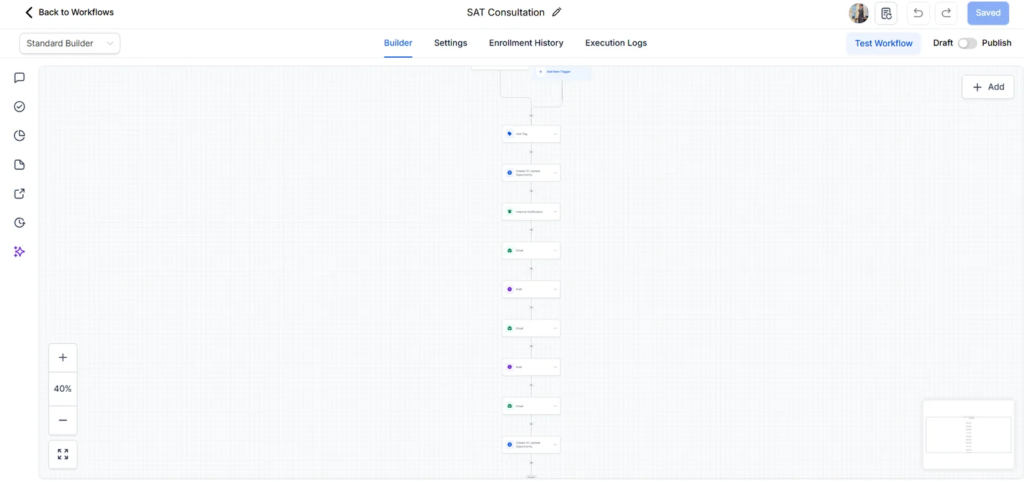
The result was over 1,000 student interactions handled through automated workflows, with a significant reduction in mid-program dropout. The system did not replace the human coaching relationship. Instead, it ensured that no student fell through the gap between sessions without someone (or something) reaching out.
The parallel to fitness studio SMS automation is direct. Consistent, behavior-triggered communication keeps members in their routine and dramatically reduces the drift that leads to cancellation. The channel differs. The outcome is the same.
Talk to our team or get to know us better to map out what an SMS automation system would look like for your specific studio.
The Bottom Line
Empty class spots and lapsing memberships are rarely the result of a bad product. They are almost always the result of a communication gap between the studio and the member at exactly the moment the member needed a nudge to show up.
SMS automation closes that gap. It keeps your studio present in members’ lives between visits, reduces no-shows, fills last-minute spots, and re-engages members who are starting to drift before they reach the point of cancellation.
For fitness studios of any size, from boutique yoga studios to multi-location gym chains, the combination of a 90% open rate and behavioral trigger automation makes SMS the highest-ROI retention tool available.
That is the system we help health and wellness businesses build through our marketing automation service, retargeting campaigns, sales funnels for service businesses, and full-funnel demand generation programs.
Let us build it for your studio.
– Blog written by Sarah Joshi