It is the last working day of the month. Somewhere in a marketing agency, someone is copying numbers out of Google Ads into a spreadsheet.
Then, out of Meta Ads Manager, out of LinkedIn Campaign Manager, out of Google Analytics, and formatting everything into a slide deck. Then checking it all again because the numbers do not match. It is 7 pm.
This is manual reporting. And it is happening at agencies of every size, every month, at high cost.
The time spent pulling, reconciling, and formatting data is time not spent on strategy, optimisation, or client relationships. Furthermore, the data is already stale by the time the report is finished. If a campaign started underperforming on the 15th, the team will not know until the end-of-month review.
Automated performance reporting solves both problems. It eliminates manual labour and delivers real-time visibility at the same time. Here is what it means, what it costs agencies not to have it, and how to build a system that genuinely works.
What Automated Performance Reporting Actually Means
Automated reporting is a system that pulls data from every platform your agency uses, including Google Ads, Meta, LinkedIn, GA4, email tools, and CRMs, and consolidates it into a single dashboard or report. That dashboard updates continuously without any manual input.
Instead of someone spending three hours at month-end extracting and formatting data, the system does it automatically. Reports are generated on a schedule, shared with clients directly, and always reflect current performance rather than data that is days old.
The key distinction from a basic dashboard is that automated reporting also interprets and formats the data into something a client can read and act on. Numbers in a live dashboard are useful internally. A clearly structured, branded report that tells a narrative about campaign performance is what clients actually want to see.
According to Glean’s 2025 agency reporting analysis, the traditional approach of manually extracting metrics from dozens of platforms, reconciling conflicting data points, and building custom presentations consumes resources that could drive strategic innovation. AI and automation now transform raw marketing data into polished, insight-rich reports within minutes rather than days.
The Numbers Behind the Admin Problem
The data on how much time agencies spend on reporting is both consistent and uncomfortable.
According to HubSpot’s 2025 State of Marketing Report cited by BeastMetrics, marketers spend 21% of their workweek on administrative tasks rather than strategic work.
At an average marketing salary of $75 per hour, that translates to approximately 24 hours monthly and $1,800 in wasted labour per team member. That figure does not even account for the opportunity cost of delayed optimisations and missed strategic insights.
Furthermore, DoubleVerify’s 2025 Global Insights Report found that campaign managers spend 26% of their time, over 10 hours per week, on manual work, including reporting and optimisation tasks. For North American agencies, that translates to over $17,000 annually per team member allocated to repetitive tasks.
Additionally, LeadLab Media’s 2024 research cited by Fyr.ai found that automated dashboards saved clients over 30 hours per month on reporting tasks specifically. At agency billing rates, those 30 hours are either recovered as billable time or redirected to work that grows the business.
The financial case is straightforward. Automated reporting is not an operational nicety. It is a direct revenue protection strategy.
What Manual Reporting Is Really Costing Your Agency
The time cost is the visible part. However, the hidden costs of manual reporting are often larger.
Data accuracy risk. Manual data entry across multiple platforms introduces errors at every step. A copy-paste mistake, a mismatched date range, or a forgotten attribution window can make a performing campaign look weak or a failing one look successful.
According to Gartner estimates cited by Fyr.ai, poor data quality costs organisations $12.9 million annually. For an agency, a reporting error that leads to a wrong budget decision or a client dispute is a relationship risk, not just a data problem.
Delayed optimisation. When campaign performance data is only reviewed at month-end, issues go unaddressed for weeks. A Meta campaign that started haemorrhaging budget on the 12th of the month will continue doing so until the end-of-month report reveals it. Real-time automated reporting catches performance drops immediately, allowing the team to act before significant budget is wasted.
Billable hours lost. According to AgencyAnalytics’ 2024 benchmarks report cited by Wayfront, 48% of agencies identify tracking billable hours as their most significant operational pain point. When senior strategists spend hours building reports, those hours cannot be billed.
Moreover, when agencies charge $150 to $224 per hour (the range reported by Promethean Research), the revenue lost to unbillable reporting time adds up quickly.
Client perception of value. A client who receives a manually assembled spreadsheet at month-end has a very different perception of agency value. Compare that to a client with access to a live branded dashboard showing real-time campaign performance. The quality of reporting directly influences client retention, regardless of the actual campaign results.
The Specific Workflows Worth Automating First
Building these automated workflows requires the right infrastructure behind them. Here is a quick look at how we approach marketing automation for agencies and in-house teams.
Not all reporting tasks are equal in time cost or strategic importance. These four are where automation delivers the fastest return.
Cross-platform data consolidation. Pulling data from Google Ads, Meta, LinkedIn, GA4, and any other active channels into one unified view is the single highest-time-cost reporting task for most agencies. Automating this one workflow eliminates the majority of manual reporting hours immediately.
Scheduled client reports. Weekly or monthly reports sent automatically to clients on a fixed schedule, with data refreshed in real time, eliminate the end-of-month scramble. Furthermore, clients who receive consistent, timely reporting are more confident in agency performance regardless of campaign results.
Performance alert triggers. Automated alerts that fire when a campaign drops below a defined ROAS threshold, when spend exceeds a daily cap, or when a key metric changes significantly give the team visibility without requiring someone to check dashboards manually. As a result, the team responds to problems faster and spends less time monitoring.
Budget pacing reports. Tracking spend pacing across all client accounts manually is both time-consuming and error-prone. Automated pacing reports show current spend against the monthly budget for every client in real time. As a result, account managers can spot overspend or underspend instantly without any manual calculation.
Our marketing automation service at Trigacy builds these workflow automations for agencies and in-house marketing teams, connecting data sources, setting alert thresholds, and delivering reports in formats that work for both internal teams and client stakeholders.
What Makes an Automated Report Actually Useful
Automated reporting that produces data without context is not useful. A good automated report has four characteristics.
It tells a story, not just a number. A report that shows “CTR: 2.3%” is less useful than one that shows “CTR increased 0.8% week over week following the creative refresh on the 14th.” Narrative context is what turns data into insight. Modern automated reporting tools, particularly those with AI narrative generation, produce this kind of contextual commentary automatically.
It shows what matters to the client, not what is easy to report. Many agencies report on metrics that are easy to pull rather than metrics that reflect actual business value. Automated reporting is only valuable when the underlying KPIs are aligned with what the client actually cares about: leads generated, cost per acquisition, revenue attributed, and pipeline created.
It is consistent in format and timing. Inconsistent report formats confuse clients and create internal inefficiency when switching between accounts. A standardised reporting template that applies across all clients, with client-specific customisation where needed, makes the agency look more professional and makes internal review faster.
It surfaces anomalies automatically. The most valuable automated reports do not just show what happened. They flag what is unusual. A sudden drop in conversion rate, an unusually high CPC spike, or a platform algorithm change reflected in impressions are all signals that require attention.
Automated anomaly detection ensures nothing important gets missed between reporting periods.
What Most Agencies Get Wrong
Automating the wrong things first. Some agencies automate the vanity metrics (impressions, clicks, follower counts) because they are easy to pull, while continuing to manually compile the metrics that actually drive client decisions (cost per lead, pipeline attributed, ROAS by campaign). The automation should follow the metrics that matter, not the convenient metrics.
No integration between reporting and campaign management. A report that shows performance but does not connect to the workflow for acting on that performance is incomplete. The most effective automated reporting systems are integrated with the campaign management workflow, so a flagged underperformer triggers a review task, not just a data point in a dashboard.
Over-reporting to clients. Some agencies automate daily report delivery to every client. In practice, most clients do not want daily reports. They want the right information at the right frequency. Weekly performance summaries with real-time access for deeper dives typically work better than daily data dumps.
Furthermore, too-frequent reporting can actually undermine confidence by surfacing normal day-to-day fluctuations that look alarming without context.
Not using reporting data to inform strategy. The most underused benefit of automated reporting is the pattern recognition it enables over time.
When three months of automated data show that video ads consistently outperform static across a specific client’s audience, that is a strategic insight that should change the creative briefing process. Agencies that use reporting only for client communication rather than internal strategic learning waste half their value.
42% failure rate from poor integration. According to Improvado’s 2026 guide to report automation, 42% of marketing automation projects fail due to data quality issues and integration challenges. The most common cause is trying to connect too many platforms at once without properly validating data integrity at each stage.
Building incrementally and validating each connection before adding the next one dramatically improves implementation success rates.
How We Manage Reporting Across 1,200+ Client Accounts Without a Room Full of Analysts
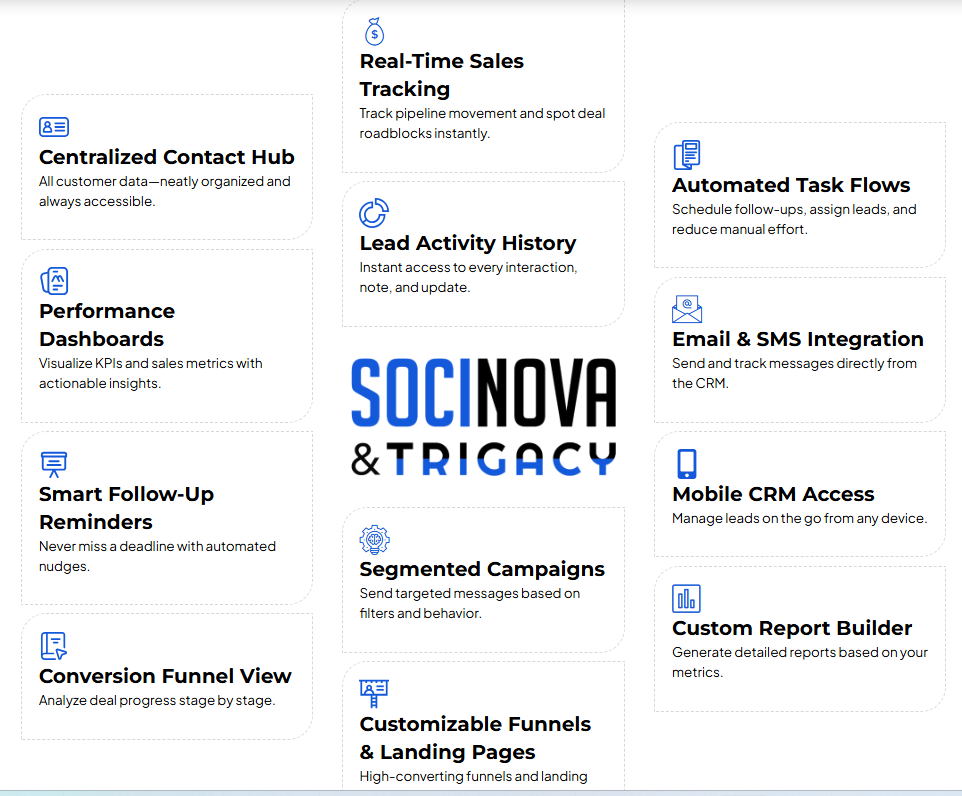
At Socinova and Trigacy, we manage marketing and demand generation for over 1,200 businesses worldwide. The range of client types spans restaurants, SaaS companies, healthcare providers, professional services firms, ecommerce brands, and B2B technology companies.
Each client runs campaigns across multiple platforms. Each client has different KPIs, different reporting cadences, and different levels of data sophistication.
Managing reporting for that volume of clients without automation infrastructure is simply not possible at a quality level that retains clients. Consequently, our reporting workflows are built on automated data consolidation, standardised but customisable report templates, real-time performance alert systems, and scheduled delivery that keeps clients informed without requiring manual assembly at every reporting cycle.
The result is that our account managers spend their time on strategy, optimisation, and client communication rather than data extraction. Clients receive consistent, timely, and clear reporting that reflects genuine campaign performance. Furthermore, our internal teams can identify cross-client performance patterns that inform how we approach campaigns across similar industries and objectives.
This is not a sophisticated technical achievement. It is a systematic one. The tools exist. The discipline of building the right workflow around those tools is what makes the difference.
If you are running an agency and your reporting is still largely manual, the time and revenue cost of that approach is likely higher than you have calculated. Book a conversation with our team or get to know us here, and we will walk you through how we have approached this at scale.
The Bottom Line
Manual reporting is one of the most expensive operational habits a marketing agency can maintain. It costs time, it costs accuracy, it costs billable hours, and it costs the strategic clarity that comes from real-time visibility into campaign performance.
Automated performance reporting addresses all of these simultaneously. It frees teams to focus on work that grows the business, delivers better client experiences through consistent and timely data, and creates the internal intelligence that improves campaign performance over time.
For agencies at any stage, from boutique independents to multi-client groups, the question is not whether to automate reporting. The question is how quickly you can implement it without disrupting existing client relationships.
That is exactly the kind of operational infrastructure we help agencies and in-house marketing teams build through our marketing automation service, demand generation programs, fractional CMO engagements, and full-funnel reporting and optimisation systems.
Let us talk about what this looks like for your agency.
– Blog written by Sarah Joshi