Most SaaS sales teams have a LinkedIn problem they do not talk about openly.
It is not that LinkedIn does not work. It clearly does. It is that the way they are using it does not scale. One rep, sending connection requests one by one, following up manually, losing track of conversations in a cluttered inbox. It works just well enough to keep doing it. But it never grows into something the company can actually rely on.
That is the trap.
The moment that rep gets pulled into a big deal, or takes a week off, or moves to a different role — the pipeline they were building manually disappears with them. There is no system. There is just a person doing a thing.
Automated LinkedIn prospecting is what you build when you are ready to stop depending on a person and start depending on a process. And for SaaS companies that need a consistent, qualified pipeline month after month, that shift changes everything.
Here is how it works, what most companies get wrong when they try it, and what it actually looks like when it is done right.
The Problem Every SaaS Company Knows Too Well
Your sales team is talented. Your product is strong. However, the pipeline is inconsistent.
Some months are great. Deals are closing, demos are booked, and the team is energized. Then the next month arrives, and the calendar is half empty. Nobody knows exactly why. The product did not change. The pricing did not change. But somehow the flow of qualified leads dried up.
This is the feast-and-famine cycle that kills SaaS growth. And in most cases, it comes down to one thing: prospecting is being done manually, reactively, and inconsistently.
Manual LinkedIn outreach is time-consuming. A sales rep spending two to three hours a day on LinkedIn is doing well by most standards. But that still only produces a limited number of connection requests, follow-ups, and conversations per week. When a deal closes, and the rep shifts focus to onboarding, prospecting stops entirely. Pipeline dries up. And three months later, the team is scrambling again.
Furthermore, manual prospecting does not scale. You can hire more reps, but that increases your cost per lead significantly before you even know if the channel works for your specific ICP.
Automated LinkedIn prospecting solves this problem at its root.
What Automated LinkedIn Prospecting Actually Means
First, let us be clear about what this is and what it is not.
Automated LinkedIn prospecting is not spam. It is not blasting generic connection requests to thousands of people with a pitch in the first message. That approach does not work, it damages your brand, and it risks getting your LinkedIn account restricted.
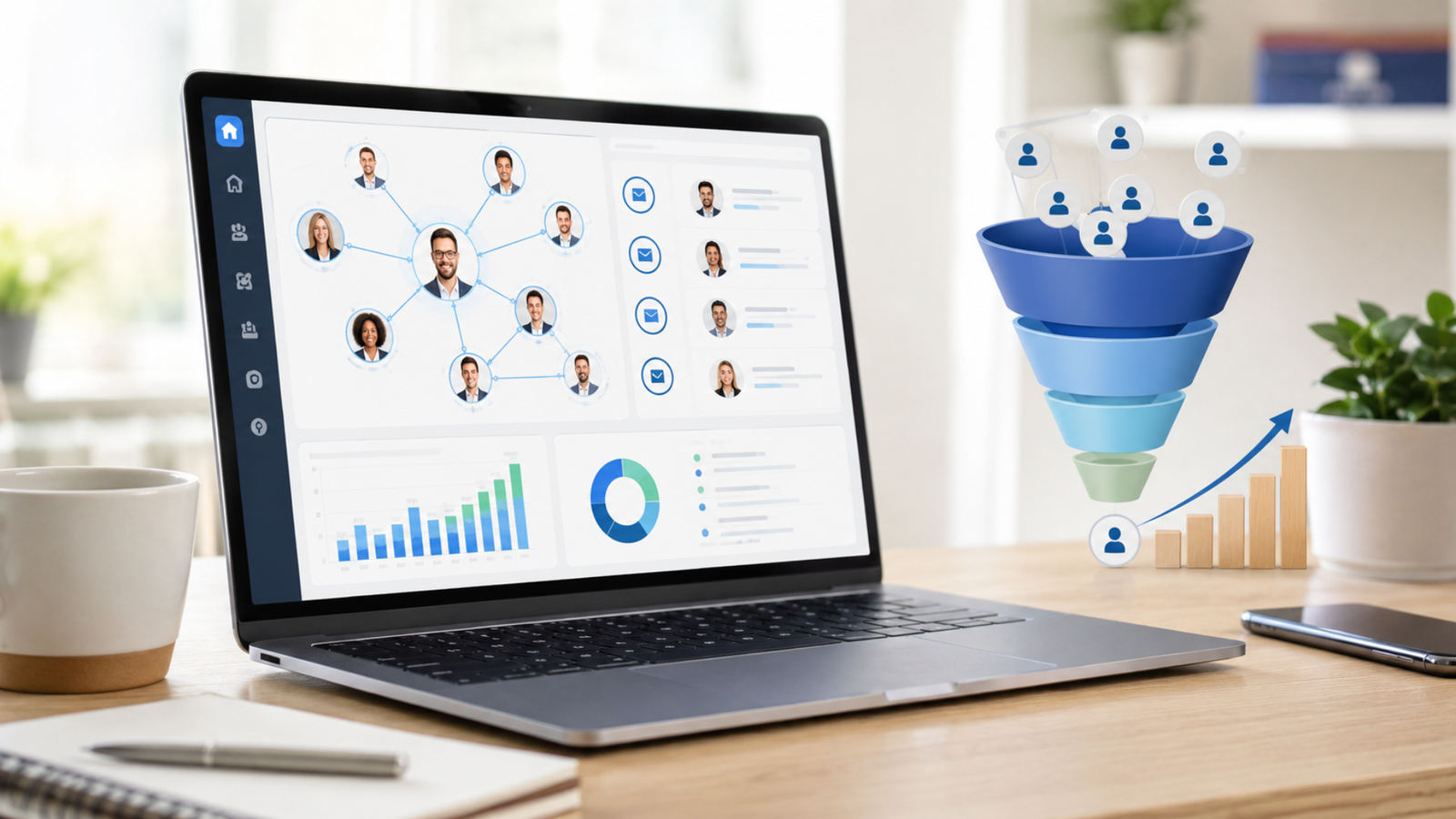
What it actually means is using a systematic, tool-assisted workflow to:
- Identify your ideal customer profile (ICP) at scale using LinkedIn’s search and filter tools
- Send personalized connection requests to the right people
- Follow up with a pre-planned message sequence once they connect
- Qualify responses and route warm leads to your sales team
- Track every touchpoint so you know what is working
In other words, automation handles the volume and consistency. Your sales team handles the conversations that actually matter.
This is exactly the kind of demand generation system we build for B2B and SaaS clients at Trigacy. The goal is to make sure your pipeline never dries up, regardless of what else is happening in the business.
The Numbers That Make LinkedIn Impossible to Ignore for SaaS
Before getting into the how, it helps to understand why LinkedIn specifically is the right channel for SaaS B2B prospecting.
According to LinkedIn’s own data, 4 out of 5 LinkedIn members drive business decisions at their companies. That is 800 million people, the majority of whom are in roles where they can buy, recommend, or influence software purchasing decisions.
Moreover, LinkedIn generates 3x more B2B leads than Facebook or Twitter, according to LinkedIn’s own marketing research. For SaaS companies selling to mid-market or enterprise buyers, there is simply no other social platform where your target audience is as concentrated and as professionally reachable.
Additionally, a report by HubSpot found that LinkedIn is the most effective social media platform for B2B lead generation, with a visitor-to-lead conversion rate nearly 3x higher than Twitter or Facebook.
The channel works. The question is whether your prospecting process on it works.
What Most SaaS Companies Get Wrong with LinkedIn Prospecting
We work with B2B and SaaS brands through our demand generation services at Trigacy, and the same mistakes come up again and again.
The ICP is too broad. “Tech companies with 50 to 500 employees” is not an ICP. It is a category. Your ideal customer has a specific title, a specific pain point, a specific stage of growth, and a specific budget. Without that precision, you are sending the right message to the wrong people.
The connection request has a pitch in it. This is the single fastest way to get ignored. People on LinkedIn are not scrolling their feed looking for vendors. A connection request with a pitch in it signals immediately that you are not interested in a relationship. You are interested in a transaction. Delete it.
There is no follow-up sequence. Someone accepts your connection request. You send one message. They do not reply. You move on. That is a missed opportunity. Research consistently shows that most B2B conversions happen after 5 or more touchpoints. One message and done is not a strategy.
The messaging is about you, not them. “We help SaaS companies grow faster with our AI-powered platform,” tells the prospect, but that’s nothing useful. It does not speak to their specific problem. It does not show that you understand their world. As a result, it gets ignored.
There is no system to handle replies. Automated outreach without a reply management process creates chaos. Leads come in, and nobody picks them up fast enough. Warm prospects go cold because response time is too slow. Research by InfluxMD showed that leads contacted within 5 minutes are 10 times more likely to convert. That applies across B2B, not just healthcare.
How Automated LinkedIn Prospecting Works in Practice
Here is the step-by-step framework we use when building LinkedIn prospecting systems for SaaS clients.
Step 1: Define the ICP with surgical precision
Before touching any tool, you need absolute clarity on who you are targeting. For a SaaS company, this typically means:
- Job title (e.g., VP of Operations, Head of Revenue, CTO)
- Company size (e.g., Series A to Series C, 50 to 300 employees)
- Industry vertical (e.g., fintech, healthtech, logistics SaaS)
- Geography
- Signals of buying intent (recently hired in a relevant role, raised funding, expanded headcount)
The tighter the ICP, the higher the conversion rate on every subsequent step. This is not optional. It is the foundation on which everything else is built.
Step 2: Build a targeted prospect list
Using LinkedIn Sales Navigator combined with other B2B data enrichment tools, you build a list of prospects that match your ICP exactly. This list gets validated and cleaned before a single message goes out.
At Trigacy, our B2B outreach service handles this entire list-building and validation process. We do not just pull names. We verify that contact data is accurate and that each prospect genuinely fits the profile before they enter any sequence.
Step 3: Write a connection request that actually works
A great LinkedIn connection request does three things:
- References something specific about the prospect (their company, their role, a post they wrote)
- State clearly but briefly why you are reaching out
- Asks for nothing
That last point is critical. The connection request is not the place to pitch. Its only job is to get accepted. Keep it under 300 characters. Make it feel human.
Step 4: Deploy a message sequence
Once the connection is accepted, a pre-planned sequence of 3 to 5 messages runs over the following 2 to 3 weeks. Each message:
- Builds on the previous one
- Adds value (a relevant insight, a case study, a question about their current challenge)
- Has a soft CTA (a question, not a meeting request)
- Gets progressively more direct as the sequence progresses
The final message in the sequence is always a clear, low-friction ask. “Would a 20-minute call be worth your time?” Not a demo request. Not a proposal. Just a conversation.
Step 5: Route warm leads to your sales team immediately
When a prospect replies positively, they need to hear back within minutes, not hours. This is where marketing automation plays a critical role. Replies trigger instant notifications. The sales rep picks up the conversation from there and books the meeting.
Step 6: Retarget non-responders across other channels
Not everyone will reply on LinkedIn. Some prospects need to see you in multiple places before they engage. That is why retargeting campaigns on LinkedIn Ads, Google Display, and Meta run in parallel with the outreach sequences. By the time a prospect gets on a call, they have already seen your brand multiple times. That familiarity dramatically shortens the sales cycle.
Why LinkedIn Prospecting Compounds Over Time for SaaS
Here is something most growth teams underestimate. LinkedIn prospecting is not just a lead generation tactic. When done consistently, it becomes a brand-building engine.
Think about it. Every connection you make is a permanent follower of your profile and your company page. Every message you send is a touchpoint in someone’s memory. Every piece of content your team posts reaches those connections organically.
So after 6 months of consistent prospecting, you have not just generated leads. You have built a network of hundreds of qualified decision-makers who know your brand, recognize your name, and are far more likely to respond when you reach out again or when a colleague asks for a recommendation.
This is compounding. And it is one of the most undervalued advantages of LinkedIn as a channel for SaaS growth.
Moreover, as your network grows, your content gets more reach. More reach means more inbound interest. More inbound interest means lower cost per lead over time. The economics get better every month you stay consistent.
Our full-funnel approach at Trigacy is built on exactly this principle. We do not run one-off campaigns. We build systems that compound.
The Tools That Power Automated LinkedIn Prospecting
You do not need dozens of tools to make this work. You need the right ones, configured correctly.
LinkedIn Sales Navigator is the starting point. It gives you advanced search filters, lead recommendations, and CRM integrations that the free version simply cannot match. For any serious SaaS B2B prospecting effort, it is a non-negotiable investment.
Outreach automation tools (such as Lemlist, Expandi, or Dripify) handle the connection request and message sequence delivery. These tools let you personalize at scale using dynamic fields that pull in the prospect’s name, company, and role automatically.
CRM integration ensures every lead and every conversation is tracked in one place. Whether you use HubSpot, Salesforce, or a lighter-weight CRM, the integration means no lead falls through the cracks.
Email outreach in parallel dramatically improves response rates. A prospect who sees your LinkedIn message and then receives a follow-up email from the same person on the same day converts at a significantly higher rate than one who only saw one channel. Our B2B email outreach service is built to run in tandem with LinkedIn for exactly this reason.
Analytics and reporting close the loop. Which messages are getting the highest reply rates? Which job titles are responding? Which industries are converting? Without this data, you are guessing. With it, you are optimizing.
What About LinkedIn’s Terms of Service?
This is a legitimate concern and one we take seriously.
LinkedIn does restrict certain types of automated activity. Sending hundreds of connection requests per day, using tools that scrape data aggressively, or running sequences that feel robotic will get your account flagged or restricted.
The way to stay compliant is to:
- Keep daily connection request volumes within LinkedIn’s recommended limits (generally under 20 to 25 per day for standard accounts, slightly higher for Sales Navigator)
- Use tools that operate within LinkedIn’s API guidelines
- Ensure every message feels personal and adds genuine value
- Never buy scraped contact lists or use data that was obtained without consent
Done correctly, automated LinkedIn prospecting is entirely within the boundaries of LinkedIn’s terms. The key distinction is between automation that assists human outreach and automation that replaces human judgment entirely.
We navigate this on behalf of our clients every day. You can read more about how we approach compliant B2B outreach at Trigacy.
A Real Scenario: What This Looks Like for a SaaS Company
Let us say you run a B2B SaaS platform in the project management or workflow automation space. You are targeting Operations Directors and VPs of Engineering at companies with 100 to 500 employees across the US and UK. Your current pipeline is inconsistent, and your sales team is spending too much time on prospecting instead of closing.
Here is what a 90-day Automated LinkedIn prospecting program looks like for you.
Month one: We define your ICP, build your initial list of 1,500 qualified prospects using Sales Navigator, write 3 versions of your connection request and 5-message follow-up sequence, set up your automation tool, integrate with your CRM, and launch.
Month two: The first responses start coming in. We analyze reply rates across the 3 message versions, identify the winning angle, and double down on it. We also identify the 2 to 3 job titles that are converting best and tighten the targeting around them. Retargeting campaigns launch to reinforce your brand with non-responders.
Month three: You have a consistent flow of 8 to 15 qualified conversations per month. Some have booked demos. Some are in evaluation. Your sales team is spending their time on warm leads instead of cold outreach. Pipeline is predictable for the first time.

This is not a hypothetical. It reflects the kind of results we have driven for B2B clients through our demand generation programs. Our GTO Aluminum campaign generated a pipeline of over USD $400,000 within the first 60 days using a combination of outreach, sales funnels, and targeted campaigns.
If you want to see what a tailored LinkedIn prospecting system would look like for your SaaS company, book a consultation with our team or get to know more about us here.
We do not pitch generic packages. We map out your specific ICP, your competitive landscape, and the exact messaging angles most likely to resonate with your buyers.
The Bottom Line for SaaS Companies
Automated LinkedIn prospecting is not a silver bullet. It is a system. And like any system, it only produces results when it is built correctly, run consistently, and optimized based on real data.
When those conditions are met, it becomes one of the most cost-effective B2B pipeline channels available. You are reaching decision-makers directly, in a professional context, with personalized messaging, at a scale that no manual effort can match.
The SaaS companies that will own their market categories over the next three to five years are the ones building these systems now. Not experimenting with them. Actually building them, running them, and letting the compounding do its work.
That is what we help you do.
Our B2B email and LinkedIn outreach services, full-funnel demand generation programs, marketing automation systems, and sales funnel buildouts are all designed to work together toward one outcome: a predictable, scalable B2B pipeline that does not depend on any one person’s effort to keep running.
If that is what your SaaS company needs right now, let us talk.
– Blog written by Sarah Joshi