Someone downloads a coaching guide. They read it carefully, reply to the welcome email with a question, and show genuine interest. Then three weeks pass. The coach sends a follow-up. No response. Another week passes. Still nothing.
The lead, who was actively interested three weeks ago, has moved on. Not because they lost interest in coaching. Because nothing kept that interest alive while they were busy.
This is the coaching lead problem. The gap between someone expressing interest and someone booking a consultation is rarely filled by a single email. It requires multiple touchpoints over weeks or months, timed to build trust progressively rather than ask for commitment before it has been earned.
Most coaches do not have a system for this. They send a welcome email, follow up once or twice manually, and then let the lead go cold. Automated email nurturing changes this by running the entire relationship-building process in the background, consistently, for every lead, without the coach needing to track or initiate anything manually.
Here is what the data shows about how leads convert in coaching, what an effective nurture sequence looks like, and how automation makes it scalable for solo coaches and small coaching practices alike.
Why Coaching Leads Need Longer Nurturing Than Most Categories
Coaching is a deeply personal decision. A prospect is not just evaluating a service. They are deciding whether to trust someone with their goals, their challenges, and in many cases their self-perception. That decision rarely happens quickly.
According to Statista research cited by GrowthList, 63% of leads take more than three months to convert. In coaching specifically, this timeline is often longer because the commitment is both financial and emotional. A prospect who downloaded a guide on business growth coaching may not be ready to invest in a coaching program for six months.
However, they will likely buy from the coach who has stayed present and relevant throughout that consideration period.
Furthermore, research by Marketo and Forrester cited by LeadsuiteNow confirms that 50% of leads are qualified but not yet ready to purchase at the time of initial contact. These are not bad leads. They simply need time and the right sequence of touches to move from interested to ready. A coach without an automated nurture system loses these prospects to competitors who do have one.
The Numbers Behind Email Nurturing
The case for automated email nurturing is one of the most data-supported arguments in marketing.
According to Sender.net’s 2025 lead nurturing statistics, lead nurturing emails get up to 10 times the response rate compared to standalone email blasts. Furthermore, automated emails drove 37% of all email-generated sales in 2024, despite accounting for just 2% of total email volume. That ratio reflects the outsized efficiency of a well-timed, behaviorally triggered sequence versus a broadcast campaign.
The Digital Bloom’s 2026 B2B nurturing research adds further weight. Companies that excel at lead nurturing generate 50% more sales-ready leads at 33% lower cost per acquisition. Nurtured leads make 47% larger purchases than non-nurtured prospects and convert 23% faster. Additionally, automated nurturing emails generate 320% more revenue than manual campaigns.
For coaches specifically, Mailsoftly’s 2026 email marketing for coaches guide identifies a critical truth: the first five emails a subscriber receives determine whether they become a client or unsubscribe. Most coaches skip structured welcome sequences entirely, dropping new leads into a general newsletter instead. That is the moment the nurture opportunity is lost.
A purpose-built welcome sequence establishes authority, builds rapport, and moves the reader toward a discovery call before the initial interest fades.
What an Automated Coaching Nurture Sequence Actually Looks Like
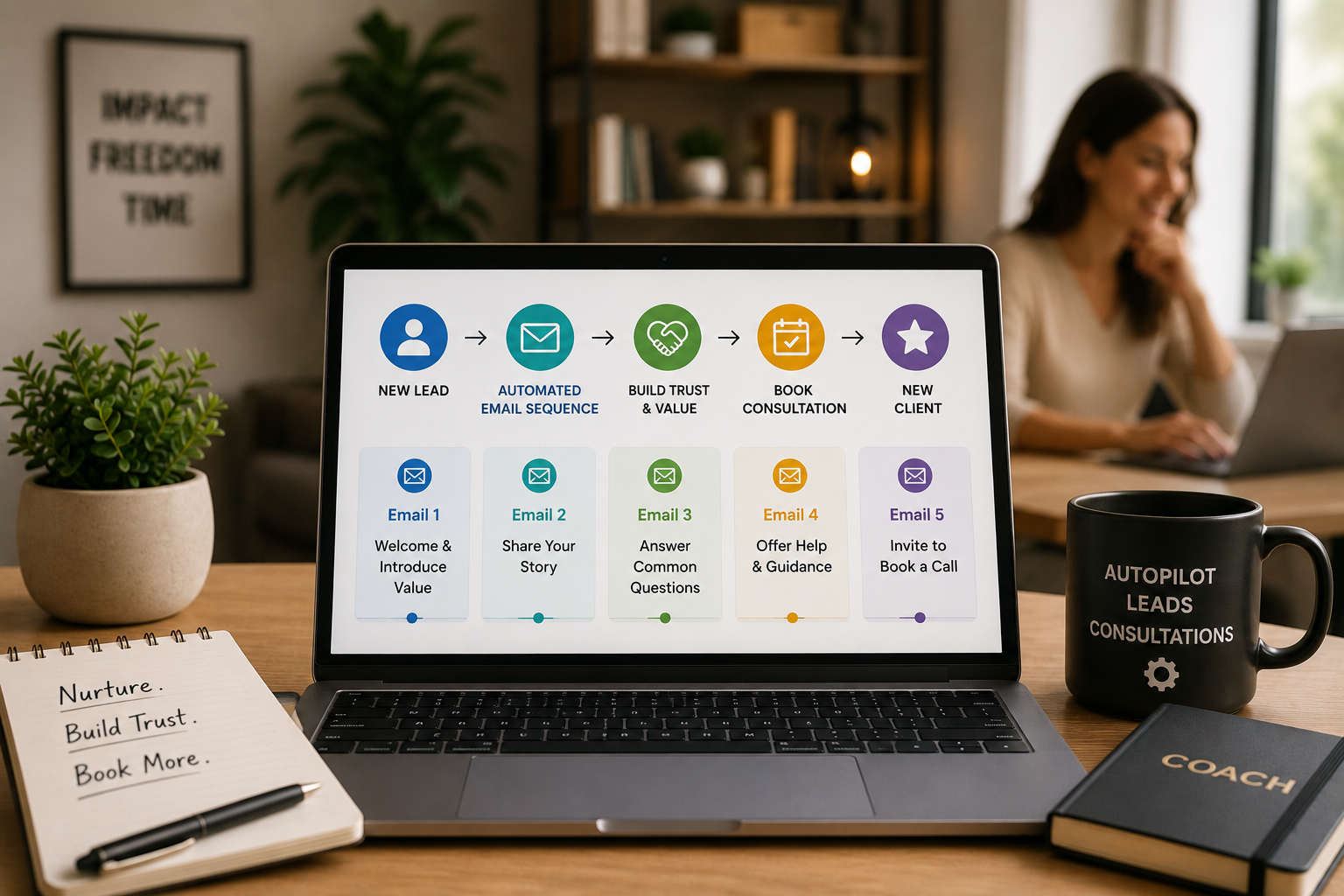
An effective coaching email nurture sequence is not a series of promotional messages. It is a structured relationship-building journey that mirrors the natural progression from interest to trust to action.
A well-built coaching sequence typically runs across six to twelve emails over three to six weeks, according to LeadsuiteNow’s 2026 email automation guide. Each email serves a specific purpose in the sequence. Together, they move the prospect from curious to confident.
The Email-by-Email Breakdown
Email 1: The welcome and proof of value. This email arrives immediately after the lead downloads a resource or subscribes. It delivers the promised content, introduces the coach’s story and philosophy briefly, and sets expectations for what the prospect will receive. Selling is not the priority here. Confirming that subscribing was a good decision is.
Emails 2 and 3: Problem-aware content. These emails address the specific challenge the prospect is trying to solve. They demonstrate that the coach understands the problem at a deep level. Content that reflects the reader’s internal experience builds the emotional resonance that makes a prospect feel genuinely understood. Consequently, the trust that converts to a consultation booking begins here.
Emails 4 and 5: Social proof and outcome stories. Client case studies, testimonials, and transformation stories answer the prospect’s underlying question: has this worked for people like me? Specificity matters here. A story about a business coach who helped a 38-year-old operations manager double her team’s revenue in six months is far more compelling than a general testimonial.
Emails 6 and 7: Addressing objections. Most prospects do not book a consultation because of unresolved objections. Cost, time commitment, uncertainty about results, and concern about fit are the most common barriers. Emails that address these explicitly, in a calm and honest tone, remove the friction that keeps interested prospects from taking action.
Moreover, addressing objections proactively demonstrates the coach’s confidence in their offering.
The consultation invitation. The final email in the core sequence extends a direct, low-friction invitation to book a discovery or strategy call. The framing matters. “Book a free discovery call” outperforms “Schedule a consultation” because it positions the call as a service to the prospect, not a sales conversation.
Our marketing automation service at Trigacy builds these sequences with behaviorally triggered branching, so prospects who engage with specific content receive follow-ups relevant to what they showed interest in, rather than a one-size-fits-all sequence.
Behavioral Triggers That Make Nurturing More Effective
A static sequence that sends the same emails to every lead at the same intervals performs significantly below a sequence that responds to what the lead actually does.
Behavioral triggers allow the sequence to adapt in real time. Someone who opens the third email but does not click the case study link receives a follow-up that resends the case study in a different format. Those who click the consultation booking link but do not complete the booking receive a specific re-engagement email with a simpler booking path.
Contacts who go quiet for 14 days enter a re-engagement sequence with a different subject line approach.
According to The Digital Bloom’s research, companies using behavioral trigger automation report revenue performance 10 times higher than broadcast email campaigns, with engagement rates reaching 42.36% open rates on triggered sequences.
Additionally, retargeting campaigns at Trigacy can run in parallel with the email sequence, serving paid ads to leads who have gone quiet on email, maintaining brand presence across the consideration period through multiple channels simultaneously.
What Most Coaches Get Wrong
Inconsistent follow-up is the single biggest reason coaching leads go cold. Here is why ownership of the follow-up process matters more than most coaches realise.
Sending newsletters instead of sequences. A general newsletter treats every subscriber identically. A lead who downloaded a guide yesterday gets the same email as someone who has been reading for three months. Sequences that reflect the prospect’s stage produce dramatically better conversion rates than broadcast newsletters.
Asking for the consultation too early. Many coaches send a “book a call” email within the first two or three days of someone subscribing. The prospect has not yet had enough exposure to the coach’s thinking, approach, or results to feel confident making that commitment.
Asking too early produces low conversion rates and occasionally a quick unsubscribe. The consultation invitation earns a higher conversion rate when it comes after the prospect has already experienced several valuable emails.
Not segmenting by lead source. A prospect who downloaded a guide on leadership coaching needs a different sequence from one who attended a webinar on scaling a service business. These two prospects have demonstrated different interests and are at different awareness levels.
Generic sequences that ignore this produce mediocre results. Segmented sequences that reflect the lead’s specific interest consistently outperform them.
No re-engagement sequence for cold subscribers. Leads who stop opening emails are not necessarily lost. They may have become busy, distracted, or overwhelmed. A three-email re-engagement sequence with a different subject line approach and a clear offer often reactivates 10 to 15% of cold subscribers. Without this sequence, those leads simply churn from the list without ever getting a genuine second chance.
Measuring opens instead of bookings. Open rate is a useful signal but not the destination. Consultation bookings are. Many coaches celebrate strong open rates while conversion to bookings remains low. Tracking the sequence specifically on consultation booking rate keeps optimisation focused on the outcome that actually generates revenue.
How a Structured Nurture Sequence Generated 30 Positive Replies and 10 Consultations in the First Month
Ennoble, a B2B consulting firm, faced the same cold-lead challenge that coaches deal with daily. A large volume of cold outreach was generating initial interest but failing to convert that interest into booked meetings. Prospects would respond positively once and then go quiet. The follow-up process was inconsistent. Warm leads were falling through the gaps.
We rebuilt the approach around a structured nurture sequence rather than ad hoc follow-up. Each touchpoint was designed to move the prospect a step closer to a meeting rather than simply ask for one. The sequence delivered relevant content at defined intervals.
Behaviorally triggered follow-ups responded to what each prospect actually engaged with. The language at each stage reflected the typical objections and considerations a prospect in their position would have.
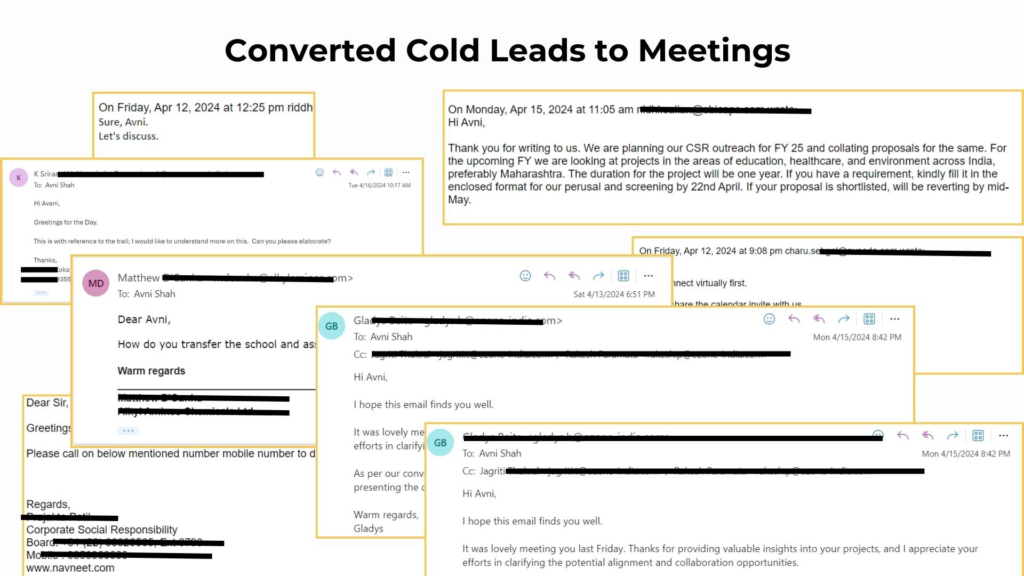
The result was 30 or more positive replies and 10 qualified consultation meetings booked within the first month. The improvement came not from generating more leads but from converting a higher percentage of the existing ones through a consistent, structured nurture process.
For coaches, the parallel is exact. A structured automated sequence that delivers value, builds trust, and invites a consultation at the right moment will consistently outperform sporadic manual follow-ups. The leads are already there. The system determines how many of them convert.
Book a call with our team to discuss how an automated nurture sequence would work for your specific coaching practice.
The Bottom Line
A cold lead is not a lost lead. Most coaching prospects need weeks or months of consistent, relevant contact before they feel ready to invest. Automated email nurturing provides that contact without requiring the coach to manually track, write, and send every follow-up.
The sequence runs while the coach is delivering sessions. Trust builds while the coach is creating content. Objections get handled while the coach is on a discovery call with someone else. Furthermore, all of this happens consistently for every lead, from first contact to consultation booking, without anything falling through the gap.
For coaches at any stage, from solo practitioners to small group practices, this is the infrastructure that turns lead generation into a predictable consultation pipeline.
That is what we help coaching and consulting businesses build through our marketing automation service, email outreach, sales funnels, retargeting campaigns, and full-funnel demand generation programs.
Let us build yours.
– Blog written by Sarah Joshi