A dental clinic with five years of experience, a team of specialists, and an impeccable clinical record sits at position seven in the Google Maps local pack. Three positions above it is a clinic that opened eighteen months ago with half the qualifications. The difference is not the quality of care. It is the number of Google reviews.
This is the reality most dentists find uncomfortable. Google’s local search algorithm does not evaluate clinical skill, years of experience, or patient outcomes. As Decisions in Dentistry’s 2025 analysis confirms, Google counts stars and reviews to determine which practices patients see first. A newer practice with 500 positive reviews will consistently appear above a decades-old practice with superior clinical outcomes but only 50 reviews.
That gap is not fixed by better dentistry. It is fixed by a better review generation system. Here is what the data shows about how reviews drive local rankings, why satisfied patients rarely leave them without a prompt, and how automation closes that gap consistently.
How Google Actually Ranks Dental Clinics in Local Search
Google’s local pack, the three business listings that appear at the top of a local search result, captures the majority of all patient clicks. According to RevUp Dental’s local SEO analysis, the top three spots in Google Maps capture over 70% of all clicks. A clinic outside those three positions is functionally invisible to most patients searching for a dentist in their area.
Three factors determine who appears in those top three positions: relevance, distance, and prominence. Relevance and distance are largely outside a clinic’s control. However, prominence is directly influenced by review quantity, review recency, and overall star rating. These are all things a clinic can actively build.
According to Authority Specialist’s 2026 benchmark data, review quantity and recency carry measurable weight in both map pack rankings and patient click-through decisions. Practices need 100 to 200 or more reviews to stand out. Additionally, stale review profiles with no new reviews in 30 or more days see declining visibility.
Furthermore, each star matters commercially. According to US Tech Automations’ dental review automation report, each additional Google star rating correlates with a 5 to 9% increase in new patient inquiries. A clinic moving from a 3.8 to a 4.7 rating is not just improving its reputation. It is directly increasing the volume of patients who contact it.
The Review Gap Most Dental Clinics Do Not Measure
Posting content and building trust are not the same thing. Here is why Google reviews are one of the most powerful trust signals a dental clinic can build.
Dental clinics generally provide excellent care. Patients generally leave satisfied. However, most of those satisfied patients never leave a review.
According to BirdEye’s healthcare review data cited by US Tech Automations, only 7% of satisfied dental patients leave a review without being asked. Furthermore, the gap between patient satisfaction and review action is entirely a process problem, not a care quality problem. Patients who would enthusiastically recommend their dentist to a friend simply do not think to leave a Google review unless something prompts them.
The impact of this gap is measurable. Practices with 50 or more Google reviews and a 4.7 or higher rating see 42% higher new patient volume than comparable practices with fewer than 20 reviews. That is a 42% difference in patient acquisition driven not by clinical quality but by a systematic process for asking satisfied patients to share their experience.
Additionally, 77% of new dental patients check online reviews before choosing a provider, according to BrightLocal’s 2025 Healthcare Consumer Survey. Moreover, 84% of patients trust online reviews as much as personal referrals when choosing a dentist. The review profile is not a supplementary marketing asset. It is the primary trust signal most new patients consult before making first contact.
What Google Review Automation Actually Does
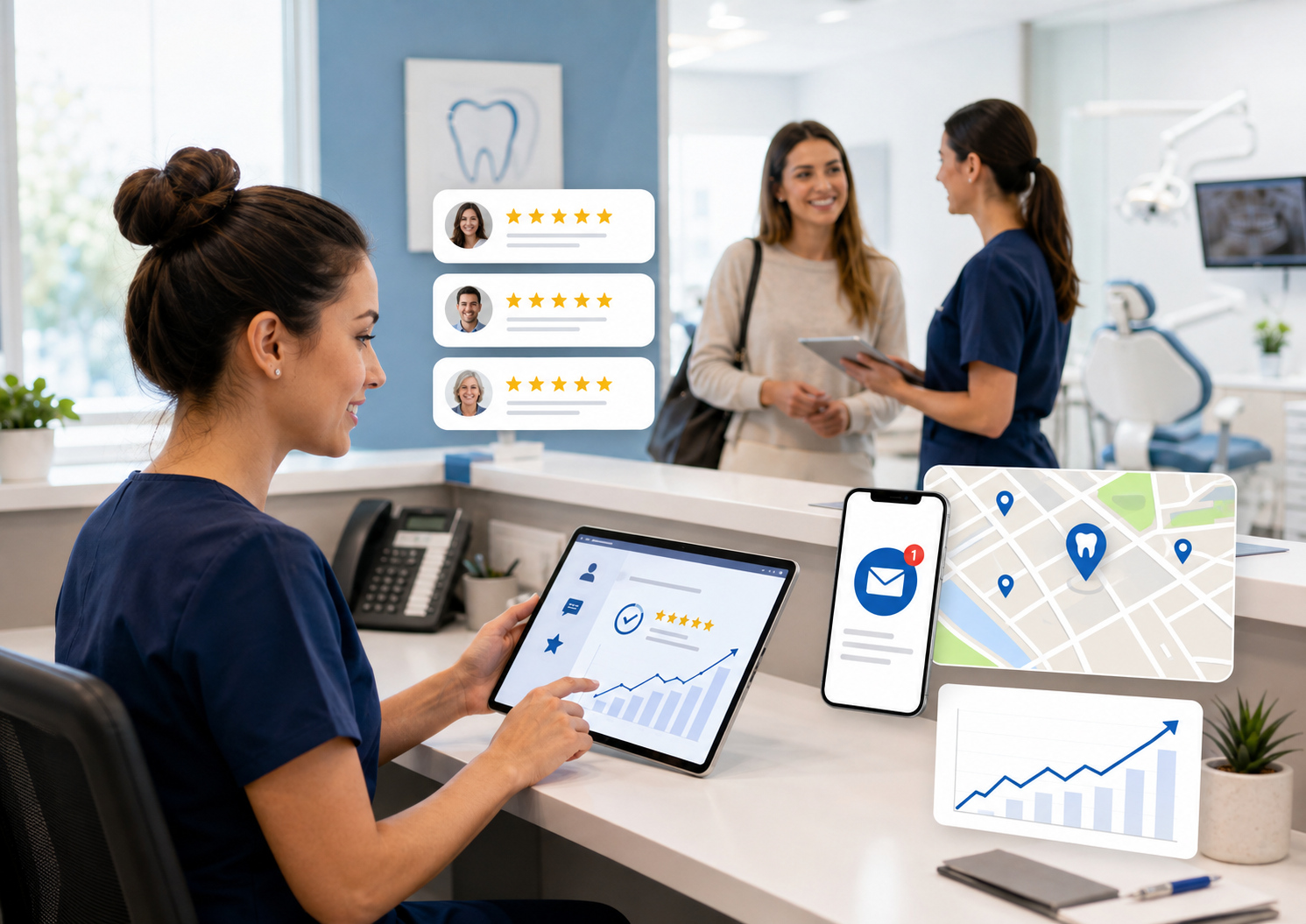
Review automation is a system that requests reviews from patients automatically after their appointment, without any staff member needing to remember to ask. The trigger fires based on a completed appointment record, and the request reaches the patient at the optimal moment: while the experience is still fresh and the emotional response to good care is highest.
The performance difference between automated and manual review requests is significant. According to PatientPop’s 2025 healthcare reputation management report, dental practices using automated review requests generate 3.2 to 5.1 times more Google reviews per month than those relying on verbal ask-at-checkout methods.
The multiplication effect is straightforward. A verbal ask at checkout depends on the staff member remembering, the patient not being in a hurry, and the interaction feeling natural. Automated requests reach every patient, consistently, through the channel they check most. SMS and email requests that arrive within hours of the appointment produce dramatically higher response rates than verbal requests that patients forget by the time they reach their car.
Our marketing automation service at Trigacy builds these post-appointment review request workflows for dental and healthcare practices, connecting the trigger to the practice’s appointment management system so every completed appointment generates an automatic request without any manual input from the front desk.
The Automation Workflow That Builds Review Volume Consistently
A well-built dental review automation workflow has four stages that work in sequence.
Stage 1: Appointment completion trigger. When a patient’s appointment is marked complete in the practice management system, the automation fires. The timing is deliberate. A request sent within two to four hours of the appointment reaches the patient while the experience is positive and memorable. Requests sent the following day or week produce meaningfully lower conversion rates.
Stage 2: Personalised SMS or email request. The request goes out via SMS for patients who have provided a mobile number, and via email otherwise. The message references the patient by name, acknowledges the specific type of appointment they attended, and includes a direct link to the practice’s Google review page.
Direct links are essential. A request that asks patients to search for the practice and navigate to the review section loses a significant percentage of willing reviewers at each step.
Stage 3: Sentiment check before public routing. The strongest automated systems include a brief satisfaction question before routing the patient to Google. A patient who indicates a positive experience gets the direct Google review link. A patient who indicates dissatisfaction gets routed to a private feedback form instead, allowing the practice to resolve the issue before it becomes a public one-star review.
This two-step approach protects the rating while increasing the volume of positive reviews reaching Google.
Stage 4: One follow-up for non-responders. Patients who do not respond to the initial request receive a single follow-up message after three to five days. A second follow-up recovers a meaningful percentage of reviews from patients who saw the first message but did not act on it. A third follow-up crosses into territory that patients find intrusive. One follow-up is the right balance.
What Most Dental Clinics Get Wrong
Relying on verbal requests at checkout. Front desk staff are managing multiple tasks simultaneously at checkout. Even with the best intentions, verbal review requests are inconsistent. Some patients get asked. Many do not. Automation solves this with zero additional staff workload.
Not providing a direct link. A review request that says “please leave us a Google review” without a direct link loses most of its potential responses. The friction of finding the practice on Google, navigating to the review section, and writing a review is enough to stop the majority of willing reviewers. Every request must include a tap-to-review link that takes the patient directly to the review form.
Review gating. Some automation tools claim to filter negative experiences before routing patients to Google. This practice, known as review gating, violates Google’s review policies. Practices that use it risk having their Google Business Profile penalised. The correct approach is the sentiment check described above, which routes dissatisfied patients to a private channel, not a system that prevents them from leaving any review.
No response strategy for existing reviews. According to Patient NEWS’ dental review analysis, Google’s algorithm favours businesses that engage with reviews. Responding to both positive and negative reviews within 24 to 72 hours signals active management of the profile and contributes to local search ranking improvement. Review automation handles the collection. A response strategy must handle the engagement.
Stopping after an initial burst. Many practices run a review campaign, collect 30 or 40 reviews quickly, and then let the system lapse. Google weights recency alongside volume. A profile with 150 reviews and no new ones in 60 days loses ground to a profile with 80 reviews that receives 5 to 10 new ones each month. Ongoing automation is more valuable than a one-time push.
How Systematic Trust Building Generated 25 Qualified Healthcare Leads Per Month
CGA Weight Loss operates in a healthcare category where trust is the primary driver of the patient’s decision to make first contact. Weight loss surgery is a high-stakes, emotionally significant decision. Patients research extensively, compare providers carefully, and choose the practice that feels most credible and trustworthy before they ever speak to a member of the team.
The challenge was generating a consistent flow of qualified enquiries from patients who were genuinely ready to take the next step. Broad campaigns that reached the wrong audience produced volume without quality. The acquisition system needed to reach the right people with messages that built enough trust to prompt a consultation request.
We built a targeted campaign system that combined audience precision with automated follow-up sequences. Every inbound enquiry received an immediate personalised response. Follow-up sequences continued building the relationship through relevant information until the patient was ready to book. The system ensured that no warm lead went cold from slow response.
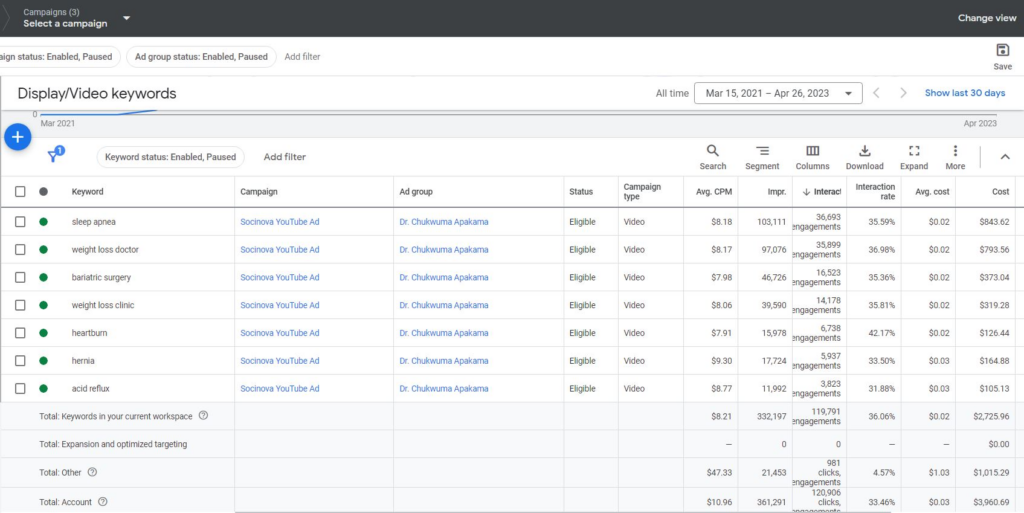
The result was 25 or more qualified leads per month at a consistently lower cost per acquisition. The trust-building system was the common thread. Patients who reached the booking stage had already been exposed to enough credibility signals to feel confident in their decision.
The principle maps directly to dental review automation. Google reviews are the primary trust signal a prospective patient encounters before making first contact. A system that consistently generates them is a system that consistently builds the credibility that converts searchers into new patients.
Book a call with our team to discuss how a Google review automation system would work for your specific practice.
The Bottom Line
Google’s local search algorithm does not know how good your dentistry is. It knows how many patients have said so publicly, how recently, and how consistently. A practice with an automated review generation system accumulates those signals continuously. A practice without one relies on the 7% of satisfied patients who happen to leave reviews without being asked.
The ranking difference between those two practices is visible in the local pack. The revenue difference is visible in the patient acquisition numbers.
For any dental clinic investing in paid search, social media, or local marketing, Google review automation is the foundational infrastructure that makes every other effort more effective. A clinic with 200 recent five-star reviews converts the traffic those campaigns generate at a significantly higher rate than one with 35 reviews and a three-year-old profile.
That is the system we help dental and healthcare practices build through our marketing automation service, healthcare marketing programs at Socinova, retargeting campaigns, sales funnels, and full-funnel demand generation.
Let us build it for your practice.
– Blog written by Sarah Joshi