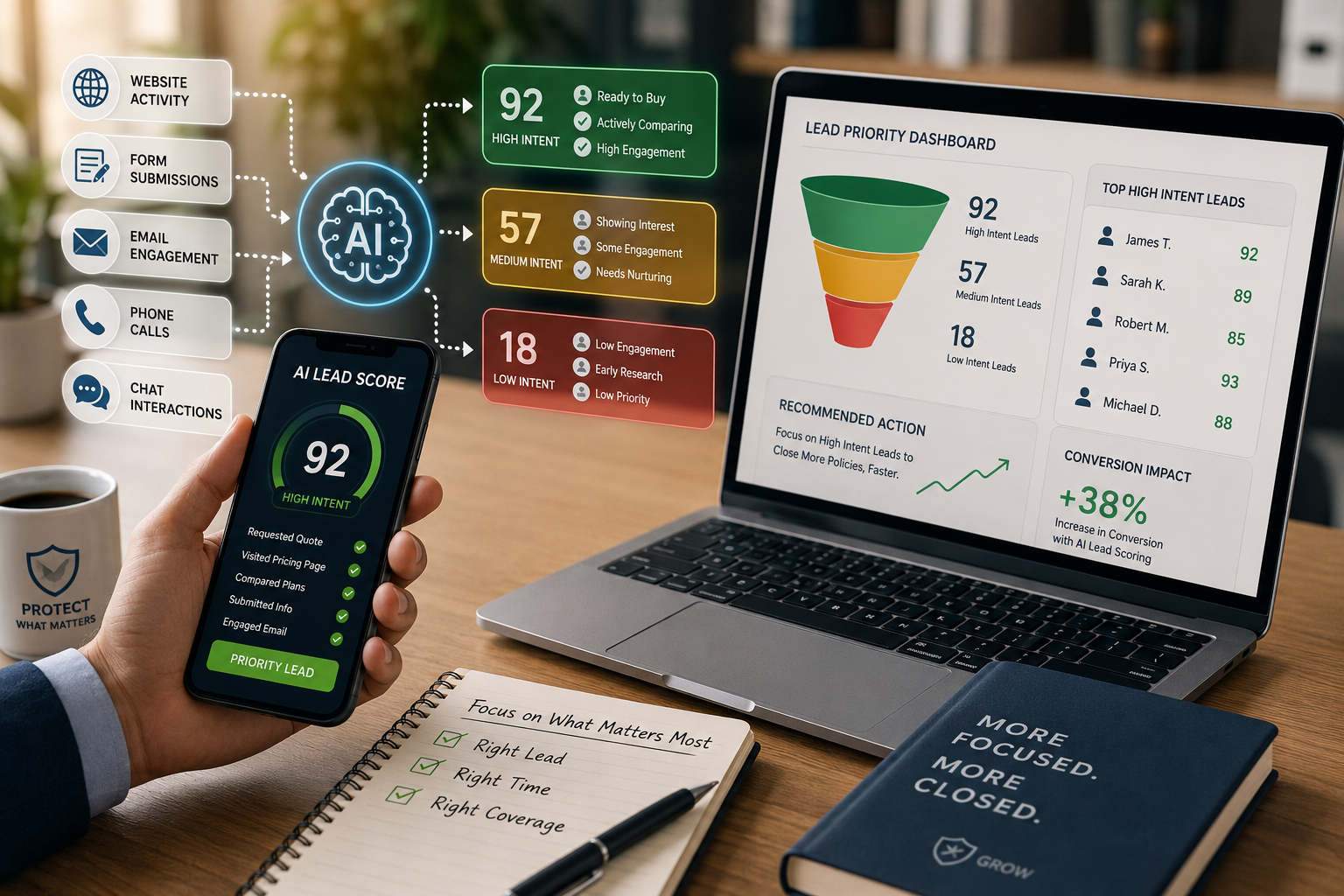
An insurance agent has 80 leads on their list this Monday morning. Some of those leads researched term life policies last night at 11 pm. A few compared quotes on three different websites over the weekend. One downloaded a critical illness coverage guide and then visited the pricing page twice. The agent does not know which is which. So they start at the top of the list and work their way down.
By the time they reach the high-intent prospects, it is Wednesday. Those prospects already bought from a competitor who called back within an hour of their initial enquiry.
This is the fundamental problem AI lead scoring solves. It reads the behavioral signals that indicate purchase intent and surfaces the highest-intent leads to the top of the queue automatically. The agent does not start at the top of an alphabetical list. They start with the person most likely to buy today.
Here is how AI lead scoring works in the insurance context, why the timing advantage it creates is so commercially significant, and what a properly built system looks like in practice.
What AI Lead Scoring Actually Does in Insurance
AI lead scoring is a system that analyses multiple data points about each lead and assigns a numerical score reflecting their likelihood to convert. Higher scores mean higher intent. The agent’s call queue reorganises itself around those scores in real time.
However, AI scoring in insurance goes further than a simple points system. According to Insurnest’s 2026 AI lead scoring guide, modern systems analyse real-time browsing activity, which blogs a visitor reads, which premium calculators they use, and precisely where they click on pricing or coverage pages. Each of these signals feeds into a continuously updated intent profile.
The result is a score that reflects what the prospect cares about right now, not what they filled in on a form three weeks ago.
Furthermore, Convin’s insurance lead generation research identifies a critical window problem. Leads that come in outside business hours are often the most likely to vanish. A prospect who fills in a life insurance enquiry form at midnight expects a response.
If they do not receive one before they wake up, they move on. AI systems that route and score these overnight leads allow agents to prioritise morning callbacks precisely where intent is highest.
According to Gartner research cited by SmartLead, companies using AI-powered lead scoring models experience a 30% increase in sales productivity and a 25% decrease in sales cycle length. Both outcomes compound over time. An agent handling 30% more productive conversations per week significantly outperforms the one working through an unscored list.
Why Timing Is the Critical Variable in Insurance Sales
Insurance leads go cold faster than almost any other product category. A prospect comparing car insurance quotes is often on three or four comparison sites simultaneously. The first agent to call back with a relevant, personalised offer wins a disproportionate share of that business.
According to Nurix AI’s insurance lead management research, the global AI in Insurance market is growing at a 33.60% CAGR, reaching $4,681.2 million in 2024. That growth reflects a market that is actively moving away from manual follow-up because the speed gap between AI-assisted and manual outreach is simply too commercially significant to ignore.
Moreover, Convin’s research shows that by 2025, more than 90% of insurers are expected to deploy some form of AI in their customer acquisition processes. Additionally, the Accenture 2024 survey cited by InsuranceNewsNet found that nine in ten financial advisors believe AI can help grow their book of business organically by more than 20%. The industry has made its assessment.
The Signals AI Scoring Tracks
Not all behavioral signals carry equal weight. AI lead scoring systems build their models by identifying which signals most reliably predict a closed policy. Several patterns appear consistently in high-converting insurance leads.
Premium calculator engagement. A prospect who uses a life insurance calculator and adjusts the coverage amount multiple times is demonstrating active buying intent. Casual browsers do not spend ten minutes adjusting term lengths and premium ranges. According to Insurnest’s analysis, calculator engagement is one of the most reliable indicators of emerging buying intent in insurance.
Return visits to coverage or pricing pages. A single visit to a pricing page may be research. Multiple return visits to the same page, particularly within 48 to 72 hours, signal a prospect who is actively narrowing their decision. AI systems flag these return patterns and escalate the score accordingly.
Form fill completion and specificity. A prospect who fills in a detailed health questionnaire or provides accurate date-of-birth and coverage amount information is further along in the decision process than one who submits only a name and email. The depth of information provided signals how far into the buying process the prospect actually is.
Engagement with specific product content. A prospect who reads a critical illness guide and then a policy comparison article is showing a clear product interest signal. AI systems map this content journey and score it relative to the agency’s conversion data from similar journeys.
Response speed to automated touchpoints. When an initial automated email or SMS goes out to a new lead, how quickly and how substantively they respond provides another scoring signal. A prospect who replies to an automated email with a specific question about coverage limits is demonstrating a meaningfully higher intent level than one who opens the email and does not respond.
How the Workflow Changes With AI Prioritisation
The practical change AI lead scoring creates for an insurance agent is a fundamentally different daily workflow.
Without AI scoring, the morning starts with a large undifferentiated lead queue. Time gets distributed roughly equally across leads of wildly varying intent levels. High-intent prospects wait while the agent works through lower-priority contacts. By the time the agent reaches them, the moment of peak intent has passed.
With AI scoring, the morning starts with a prioritised list. The top five leads have demonstrated clear buying intent signals in the last 24 hours. These are the first calls made. As a result, the agent’s first conversations of the day are with the prospects most likely to convert, when those prospects are most ready to discuss coverage.
Furthermore, the lower-intent leads do not get abandoned. They enter automated nurture sequences through our marketing automation service at Trigacy. Follow-up emails, relevant content, and policy reminders keep the brand present as those prospects move through their own consideration timeline. When their score rises due to increased engagement, they surface back to the top of the agent’s call queue.
Additionally, retargeting campaigns can run in parallel for leads who have gone quiet after initial engagement. A prospect who visited the pricing page twice two weeks ago but has not responded to follow-up emails can be served relevant display ads that keep the agency visible during their consideration window.
What Most Insurance Agents Get Wrong
Chasing low-intent leads often leads to offering discounts just to close something. Here is why that approach costs more than it saves.
Treating all leads from the same source equally. An inbound lead from a targeted Google Ad for life insurance term quotes is a fundamentally different prospect from an inbound lead from a general awareness campaign. Many agents route both into the same queue and call them in the same order. AI scoring uses source data as one input in the scoring model, ensuring that high-intent source leads surface appropriately.
Stopping follow-up too quickly. Research consistently shows that a significant percentage of insurance sales happen after the fifth or sixth contact. Many agents stop following up after two or three attempts. AI-powered nurture sequences maintain consistent contact over the full consideration period without requiring the agent to manually track follow-up timing for every lead.
Not connecting score data to the CRM. AI lead scores only improve agent productivity when they are visible inside the CRM the agent actually uses. A scoring system that sits in a separate dashboard that nobody opens adds no value. Integration between the scoring system and the workflow is non-negotiable. Our sales funnel buildouts at Trigacy include this CRM integration as a standard component.
Using static scoring models. A scoring model built on data from 12 months ago may not accurately reflect current buyer behaviour. Product launches, market events, regulatory changes, and seasonal patterns all shift what high-intent insurance buyer behaviour looks like.
AI systems that update their scoring models continuously based on recent conversion data outperform static models significantly. According to DataGrid’s analysis, businesses implementing continuously updated automated qualification systems see conversion rate improvements of 15 to 37%.
Ignoring the after-hours lead window. According to Convin’s research, leads that arrive outside business hours are among the most likely to go cold before an agent responds. Automated initial engagement that fires within minutes of a form submission, whether via SMS, email, or chatbot, bridges this gap and keeps the lead warm until an agent can call.
How Lead Prioritisation Generated 10 Qualified Meetings in a Single Month
Ennoble, a B2B consulting firm, faced a version of the same lead prioritisation challenge that insurance agencies deal with daily. A large volume of outreach was generating responses of varying quality. Without a systematic way to prioritise which prospects to pursue first, the team spent time on conversations that were unlikely to convert while higher-value opportunities waited.
We rebuilt the approach around prioritisation first. The outreach sequences surfaced intent signals early. Prospects who demonstrated clear alignment and interest received a meeting invitation. Those showing lower intent entered a longer nurture sequence rather than consuming agent time in the same way. The system made the prioritisation decision automatically, based on behavioural response data rather than manual judgment.
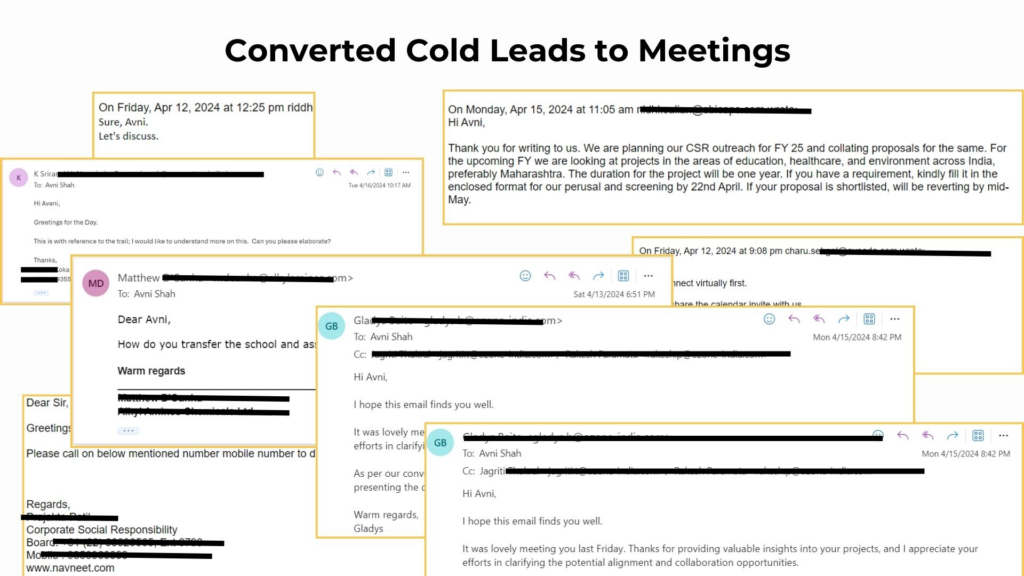
The result was 30 or more positive replies and 10 qualified meetings booked within the first month. More importantly, those meetings were with genuinely high-intent prospects. The team spent their time on conversations that had real commercial potential rather than working through an undifferentiated list from top to bottom.
For insurance agents, the parallel is direct. AI lead scoring does for the agent queue what Ennoble’s prioritisation system did for their outreach. It makes the call sequence a strategic decision informed by data, not an administrative task worked through in order.
Book a call with our team to explore how AI-powered lead prioritisation would work for your insurance agency or get to know us.
The Bottom Line
The insurance agent who calls the right person at the right moment wins the policy. AI lead scoring makes that happen systematically rather than by luck or by seniority of position on a static list.
Agents using AI scoring spend more of their time on conversations with prospects who are actively considering coverage right now. Response speed to high-intent enquiries improves. Consistent contact with lower-intent leads happens through automation rather than manual effort. Consequently, conversion rates improve without requiring more working hours.
For insurance agencies at any scale, this is one of the most direct paths from lead volume to revenue improvement available today.
That is the infrastructure we help insurance and professional services businesses build through our marketing automation service, email outreach, retargeting campaigns, sales funnels, and full-funnel demand generation programs.
Let us build it for your agency.
– Blog written by Sarah Joshi