An online education platform has one problem that good content cannot solve on its own. There are only so many hours in a day. A founder who teaches, demos, or hosts enrollment calls manually can realistically reach thirty, maybe fifty, prospective students per week. Beyond that, the business does not grow unless someone else is hired to do the same thing.
This is the enrollment ceiling. Every EdTech platform hits it eventually. Good content exists. Real student results exist. Demand exists. However, the delivery model is still one-to-one or one-to-small-group, which means growth is capped by the number of humans available to do the work.
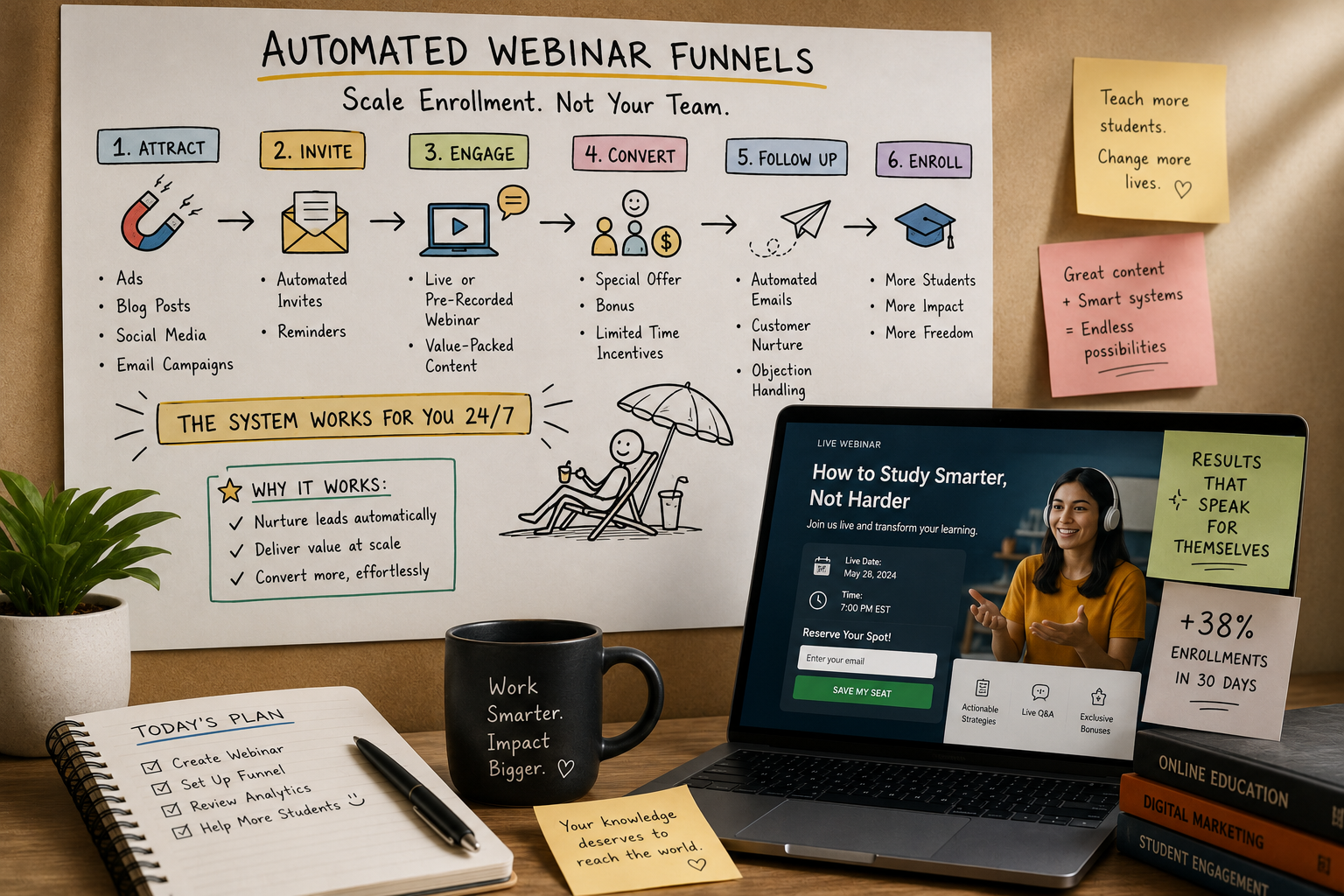
Automated webinar funnels break that ceiling. A single recorded teaching session can enroll students in Tokyo, Toronto, and Nairobi simultaneously, on a Tuesday afternoon and a Sunday at midnight, without anyone on the team being present. Furthermore, the funnel handles registration, reminders, the session itself, follow-up sequences, and enrollment handoff automatically.
Here’s how smarter systems can help EdTech platforms save time, reduce manual follow-ups, and scale enrollment without adding more people.
Here is how the system works, why it is particularly powerful for EdTech, and how to build one that produces consistent enrollments at scale.
What Automated Webinar Funnels Actually Mean for EdTech
An automated webinar funnel is a system that delivers a pre-recorded or simulated-live teaching session to prospective students, then moves them through a defined enrollment journey without manual intervention at any stage.
For EdTech platforms specifically, this is different from a generic sales funnel. According to EdTech enrollment funnel research from ProductionEWP, the key distinction is the endpoint. A SaaS demo funnel ends with a sales call. An EdTech webinar funnel ends with a student inside lesson one. The funnel does not just generate a lead. It completes enrollment and moves the student directly into the learning experience.
This distinction matters because it changes what the webinar needs to accomplish. Creating interest alone is not enough. Instead, the webinar must deliver enough genuine teaching value that the prospective student understands exactly what they are buying, trusts that it will work for them, and has already experienced a version of the learning before they pay.
Additionally, according to EasyWebinar’s 2025 automated webinar guide, one team implementing automated webinar funnels reported generating 35% more qualified leads with zero additional team hours. That is the core value proposition: enrollment growth that does not require proportional headcount growth.
The Numbers Behind Webinar-Driven Enrollment
The performance data for webinar funnels in education and EdTech is consistently strong.
According to Teleprompter’s 2025 webinar statistics, 95% of marketers consider webinars important to their strategy. Furthermore, 73% of B2B marketers say webinars are their top source of high-quality leads. The average webinar converts 57% of registrations into live attendees. Top-performing webinars achieve attendance rates as high as 90% of registrants.
The ON24 2025 Webinar Benchmarks Report adds two particularly relevant findings for EdTech. Making webinars on-demand by default increases total views by up to 80%. Moreover, personalized webinar landing pages generate three times more registrations than non-personalized ones. Both findings point in the same direction. Accessibility and relevance drive enrollment volume.
The broader market context also supports aggressive investment in this channel. According to EasyWebinar’s market data, the virtual events industry was valued at $195.7 billion in 2024 and is projected to reach $1.096 trillion by 2033. EdTech platforms building automated webinar infrastructure now are building into a channel with compounding long-term value.
Additionally, Wildnet’s 2026 enrollment funnel research found that 62% of student enrollments were driven by digital channels in 2025. Digital-first enrollment systems are no longer an advantage. They are the baseline expectation.
The Five Stages of an EdTech Webinar Funnel
A well-built EdTech webinar funnel moves through five connected stages.
Stage 1: Traffic. Prospective students arrive at the webinar registration page through paid ads, organic content, email campaigns, or referrals. Our social media advertising service at Socinova drives targeted traffic to EdTech webinar registration pages, reaching audiences segmented by learning interest, career stage, and educational background.
Stage 2: Registration. The registration page makes one specific promise. Not a general overview of the platform. One concrete outcome the prospective student will achieve by attending. Specificity drives registration rates. “Leave this session knowing how to structure a six-figure consulting offer” outperforms “Join our free masterclass on business growth” every time.
Stage 3: The session. This is the webinar itself. For EdTech, the most effective format is teaching-forward, not pitch-forward. The session delivers genuine value first. According to ProductionEWP’s research, a 45-minute teaching session earns more trust than 200 short-form content pieces combined. Consequently, the enrollment offer at the end lands on an audience that has already experienced the quality of the teaching.
Stage 4: Behavioral follow-up. After the session, the funnel splits based on behavior. Attendees who watched the full session receive a direct enrollment sequence. Attendees who drop off early receive a re-engagement sequence offering the replay. Registrants who did not attend receive a different replay offer highlighting the specific value they missed. Our marketing automation service at Trigacy builds these behavioral branching sequences, ensuring every prospect receives a follow-up that reflects their actual engagement with the webinar.
Stage 5: Enrollment and LMS handoff. Anyone who completes enrollment is automatically pushed into the platform, assigned to the correct cohort or course, and sent their onboarding sequence. No manual processing. No delay between payment and the first lesson. The student experience begins immediately. This stage is what most EdTech funnels skip, according to ProductionEWP’s analysis, and it is where the enrollment experience either builds or destroys initial student satisfaction.
Live Versus Automated: When Each Approach Works
EdTech platforms often debate whether to run live webinars or automated evergreen sessions. Both have a clear role in a well-built enrollment system.
Live webinars work best for course launches, cohort openings, and promotional moments where urgency and interactivity are central to the enrollment decision. According to Teleprompter’s data, 89% of webinar leads come from live attendees. Live events create the kind of real-time engagement that drives immediate enrollment decisions.
Automated webinars work best for passive, always-on enrollment that runs between launches. A simulated-live webinar scheduled to start every few hours across multiple time zones allows prospective students to join at a convenient time without the platform needing to host a live session. Furthermore, the evergreen model scales enrollment without adding to the teaching workload.
The most effective EdTech platforms run both. They use live webinars for launch moments and automated sessions to capture enrollment interest between launches. Together, the two approaches create a system that never goes dark.
Retargeting campaigns extend the funnel’s reach beyond the webinar session itself. They serve follow-up ads to registrants who attended but did not enroll, as well as to prospective students who visited the registration page but did not sign up. This layer recovers a meaningful percentage of near-conversions that a webinar-only system would lose.
What Most EdTech Platforms Get Wrong
Pitching too early in the session. The moment a webinar transitions from teaching to selling, a portion of the audience checks out. The most effective EdTech webinar funnels spend 80% of the session on genuine teaching value and reserve the enrollment offer for the final segment. Trust comes first. The pitch follows naturally from the value already delivered.
No behavioral segmentation in follow-up. Sending the same follow-up email to every registrant regardless of whether they attended, dropped off early, or never joined is one of the most common and most costly webinar funnel mistakes. Behavioral segmentation makes every follow-up more relevant and significantly improves conversion rates from the post-webinar sequence.
Not making the session on demand. According to ON24’s research, making webinars on-demand increases total views by up to 80%. Many EdTech platforms run live sessions and then let the recording sit unused. A simple on-demand flow that serves the recording to registrants who could not attend, and to new visitors who find the registration page after the live date, multiplies the return on the original session investment.
Friction between enrollment and course access. When a student completes payment and then waits hours for an access email, the initial enthusiasm fades. An automated handoff that delivers access credentials and a welcome sequence immediately after enrollment protects the new student experience and reduces early dropout rates.
No traffic strategy behind the funnel. A perfectly built webinar funnel with no traffic arriving at the registration page produces zero enrollments. Our demand generation programs at Trigacy ensure the funnel has consistent, targeted traffic flowing into it through paid ads, email marketing, and content distribution.
How Automating the Enrollment Journey Generated 1,000 Qualified Student Interactions
AP Guru, an SAT and ACT preparation platform, faced the exact enrollment ceiling described at the start of this blog. Consultation requests were arriving across multiple channels simultaneously. Manual handling caused slow response times. Students who enquired after hours frequently chose alternative providers before the team could follow up the next morning.
We built an automated enrollment and follow-up system that changed the fundamental structure of how AP Guru handled incoming interest. Every enquiry triggered an immediate CRM entry. A WhatsApp acknowledgement went out within seconds.

A personalized consultation brief followed automatically. Appointment reminders fired before each session. Post-consultation follow-up sequences ran without any manual input from the team.
The result was more than 1,000 qualified student interactions handled entirely through automated workflows. Enrollment booking became available 24 hours a day. The team’s manual administrative workload dropped significantly. More importantly, prospective students who reached out at 11 pm received the same immediate, professional response as those who enquired at 9 am.
This is what a well-built EdTech webinar funnel delivers at scale. It removes the human bottleneck from the enrollment process without removing the human element from the teaching experience. Automation handles the journey from first interest to first lesson. Educators focus entirely on delivering the teaching that makes students want to enroll in the first place.
Book a call with our team to discuss how an automated webinar funnel would work for your specific EdTech platform and enrollment goals, or get to know us.
The Bottom Line
The enrollment ceiling is a systems problem, not a content problem. EdTech platforms with excellent teaching and genuine student results are still leaving enrollment revenue on the table because the delivery model depends on human availability at every stage.
Automated webinar funnels remove that dependency. A single well-produced session can run indefinitely, across time zones, at any hour, moving prospective students from first exposure to enrolled and active without any team member needing to be present.
For EdTech platforms at any stage, from solo course creators to multi-programme education businesses, this infrastructure is what transforms good content into a scalable enrollment engine.
That is exactly what we help EdTech platforms build through our sales funnel service, marketing automation, retargeting campaigns, paid social advertising, and full-funnel demand generation.
Let us build your enrollment funnel.
– Blog written by Sarah Joshi