A personal injury attorney spends 45 minutes screening a potential client by phone. It turns out the case falls outside their jurisdiction. Six months ago, the statute of limitations passed. Nothing can be done. Those 45 minutes are gone, along with the revenue they could have generated for a viable client who called while the line was busy.
This happens constantly at legal firms of every size. Intake processes that depend entirely on a lawyer or paralegal screening every enquiry consume billable time on leads that will never convert. Furthermore, the leads that do qualify often wait too long before receiving a response.
According to Attorney at Work’s 2025 legal trends report, 73% of legal shoppers would not recommend the law firms they contacted due to poor responsiveness. That number represents a significant volume of high-value cases walking out the door before the firm ever gets a chance to take them on.
Lead qualification chatbots fix both problems simultaneously. They screen enquiries instantly, filter out cases that do not meet the firm’s criteria, and present the intake team with only the cases that are worth pursuing. Here is how they work, why legal firms specifically benefit, and what the adoption data shows about where the industry is moving.
Why Legal Intake Is So Costly Without Automation
Legal intake is one of the most resource-intensive processes in any law firm. Every incoming enquiry needs to be screened for practice area fit, jurisdiction, case strength, and financial viability. Doing this manually requires skilled staff time on every single contact, regardless of whether the case has any potential.
The cost compounds quickly. A firm receiving 80 enquiries per month, with 60 of those being unqualified, spends significant staff time on leads that produce no revenue. Moreover, the 20 genuinely viable cases sometimes wait hours or days for a response because intake staff are occupied with screening the other 60. In a competitive legal market, that delay costs the firm the case.
According to the Clio 2025 Legal Trends Report, growing law firms have nearly doubled their revenue over the past four years, with only a 50% increase in clients and matters. The distinguishing factor is technology adoption. Firms that implemented intake tools alongside practice management software saw a 51% increase in leads and a 52% increase in revenue.
Consequently, the operational efficiency of the intake process is directly linked to the firm’s financial performance.
What a Lead Qualification Chatbot Does in a Legal Context
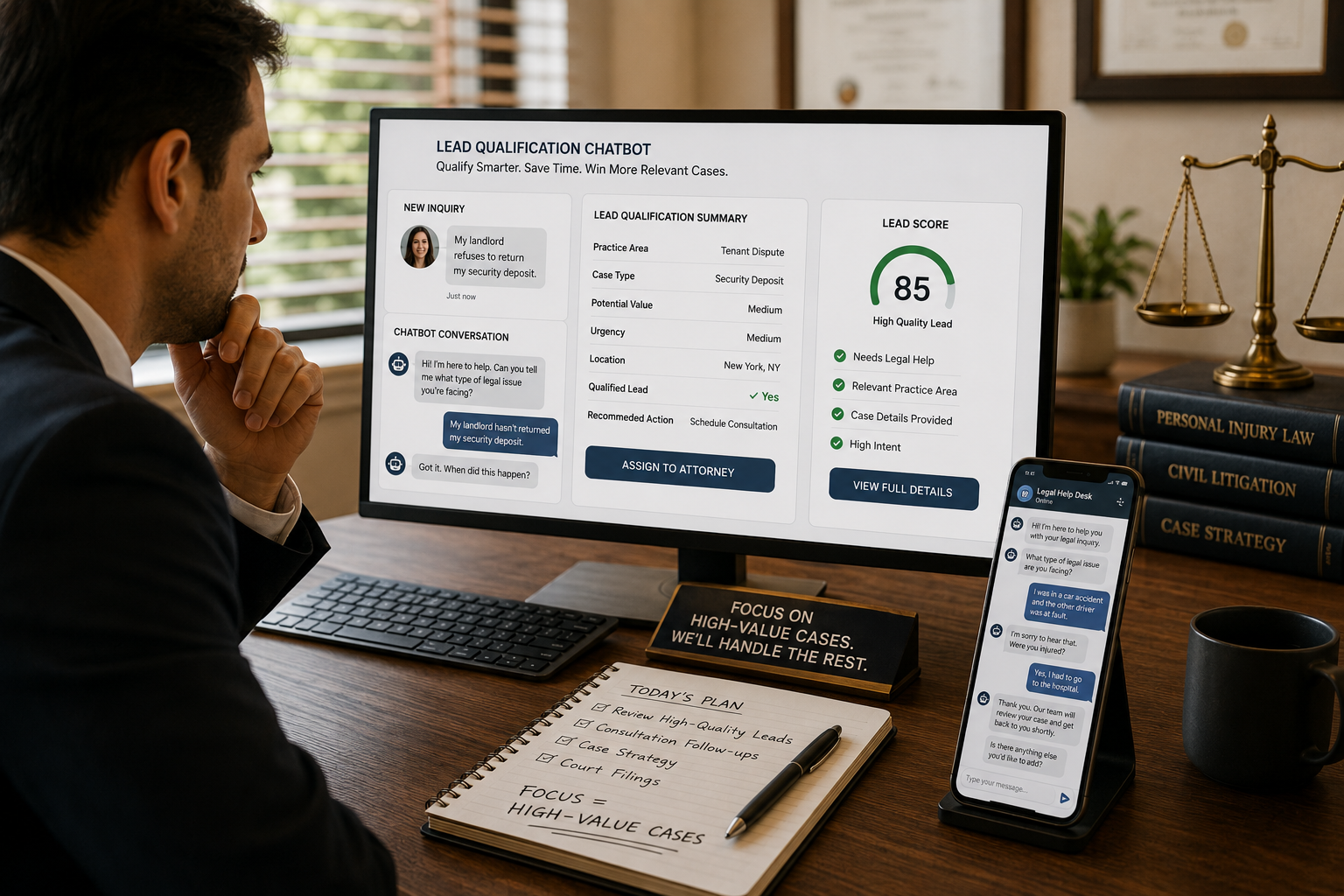
A lead qualification chatbot is an automated system that engages website visitors and incoming enquiries through a conversational interface. It asks predefined questions, evaluates the answers against the firm’s qualification criteria, and routes leads accordingly.
For a legal firm, the qualification logic might look like this. A personal injury firm asks whether the incident occurred within the last two years. It also checks whether the enquiry is located in the firm’s jurisdiction and whether medical treatment was received.
A lead that answers yes to all three gets routed immediately to a consultation booking. A lead that answers no to any one gets filtered out with a polite explanation, freeing the intake team for genuinely viable cases.
Furthermore, the chatbot handles this process 24 hours a day. According to the same Attorney at Work report, 51% of legal consumers find chatbots a useful starting point. However, 61% say they will only use one if it leads to speaking with a lawyer. This is an important nuance. The chatbot should not replace the lawyer. Its job is to ensure the lawyer’s time goes only to leads that have already passed the qualification gate.
The Numbers Behind Legal AI Adoption
The legal industry’s movement toward AI-powered intake tools has accelerated sharply in recent years.
According to 8 am’s 2026 legal AI report via LawSites, AI adoption among legal professionals jumped from 31% in 2025 to 69% in 2026. That more than doubled in a single year. The Thomson Reuters 2025 GenAI report found that 45% of law firms either use AI or plan to make it central to their workflow within one year.
On the chatbot qualification side, Spur’s 2025 chatbot analysis found that 62.5% of companies using chatbots deploy them specifically for lead qualification. Businesses using chatbots report on average three times higher conversion rates compared to those using static web forms.
Moreover, chatbots are saving businesses up to 2.5 billion hours annually in handling initial intake questions. For a legal firm, those saved hours translate directly into recovered billable time.
How a Legal Chatbot Qualification Workflow Works
A well-built legal chatbot qualification workflow moves through four stages.
Stage 1: Initial engagement. The chatbot greets the visitor immediately when they land on the firm’s contact page or website. It opens with a question about the nature of the legal matter, not a generic greeting. Starting with a specific question keeps the visitor engaged and begins the qualification process instantly.
Stage 2: Qualification questions. The chatbot works through a short sequence of questions tailored to the firm’s practice areas. These questions cover jurisdiction, case type, timeline, and any other firm-specific criteria. The sequence is short. Visitors drop off when the intake process feels lengthy or bureaucratic.
Stage 3: Routing by outcome. Qualified leads get routed to an immediate consultation booking. Our marketing automation service at Trigacy connects this routing to a calendar system so the prospect can book the consultation in the same flow without leaving the chatbot. Unqualified leads receive a helpful response explaining why the firm cannot assist and, where appropriate, a referral suggestion.
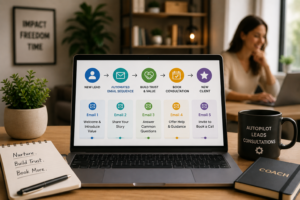
Stage 4: Follow-up sequences. Qualified leads who do not book immediately enter an automated follow-up sequence. An email goes out within minutes. A reminder follows if they have not responded within 24 hours. A final follow-up goes out on day three. Our email outreach infrastructure at Trigacy manages these sequences, ensuring every qualified lead receives timely follow-up regardless of how busy the intake team is.
What Makes Legal Chatbot Qualification Different From Other Industries
Legal firms have specific requirements that make chatbot qualification more nuanced than in other service categories.
First, compliance and confidentiality matter enormously. The chatbot must not create an attorney-client relationship prematurely. Questions should be framed to gather information without providing legal advice. The system must clearly communicate that it is not providing legal counsel. This is not complex to implement, but it must be explicitly designed into the chatbot’s conversation flow.
Second, the qualification criteria change by practice area. A family law firm screens for different factors than an employment law firm or a commercial litigation practice. The chatbot needs separate qualification flows for each practice area the firm handles. A single generic flow underperforms for firms with diverse case types.
Third, emotional sensitivity is critical in legal intake. Clients reaching out to a personal injury or family law firm are often in a distressed state. The chatbot’s tone must be warm, clear, and empathetic rather than mechanical. This is achievable through careful conversation design, but it requires deliberate attention during setup.
What Most Legal Firms Get Wrong
Building a chatbot that asks too many questions. Longer qualification flows produce more drop-offs. Five questions that cover the essential criteria outperform fifteen questions that try to cover everything. Start with the hardest disqualifiers first, so unqualified leads exit early without working through the entire flow.
Not connecting the chatbot to the calendar. A chatbot that qualifies a lead and then asks them to call during business hours to book a consultation loses half the conversion rate of one that routes directly to a booking page. The booking must happen inside the same conversational flow while the lead’s intent is highest.
Treating all practice areas with the same flow. A qualified personal injury lead and a qualified employment law lead require completely different qualification criteria. Using one generic flow for both produces either too many unqualified leads getting through or too many qualified leads getting filtered out. Practice area-specific flows are essential.
No human escalation for complex or ambiguous cases. Some leads will not fit neatly into the chatbot’s qualification logic. They may describe unusual case circumstances or answer questions in ways that the system cannot reliably evaluate.
Building a clear escalation path to a human intake team member ensures those cases are not lost. The chatbot should hand them off cleanly rather than forcing them into a binary qualified or unqualified outcome.
Not measuring chatbot performance separately from overall lead metrics. Many firms implement a chatbot and then evaluate it only by whether total lead volume increased. However, the chatbot’s specific value is in qualification quality, not quantity. Measuring the percentage of chatbot-sourced leads that convert to paying clients separately from other sources shows the real impact on case quality.
How a Qualification-First Approach Generated 10 High-Value Meetings in the First Month
Ennoble, a B2B consulting firm, faced a challenge that directly mirrors what legal firms experience with unqualified intake. Their outreach was generating responses, but the quality of those responses was inconsistent. Significant time went into following up with contacts who were not a real fit, leaving less time for the prospects who genuinely were.
We rebuilt the approach around qualification first. The outreach sequence was designed to surface intent and fit before any meeting was requested. Contacts that demonstrated clear alignment with Ennoble’s offering were advanced to a meeting invitation. Those that did not were filtered out without consuming further team time.

The result was 30 or more positive replies and 10 qualified meetings booked within the first month. More importantly, the meetings that did get booked were with genuinely interested and suitable prospects. The team spent their time on conversations that had real commercial potential.
The same qualification-first logic applies to legal intake. When a chatbot filters intake before any human contact happens, every consultation the lawyer attends has already passed a quality threshold. The time saved on unqualified screening is recovered as billable time or invested in building the client relationship with cases that matter.
Book a call with our team to discuss how a lead qualification system would work for your specific firm and practice areas, or get to know us.
The Bottom Line
Here is a quick look at how our fractional services help businesses like yours save time and reduce operational costs through the right systems.
The volume of incoming legal enquiries is not the problem. The problem is the proportion of that volume that reaches a lawyer’s desk without passing any qualification filter. Lead qualification chatbots change that ratio permanently.
Every enquiry gets screened instantly and consistently. Qualified cases move to consultation booking without delay. Unqualified cases get filtered out before consuming any billable time. Moreover, the system operates continuously, ensuring that a high-value case that arrives at 11 pm on a Sunday receives the same immediate, professional response as one that arrives on a Tuesday morning.
For legal firms competing in busy practice areas, this is not a marginal efficiency improvement. It is a structural change in how the firm acquires clients and protects the time of its highest-earning professionals.
That is the system we help legal and professional services firms build through our marketing automation service, email outreach, sales funnels, retargeting campaigns, and full-funnel demand generation programs.
Let us build it for your firm.
– Blog written by Sarah Joshi