Your biggest competitor just launched a 30% off sale across Google and Meta.
They started running it three days ago. You found out this morning when a customer mentioned they were comparing your prices to the offer. In those three days, your competitor probably captured a meaningful chunk of the demand you were both targeting.
That gap between when a competitor makes a move and when you find out about it is where market share gets lost. In fast-moving retail, three days of delay is enough to lose a campaign cycle, a promotional window, and a segment of buyers who were ready to convert right now.
Automated competitor ad monitoring eliminates that gap. Instead of discovering competitor moves from customer comments or accidental browsing, you get real-time alerts the moment a competitor changes their messaging, launches a new promotion, enters a new channel, or increases their spend.
Here is why this matters for retail market position specifically, what the monitoring actually captures, and how to build a system that gives your team the intelligence to respond before the damage happens.
Why Retail Is More Exposed to Competitor Ad Moves Than Most Categories
Retail is a category where pricing, promotions, and messaging change constantly. A competitor can launch a flash sale, introduce a new product line, or shift their entire seasonal campaign overnight. Furthermore, retail buyers are highly price-sensitive and actively compare offers across brands before making a purchase decision.
According to Retail Dive data cited by Celerant, 90% of consumers say they are more likely to shop with brands they follow on social media. This means competitor social ads are not just reaching your shared audience. They are also building the kind of brand familiarity that influences future purchase decisions.
Additionally, the competitive ad tracking market itself reflects how seriously brands are taking this challenge. According to Growth Market Reports’ 2025 analysis, the AI-powered competitive ad tracking market reached $2.3 billion in 2024 and is projected to grow to $11.7 billion by 2033 at an 18.1% CAGR.
Retailers across every category are investing in competitive ad intelligence. Flying blind in a market where competitors are watching your every move is simply too costly.
What Automated Competitor Ad Monitoring Actually Captures
Manual competitor monitoring involves someone periodically checking the Meta Ads Library, searching for competitor Google Ads, and hoping they notice something relevant. This approach is slow, inconsistent, and dependent on an individual’s available time.
Automated monitoring is different. It runs continuously and tracks everything.
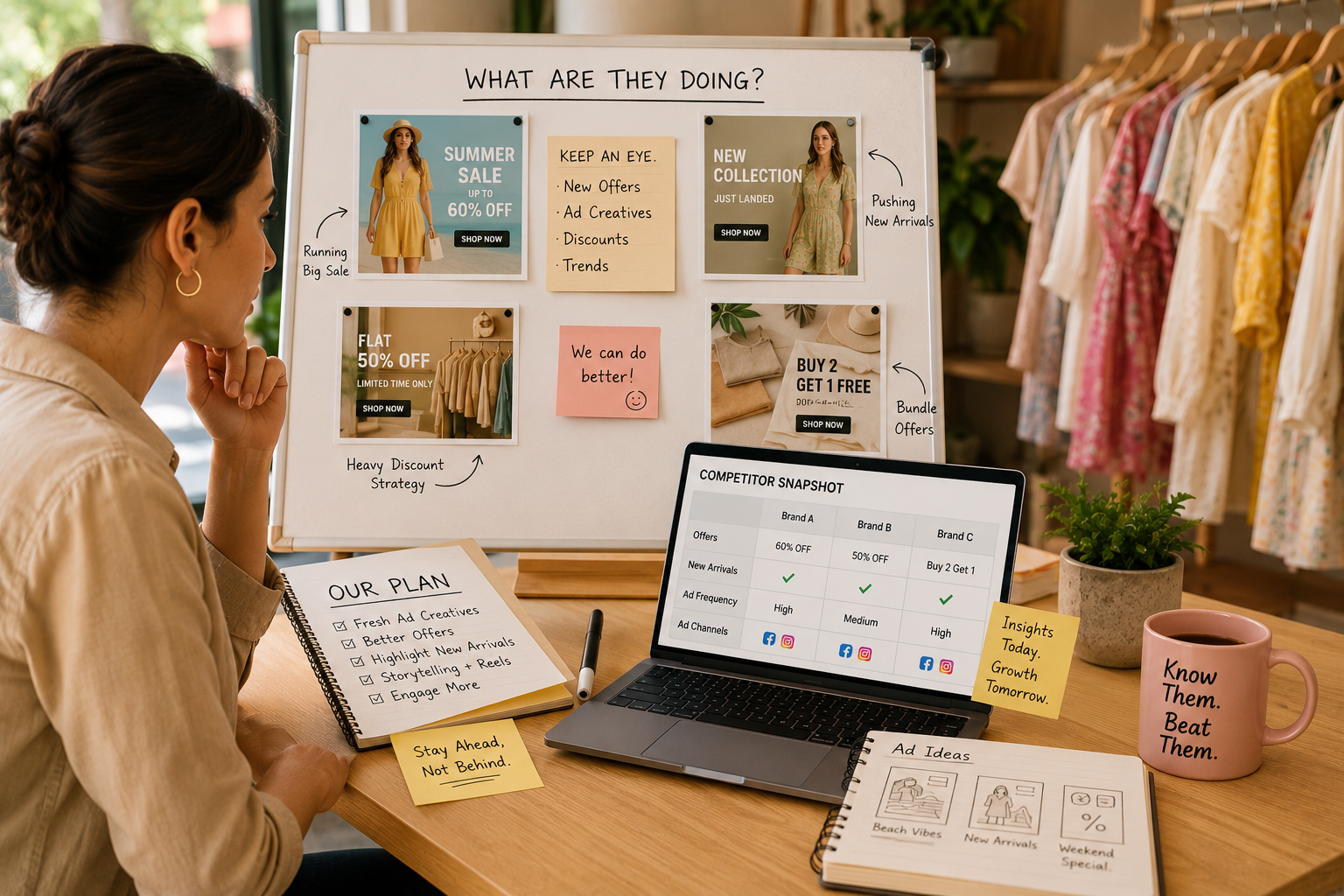
Creative and messaging changes. When a competitor updates their ad copy, changes their headline, or introduces a new creative angle, the system captures it. This tells you what messages they are testing and, over time, which ones they are scaling. If a competitor starts running the same headline variation across multiple campaigns, it is a strong signal that it is converting well for them.
Promotional offers and pricing. When a competitor launches a discount, a bundle offer, or a seasonal promotion, automated monitoring flags it in real time. You know the exact offer, the approximate timing, and the channels they are using. Consequently, your team can decide whether to match it, undercut it, or differentiate against it before the promotional window closes.
Channel and spend signals. Tools like those described in Visualping’s competitive intelligence guide track where competitors are advertising, which platforms they are increasing spending on, and where they appear to be pulling back. If a competitor suddenly scales up their Google Shopping budget while reducing Meta spend, that is strategic intelligence worth acting on.
New product and category launches. When a competitor starts running ads for a product category you both serve, early detection allows you to respond with your own campaign before the competitor establishes positioning in that category.
Audience targeting shifts. Advanced monitoring tools can identify when competitors change their targeting parameters. A competitor moving from broad audience targeting to tighter interest-based targeting often signals that they have found a higher-performing audience segment worth investigating.
The Market Intelligence That Separates Proactive Retailers From Reactive Ones
There is a fundamental difference between retailers who respond to market moves and retailers who anticipate them. Automated competitor monitoring is what makes anticipation possible.
Consider what consistently monitoring competitor ad activity reveals over 90 days. Seasonal campaign timing becomes visible. Product category priorities show up clearly in where competitors direct their budget. Creative strategy patterns emerge over time, whether they emphasise price, product quality, or brand story.
Furthermore, gaps where no competitor is running significant spend become obvious, and those gaps represent an opportunity to capture that audience without fighting for share.
According to the competitive intelligence research published by Visualping, understanding competitor campaigns helps businesses identify gaps in their own efforts, capitalise on opportunities, and avoid costly mistakes. Insight into competitors’ ad performance also helps optimise budget allocation and creative efforts, leading to more targeted advertising and better market positioning.
This kind of intelligence is most valuable not as a reactive tool but as a planning input. When your team sits down to plan next quarter’s campaigns, having 90 days of competitor ad data changes the quality of every decision in that planning session.
How to Build an Automated Competitor Monitoring System
A well-built competitor monitoring system for retailers has four core components.
Platform coverage. Your monitoring should cover every channel where your competitors are actively advertising. For most retailers, this includes Google Search and Shopping, Meta (Facebook and Instagram), and increasingly TikTok and programmatic display networks. Furthermore, free tools like the Google Ads Transparency Center and the Meta Ads Library provide a useful baseline.
Paid tools like Adbeat, SimilarWeb, and PowerAdSpy layer on spend estimates, historical data, and automated alerting.
Alert thresholds and triggers. The system needs to be configured to alert you when something meaningful changes, not just when anything changes. A competitor’s single new ad variation is noise. A competitor launching 15 new variations across five platforms in a week is a signal worth acting on. Setting the right thresholds prevents alert fatigue while ensuring nothing strategically significant slips through.
A structured response framework. Intelligence without a response process produces reports that nobody acts on. Every category of competitor change, pricing promotion, new creative angle, and channel expansion needs a predefined response protocol. Who gets the alert?
What is the decision-making timeline? What are the escalation options? Our fractional CMO service at Trigacy helps retailers build exactly this kind of strategic response infrastructure around their competitive monitoring data.
Integration with campaign management. The most effective monitoring systems connect directly to campaign management workflows. When a competitor launches a promotion, the system can automatically trigger a review of your own promotional calendar and flag relevant campaigns for expedited review.
Our marketing automation service builds these connected workflows for retail clients, so competitive signals translate into campaign actions without requiring a manual process between the two.
What Most Retailers Get Wrong With Competitor Monitoring
Monitoring only direct competitors. The most significant competitive threats in retail often come from adjacent category players and marketplace sellers who are capturing the same audience from a different angle. A furniture retailer focused only on other furniture brands may miss a home decor brand stealing their weekend shopper audience with lifestyle-focused creative.
Treating monitoring as a one-time or occasional activity. The value of competitor monitoring compounds over time. A single snapshot of competitor ad activity has limited value. Three months of continuous monitoring reveal patterns, testing sequences, and strategic intent that a one-time check never could.
Furthermore, occasional monitoring always risks missing the most time-sensitive information, the flash sale that runs for 48 hours, the new campaign that launches on a Friday evening.
Reacting without a clear counter-strategy. Before reacting to a competitor’s spend increase, it is worth asking whether matching their budget is actually the right move.
Seeing a competitor’s promotion and immediately matching it is sometimes the right response. However, it is not always. Matching a competitor’s discount when your margin structure is different can be commercially damaging.
A clear counter-strategy framework defines when to match, when to differentiate, and when to wait and watch. This prevents reactive decisions that look sensible in the moment but harm the business in the long term.
Not using competitive data to inform creative strategy. The creative intelligence from competitor monitoring is often more valuable than the pricing intelligence. When you can observe which headlines and visual approaches a competitor is scaling, you gain insight into what is resonating with your shared audience.
This should directly inform how your own creative briefs are written. Our demand generation approach at Trigacy uses competitive creative intelligence as a standard input when developing paid campaign strategies for retail clients.
Monitoring without acting on the data. This is the most common failure mode. A monitoring system gets implemented, alerts get set up, and then the intelligence sits in a dashboard that nobody reviews consistently. Competitive monitoring creates value only when it is integrated into regular campaign planning, creative review, and budget allocation decisions.
How Data-Driven Market Intelligence Helped a B2B Brand Build a Defensible Pipeline Position

GTO Florida, an architectural solutions company operating in a competitive B2B market, needed to build a pipeline faster than competitors who had more established brand recognition. The challenge was not just generating leads. It was generating leads from the right accounts, at the right moment, before competitors locked in those relationships.
The campaign system we built included continuous monitoring of the competitive landscape to identify where competitor messaging was weak and where demand was underserved. Campaigns targeted the audiences, and intent signals that competitors were not yet reaching effectively.
As a result, the positioning was not about outspending the competition. It was about finding the gaps they were leaving open.

The outcome was 2,697 qualified leads at an average cost of $6.79 per lead. The email open rate across follow-up sequences hit 36.30%. Total tracked pipeline opportunity exceeded $1.36 million. Competitive intelligence drove that cost efficiency by directing spend toward underserved demand rather than the most contested audiences.
For retailers, the same principle applies directly. Automated competitor monitoring reveals where competitors are spending heavily and where they are not. That gap information is where the most cost-efficient market position often sits.
Book a call with our team to discuss how competitive monitoring would fit into your retail ad strategy or get to know us.
The Bottom Line
Competitors are making strategic moves every day. Some of those moves directly affect your market position, your audience targeting, and your promotional effectiveness. Discovering them after the fact limits your ability to respond. Discovering them in real time gives you a genuine strategic advantage.
Automated competitor ad monitoring transforms competitive intelligence from a periodic research exercise into a continuous operational input. It changes how campaigns get planned, how budgets get allocated, and how quickly your team can respond when the market shifts.
For retailers competing in crowded categories with active competitors, this is not an optional optimisation. It is the infrastructure that protects market position and finds the gaps where growth is available.
That is the kind of strategic capability we help retailers build through our demand generation programs, fractional CMO engagements, retargeting campaigns, marketing automation, and paid social advertising.
Let us build your competitive monitoring strategy.
– Blog written by Sarah Joshi