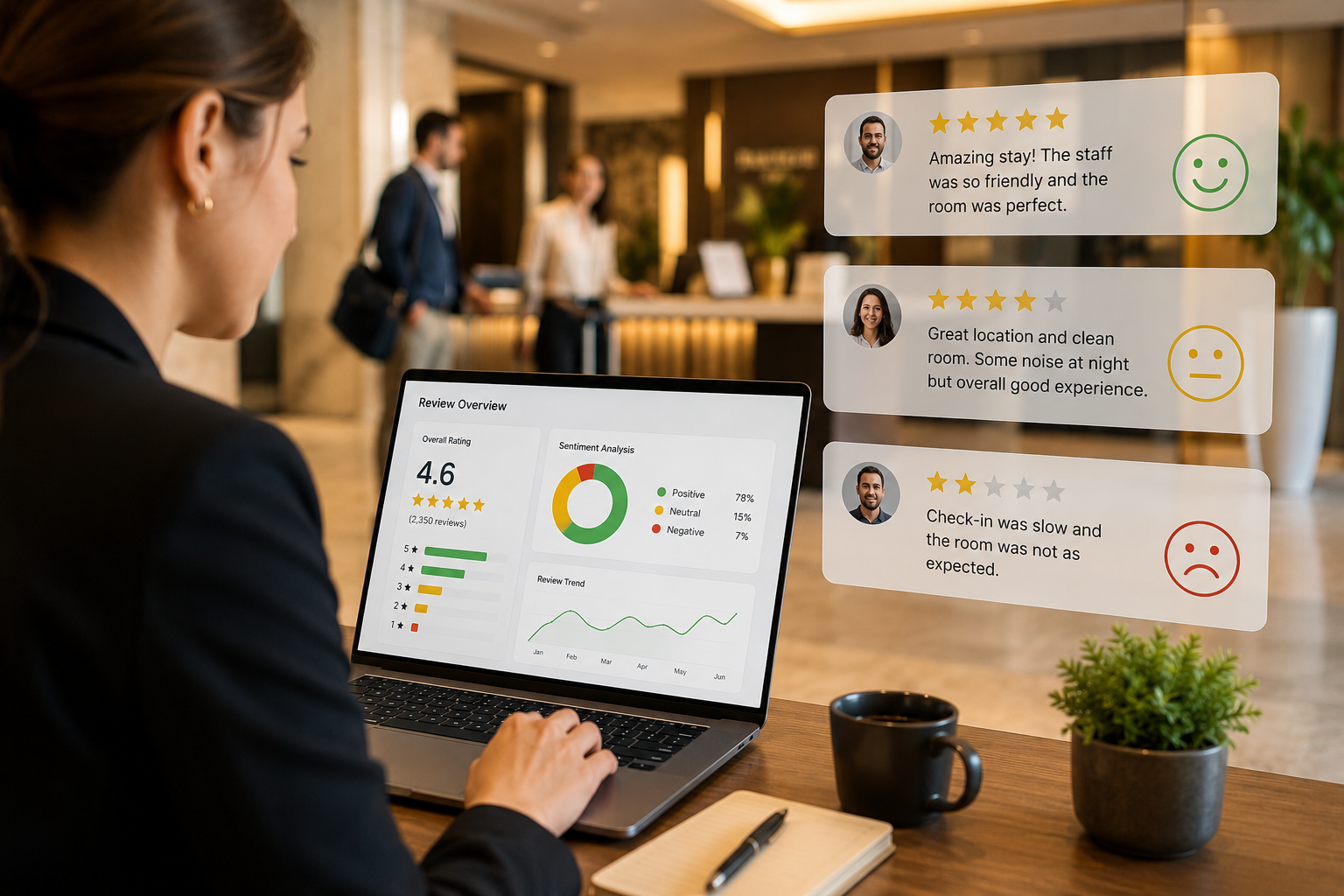
Every morning, somewhere in a hotel or restaurant group, a manager opens their laptop and pulls up TripAdvisor. Sometimes what they find is fine. Sometimes it is not. Either way, their response to what they read is usually the same: reactive, manual, and based on whatever they happen to notice that day.
That approach made sense ten years ago when review volumes were manageable. Today, a mid-sized hospitality group might receive hundreds of reviews per week across Google, TripAdvisor, Booking.com, Yelp, and social media simultaneously.
No manager, regardless of how diligent, can read all of them, identify patterns across them, and respond to the right ones fast enough to make a difference.
Customer sentiment analysis changes that entirely. Instead of reading reviews manually and reacting to whatever stands out, you run a system that reads everything, categorises it, identifies trends, flags urgent issues, and gives you actionable intelligence at scale.
Here is what it means, what the data shows about its impact on hospitality revenue, and how to build a system around it.
What Customer Sentiment Analysis Actually Means
Sentiment analysis is the process of using software to automatically identify the emotional tone behind written feedback. It categorises reviews, comments, and mentions as positive, negative, or neutral, and then breaks them down further by topic.
In practical terms, it means a system that reads 500 reviews and tells you: 73 of them mention slow service, 45 mention room cleanliness, 28 mention a specific staff member positively, and 12 mention pricing as a concern. Furthermore, it identifies whether those patterns are getting better or worse over time and how your property compares to competitors on each dimension.
That is fundamentally different from reading reviews manually. Manual review reading gives you impressions and anecdotes. Sentiment analysis gives you data. And data is what makes the difference between a hospitality group that reacts to problems and one that prevents them.
According to the Shiji ReviewPro Guest Experience Benchmark Report 2025, based on over 39 million reviews across 11,200 properties, guest satisfaction has been growing steadily since Q3 2022.
However, the same report notes that guest expectations are becoming more nuanced and specific. Consequently, the hospitality groups keeping pace are the ones with the clearest visibility into what guests are actually saying, not just what their average star rating reflects.
The Revenue Impact of Online Reputation
The business case for taking reputation management seriously is unambiguous in the hospitality sector.
According to a Harvard Business School study cited by MARA Solutions, a one-star increase in ratings contributes to a 5 to 9% increase in revenue. Cornell University research cited by Trustpiple shows that occupancy rises 0.54% for every 1% improvement in online reputation score. Furthermore, 81% of travelers read reviews before booking, and 70.9% say a property’s online reputation directly influences their accommodation choice.
The negative side of the equation is equally stark. According to the same research, 86% of potential guests would pass on a good deal from a property with numerous unattended negative reviews. Additionally, up to 15% of customer churn in hospitality is attributed to mishandled feedback.
In other words, it is not just the bad review that costs you bookings. It is the absence of a thoughtful response.
On the response side, Revinate’s 2025 Hospitality Benchmark Report found that 89% of travelers say a thoughtful response to a negative review improves their impression of the business. Moreover, 56% change how they view a property based on how it responds to feedback. The review response is therefore as much a marketing act as the review itself.
Sentiment analysis gives hospitality groups the infrastructure to respond at this level consistently, across every property, every platform, and every language.
Why Hospitality Groups Need It More Than Single Properties
A single-property hotel or restaurant can manage its online reputation with manual effort and a disciplined team. A hospitality group with five, ten, or twenty properties cannot.
The complexity compounds at every level. More properties mean more reviews, more languages, mean more context-dependent interpretation, and More platforms mean more places to monitor. Furthermore, inconsistency across properties becomes a brand problem. If one property in a group has a 4.6 average and another has a 3.8, that gap reflects on the entire brand, not just the underperforming location.
Sentiment analysis solves the scale problem. A centralised system monitors all properties, all platforms, and all languages simultaneously. It generates a consistent data framework that allows a hospitality group to compare property performance, identify which locations are driving which reputation issues, and allocate management attention where it is needed most.
Additionally, sentiment data enables benchmarking against competitors. Rather than simply knowing your own average rating, you can see how your sentiment scores on specific dimensions (cleanliness, food quality, service, value) compare to the competitive set in your market.
That competitive intelligence is the difference between managing reputation reactively and using it as a strategic tool.
What Sentiment Analysis Can Detect That Star Ratings Cannot
Star ratings are a surface-level signal. They tell you that guests are satisfied or not satisfied, but they do not tell you why, on which dimension, or what is driving the trend.
Sentiment analysis goes deeper. Here is what a well-implemented system identifies.
Recurring operational issues. When 40 reviews across three months mention long waiting times at check-in, that is an operational signal. However, without sentiment analysis, that pattern stays invisible in the aggregate star rating. This happens because the same guests often gave four stars overall despite the check-in frustration.
Therefore, the issue never gets escalated because nobody is tracking it systematically.
Staff performance signals. Sentiment analysis identifies specific staff members mentioned positively or negatively across multiple reviews. This gives HR and management teams real data for recognition, training, and performance management. It goes far beyond what mystery shopper programs or manager observation alone can provide.
Seasonal and location-specific trends. Sentiment patterns often shift by season, by day of the week, or by guest segment. A hotel might see high satisfaction scores from leisure guests but consistently lower scores from business travelers.
Identifying that pattern through sentiment data allows targeted service design for each segment rather than generic improvements.
Emerging issues before they escalate. A single negative review about a maintenance issue is noise. Five reviews in ten days mentioning the same issue is a signal. Sentiment analysis flags these clusters in real time, allowing the operations team to address problems before they multiply into a broader reputation problem.
Competitor blind spots. When sentiment analysis tracks competitor reviews alongside your own, it identifies topics where competitors consistently underperform. Those gaps are positioning opportunities. If your competition repeatedly gets criticised for slow room service and your team excels at it, that is a differentiator worth amplifying in marketing.
How to Act on Sentiment Data
Collecting sentiment data without an action framework produces reports that nobody reads. The hospitality groups getting real value from sentiment analysis have built response workflows around the data.
Automated response for positive reviews. Responding to every positive review manually at scale is unrealistic. Automated response tools handle the high volume of positive reviews while maintaining a personalised tone. They are now significantly more sophisticated than traditional templates, making responses feel genuine rather than formulaic.
According to Revenue Hub’s 2025 reputation management trends, AI-generated review responses have effectively replaced generic templates, making automated responses indistinguishable in quality from human-written ones for straightforward reviews.
Escalation protocols for negative reviews. Negative reviews above a certain severity threshold trigger an immediate alert to the relevant property manager. Response time matters. As a result, having a clear internal escalation protocol that defines who responds to what, within what timeframe, is as important as the sentiment tool itself.
Knowing how to respond to negative reviews is one of the most important reputation management skills in hospitality. Here is a practical breakdown of how to handle them.
Weekly sentiment briefings for operations teams. Rather than a continuous dashboard that nobody checks, a structured weekly report summarising the top positive and negative themes across properties gives operations leadership the context to make service decisions. Furthermore, tracking sentiment trend lines week over week shows whether changes are having the intended impact.
Integration with marketing. Positive sentiment themes are marketing assets. A property that consistently receives praise for its breakfast, its pool area, or its location should feature those specific elements. In its ad creative, booking page copy, and social media content.
Our social media advertising service at Socinova uses exactly this kind of sentiment-informed content strategy to make paid campaigns more relevant and more believable.
Connecting sentiment to revenue metrics. The most sophisticated hospitality groups connect their sentiment scores directly to RevPAR and occupancy data. When sentiment on a specific dimension (say, room cleanliness) drops, and occupancy from repeat guests drops in the same period, the causal relationship becomes visible. That visibility justifies operational investment in a way that sentiment data alone cannot.
Our marketing automation service at Trigacy builds the workflow infrastructure that connects review monitoring, response sequences, and internal escalation into one managed system for hospitality clients.
What Most Hospitality Groups Get Wrong
Treating all reviews equally. A one-star review from a first-time guest who had one bad experience and a two-star review from a regular guest who has previously left five-star reviews require completely different responses. Sentiment analysis enables this differentiation. Manual review management typically does not.
Focusing only on negative reviews. The instinct is to spend all reputation management effort on damage control. However, positive sentiment data is equally valuable. It tells you what your brand stands for in the minds of guests, which is exactly the information you need to brief marketing campaigns, train new staff, and position against competitors.
Responding without personalisation. A generic response to a detailed negative review is often worse than no response at all. It signals to potential guests reading the exchange that the property does not actually engage with feedback. Sentiment analysis can categorise the type of complaint, so the response template is matched to the issue, creating the appearance of genuine engagement even at scale.
Not sharing sentiment data with frontline teams. Guest feedback is most valuable to the people who can actually act on it: the front desk, the kitchen, and the housekeeping team. Hospitality groups that keep sentiment data at the management level and never share it with frontline staff miss the entire operational improvement loop.
Monitoring too few platforms. Google and TripAdvisor are the obvious ones. However, for hospitality groups in certain markets, platforms like Booking.com, Expedia, Agoda, and local review sites are equally significant. Furthermore, social media mentions on Instagram and Facebook contain rich qualitative sentiment that structured review platforms do not capture.
A complete sentiment analysis system monitors all of them.
How Consistent Community Management Built a Restaurant’s Online Reputation From the Ground Up
Platesman Everyday Eatery, a restaurant in Pune managed by our team at Socinova, started with a modest follower base and no established online reputation. Rather than running paid campaigns to manufacture credibility, we focused on building genuine community engagement through consistent social media management, creator collaborations, and active response to every guest interaction online.
Every comment, every DM, and every tag was acknowledged. Guest experiences were amplified through creator-led content. The brand voice across platforms was consistent, warm, and responsive. Over time, this systematic engagement with guest sentiment created a reputation that spread organically.
The result over 90 days: 134,492 accounts reached with only 331 followers, 78,543 views with 97.2% coming from non-followers, and individual creator collaboration reels hitting 39.7K, 31.4K, and 22.7K views.
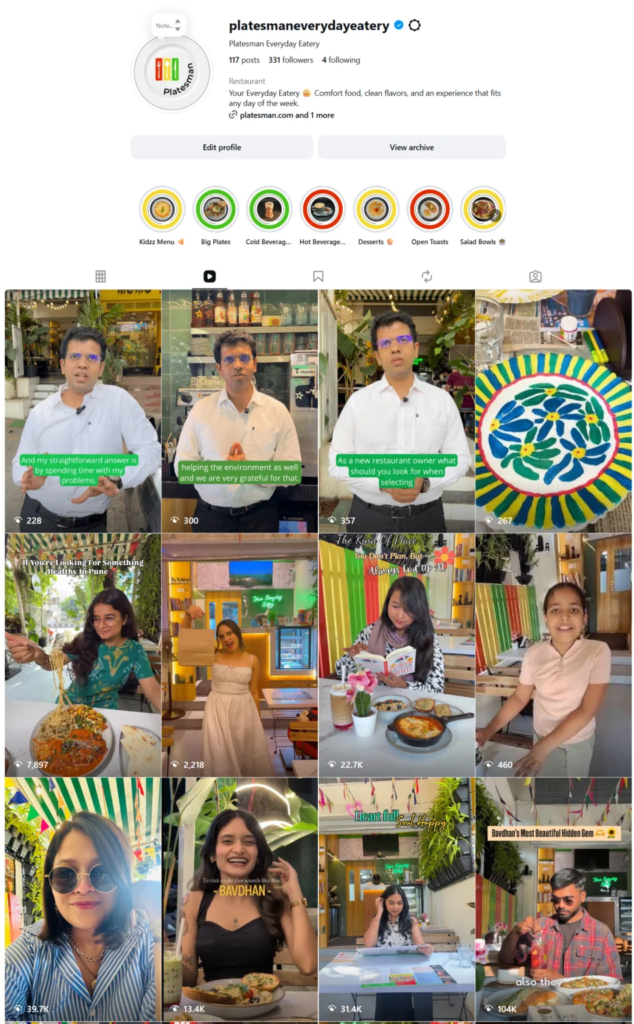
Platesman had not run a single paid ad during this period. The reach was driven entirely by reputation, community trust, and the amplification effect of positive guest sentiment expressed online.
Moreover, this demonstrates the compounding effect of reputation management done correctly. Each positive guest interaction that gets acknowledged and amplified becomes a signal that attracts more guests, who then create more positive interactions.
For a hospitality group managing multiple properties, sentiment analysis provides the data infrastructure to replicate this effect at scale. The principle is identical. The system is what changes.
Talk to our team or get to know us better to understand how we would approach reputation management and sentiment analysis for your specific portfolio of properties.
The Bottom Line
Online reviews are not just feedback. They are a revenue driver, a marketing channel, and an operational improvement system. However, they only function as all three when there is a structured system for reading, analysing, and acting on them.
Customer sentiment analysis provides that system. It turns the unstructured noise of hundreds of guest reviews into clear, actionable signals about what your properties are getting right, what they are getting wrong, and how they compare to the competition.
For hospitality groups managing multiple locations, the alternative to sentiment analysis is not just manual effort. It is a blind spot. And in a category where a one-star rating change moves revenue by 5 to 9%, blind spots are expensive.
That is the work we help hospitality businesses do through our marketing automation service, social media management and advertising, retargeting campaigns, and full-funnel demand generation programs.
Let us look at your current reputation setup and show you where the gaps are.
– Blog written by Sarah Joshi