
An event management company lives and dies by its pipeline.
When the inquiry calendar is full, the team is energised, the suppliers are engaged, and the business has the leverage to be selective about the briefs it accepts.
When the pipeline is thin, every team member feels it, every vendor relationship becomes transactional, and the principal spends their most valuable hours chasing opportunities rather than delivering the work they built their reputation on.
The paradox that most event management companies encounter as they grow is that the busier they are delivering events, the less bandwidth they have to market the business that generates the next wave of events.
The marketing activity that fills the pipeline requires consistent, strategic effort across content, social media, email, paid advertising, and brand positioning.
None of these can be executed at a high standard by a team that is simultaneously managing venue logistics, supplier negotiations, run-of-show documents, and client expectation management across multiple concurrent events.
In 2026, an outsourced marketing department is the operational decision that resolves this paradox permanently for event management companies that are serious about growing without compromising the quality of what they deliver.
The Feast and Famine Cycle That Signals a Marketing Infrastructure Problem
The most reliable indicator that an event management company needs an outsourced marketing department is a revenue pattern that oscillates between periods of intense activity and periods of concerning quiet.
This feast and famine cycle is not a reflection of the company’s quality or reputation. It is a structural symptom of a marketing approach that is reactive rather than systematic.
During busy periods, marketing is deprioritised because the team is executing. During quiet periods, marketing is accelerated in a panic because the pipeline has dried up.
The leads generated by panic marketing take weeks or months to convert into confirmed bookings, which means the quiet period extends further than it should before the next wave of activity arrives.
The company is always either too busy to market or too quiet to ignore marketing, and the oscillation between these two states prevents the consistent pipeline development that would eliminate the cycle entirely.
An outsourced marketing department operates independently of the event delivery calendar. It does not stop producing content because the team is on-site at a gala.
It does not pause the paid advertising because the account manager is managing a last-minute venue change.
It runs continuously, generating pipeline activity during the busy periods that feeds the bookings that fill the quiet periods before they arrive.
This operational independence is the mechanism that breaks the feast and famine cycle and replaces it with a revenue curve that is predictable, manageable, and consistently upward.
What an Outsourced Marketing Department Actually Manages for an Event Company
The scope of an outsourced marketing department for an event management company covers every function that a full internal marketing team would own, delivered without the overhead, the management complexity, or the single-point-of-failure vulnerability that an in-house hire creates.
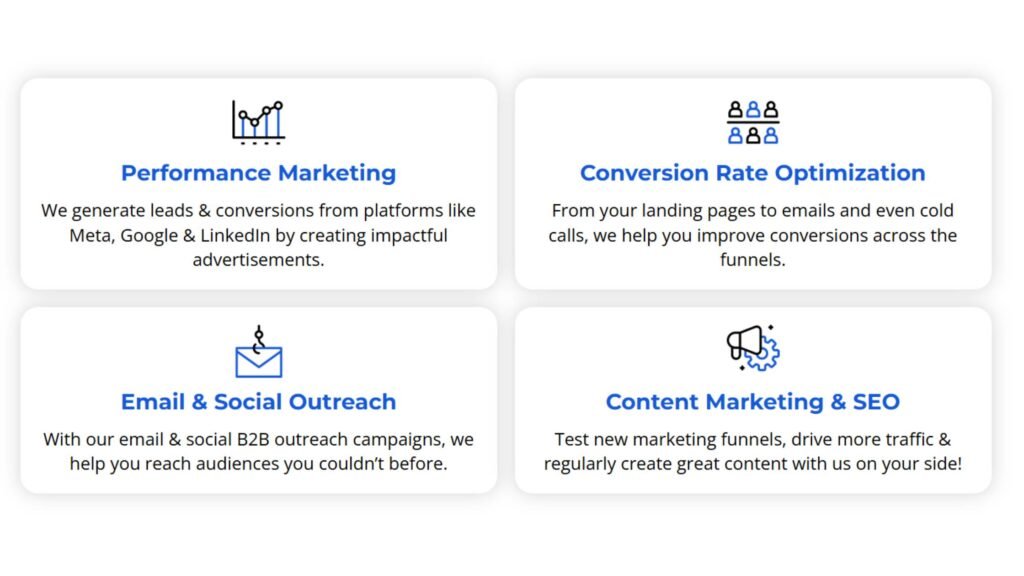
Content strategy and production covers the ongoing creation of case studies from completed events, thought leadership positioning for the principal and senior team, social media content that showcases the company’s creative range and operational capability, and blog content optimised for the search queries that prospective corporate, private, and brand clients use when evaluating event management partners.
Paid social and search advertising covers the campaigns that place the company’s brand and capabilities in front of decision-makers who are actively planning events, managing procurement for annual conference programs, or seeking a new event partner after a disappointing experience with their current supplier.
These campaigns are managed continuously, optimised against inquiry volume and booking quality rather than vanity metrics, and scaled or adjusted based on the company’s current capacity and target client profile.
Email marketing and nurture covers the systematic communication with past clients, warm leads, venue partners, and corporate procurement contacts that keeps the company present and credible in the minds of the people most likely to generate repeat bookings and referrals.
A past client who organised a product launch through the company 18 months ago and has received nothing since is a warm prospect for the next brand activation or internal conference.
A well-managed email nurture sequence keeps that relationship alive without requiring anyone on the event delivery team to maintain it manually.
Brand positioning and PR covers the strategic placement of the company’s work, expertise, and key personnel in the industry publications, award programs, and speaking opportunities that build the reputational authority that converts a prospective client’s shortlist position into a confirmed appointment.
The Specialist Depth That an In-House Hire Cannot Replicate
An event management company that attempts to solve its marketing problem by hiring a single internal marketing manager is making a structural compromise that becomes more apparent over time.
A single hire can execute tasks.
They cannot simultaneously provide the strategic direction, creative capability, paid media expertise, SEO knowledge, content production capacity, and performance analysis that a comprehensive marketing function requires.
The result is a marketing manager who is perpetually overextended, consistently underperforming against the full scope of what is needed, and gradually demoralised by the gap between what they were hired to do and what the role actually demands.
The company gets partial marketing execution at full employment cost, with all the management overhead that comes with a permanent hire and none of the specialist depth that the function actually needs.
An outsourced marketing department provides a team of specialists, each operating in the area of their highest competency, coordinated by a strategic lead who understands the event management market and is accountable for the business outcome rather than the completion of individual tasks.
The copywriter who writes case studies is not also managing the Google Ads account. The paid media specialist who optimises the campaigns is not also designing the social media graphics.
The breadth of capability that an outsourced department delivers at a comparable or lower cost than a single senior hire is the economic argument that makes the decision straightforward for most event management company principals who have experienced both models.
The Brand Positioning Work That Fills Premium Pipeline
For event management companies operating above the commodity price point, the quality of the marketing is a direct signal of the quality of the events.
A prospective corporate client evaluating two event management companies will make a significant part of their assessment based on how each company presents itself before a single conversation has taken place.
A company with a polished, consistent, and strategically positioned brand presence communicates the same attention to detail, aesthetic sensibility, and operational precision that the client is hoping to experience in the event itself.
An outsourced marketing department builds this brand positioning across every touchpoint where a prospective client encounters the company, from the website and the social media presence to the proposal design, the pitch deck, and the credentials document that arrives before the first meeting.
When every element of the brand experience is consistent, considered, and strategically aligned with the company’s target client profile, the premium price point becomes easier to defend because the marketing itself has already demonstrated the value of the experience the client is being asked to pay for.
This positioning work is ongoing rather than one-time.
The event management market evolves, client expectations shift, new competitors enter, and the company’s own capabilities expand as its portfolio grows.
An outsourced marketing department monitors these changes continuously and adapts the positioning strategy in response, ensuring the company is always presenting itself at the leading edge of its market rather than on the basis of a brand identity that was built for an earlier version of the business.
The Measurement Framework That Connects Marketing Activity to Booked Revenue
One of the most consistent frustrations that event management company principals express about their marketing investment is the difficulty of connecting specific marketing activities to specific booked events.
When the marketing is managed internally by a generalist or handled sporadically by the principal themselves, the attribution chain between a piece of content, a paid ad, an email campaign, and a confirmed booking is invisible.
The marketing feels like a cost rather than an investment because there is no system that makes its return visible.
An outsourced marketing department builds the measurement framework that makes this attribution chain explicit. Every inquiry source is tracked. Every campaign is connected to the pipeline it generates.
Every content piece is evaluated against the engagement and inquiry volume it produces over time.
Monthly reporting gives the principal a clear view of which marketing activities are generating the highest quality inquiries, what the cost per booked event is across each channel, and where the next increment of marketing investment will produce the greatest return.
This measurement clarity changes the nature of the marketing conversation entirely.
The principal is no longer making marketing decisions based on intuition or the loudest recent outcome.
They are making them based on a performance record that makes the compound value of the outsourced department visible, measurable, and consistently justifiable.
Schedule a free consultation to explore what an outsourced marketing department would deliver for your event management company’s specific pipeline objectives and growth targets. You will receive a complete audit of your current marketing activity and the pipeline gaps it is creating, a custom marketing architecture built around your target client profile and event category specialisms, and a 90 day roadmap designed to build a consistent and measurable inquiry pipeline that operates independently of your event delivery calendar, entirely obligation-free.
– Blog written by Pranit Kamble