An electrical company that is growing has a problem that its principals rarely diagnose correctly.
The visible symptoms are familiar: the diary is full, the team is stretched, quotes are taking longer to send, follow-ups are falling through, and the owner is spending more time managing incoming work than building the business that generates it. The instinctive response is to hire more people.
The actual problem, in the majority of cases, is that the operational infrastructure connecting marketing activity to booked jobs has never been built.
A sole trader who becomes a three-van operation becomes a ten-van operation not because they worked harder but because at some point they stopped handling every customer interaction manually and built systems that handled it for them.
In 2026, managed marketing automation is the infrastructure layer that makes this transition predictable and repeatable for electrical companies of every size. It is not a technology purchase.
It is the operational backbone that allows a business to scale its revenue without scaling its administrative overhead at the same rate.
The Operational Bottleneck That Growth Creates and Automation Solves
Every electrical company that reaches a certain revenue threshold encounters the same bottleneck.
The marketing activity, whether that is Google Ads, a Facebook presence, a well-ranked website, or a strong referral network, is generating enough enquiries to fill the team’s capacity.
But the process between an enquiry arriving and a job being booked is entirely manual, inconsistent, and dependent on whoever happens to be available to respond at the moment the lead comes in.
A commercial property manager who submits an enquiry about a periodic electrical inspection at 7pm on a Thursday receives either a response within minutes if someone is monitoring the inbox or a response the following morning if they are not.
The difference between those two scenarios is not just response time. It is conversion rate.
Studies across the trades sector consistently show that leads contacted within five minutes of enquiry convert at a rate multiple times higher than those contacted after an hour, and the gap between a five-minute response and a next-morning response represents a significant volume of booked jobs that the business paid to generate and then failed to capture.
Managed marketing automation closes this gap permanently.
An automated response sequence triggered by a form submission, a missed call, or a chatbot interaction ensures that every enquiry receives an immediate, professional acknowledgment regardless of when it arrives or who is available on the team.
The job of the human is no longer to be first. It is to follow up when the automation has already done the work of keeping the prospect engaged.
What Managed Automation Actually Covers for an Electrical Business
The term marketing automation is broad enough to be unhelpful without a concrete breakdown of what it replaces and what it builds inside the specific operational context of an electrical company.
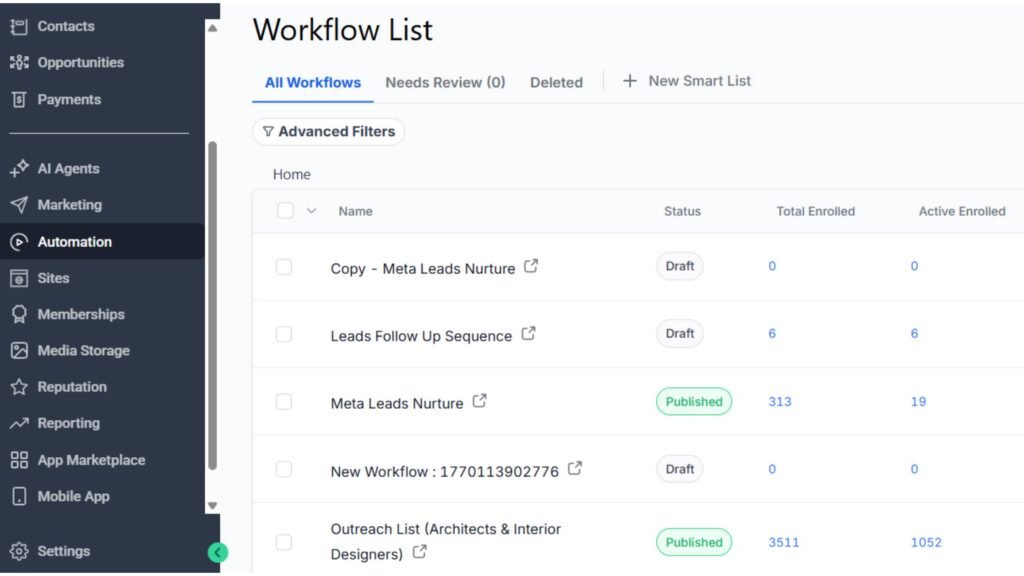
Managed automation in this context covers six distinct operational areas that most electrical businesses are currently handling manually, inconsistently, or not at all.
The first is lead capture and immediate response.
Every channel through which an enquiry can arrive, including the website contact form, the Google Business Profile, the Facebook page, and the phone line, feeds into a single centralised system that triggers an immediate personalised acknowledgment and creates a task for the relevant team member to follow up within a defined window.
The second is quote follow-up.
An electrical company that sends twenty quotes per week and follows up on each one manually is allocating significant human time to a process that automation can handle with greater consistency and at zero marginal cost.
An automated quote follow-up sequence sends a personalised reminder at 48 hours, a value reinforcement message at five days, and a final prompt at ten days, with each message adjusting its content based on whether the previous one was opened.
The third is job confirmation and pre-appointment communication.
A customer who has booked a consumer unit replacement or a commercial rewire receives an automated confirmation, a pre-appointment checklist of what to prepare, and a reminder the day before the job.
This sequence reduces no-shows, manages customer expectations, and signals a level of operational professionalism that smaller competitors running on phone calls and paper diaries cannot match.
The fourth is post-job review generation.
The period immediately following a completed job, when the customer has just experienced the result of the work and their satisfaction is at its highest, is the optimal moment to request a Google review.
An automated post-job sequence sends this request within two hours of job completion, links directly to the Google review page, and generates a review volume that compounds the electrical company’s local search visibility month over month without any manual effort from the team.
The fifth is seasonal campaign activation.
Electrical companies have predictable demand patterns around consumer unit upgrades, EV charger installations, solar and battery storage enquiries, and commercial testing and inspection cycles.
An automated seasonal campaign deploys the right message to the right audience segment at the right moment in each of these cycles, keeping the diary full during periods that would otherwise produce gaps in the schedule.
The sixth is referral and repeat customer activation.
A customer who had their consumer unit replaced 18 months ago and has not been contacted since is a warm prospect for an EV charger installation, a smart home integration, or a commercial testing contract.
An automated reactivation sequence identifies these dormant relationships and delivers a relevant, timely communication that brings past customers back into the active pipeline without any manual list management.
The Managed Component That Technology Alone Cannot Replace
The distinction between marketing automation and managed marketing automation is the difference between a tool and a system.
A CRM platform or an email automation tool is a capability. A managed automation service is the strategic intelligence, ongoing optimisation, and performance accountability that makes the capability produce a consistent business outcome.
Most electrical companies that invest in automation technology without a managed service layer find that the initial setup produces results for three to six months and then begins to decay.
Sequences stop being refreshed. Message copy that was relevant when it was written becomes dated.
Audience segments that were accurate at the point of configuration no longer reflect the actual composition of the prospect database.
The automation continues to run but the results it produces diminish because no one is monitoring performance, testing alternatives, and making the adjustments that keep the system calibrated to current market conditions.
A managed service ensures that the automation infrastructure is treated as a living operational system rather than a one-time configuration project.
Monthly performance reviews identify which sequences are underperforming and why. Seasonal updates refresh messaging ahead of demand cycles.
New customer segments are added as the business evolves. The system grows with the business rather than becoming a legacy infrastructure that the business has to work around.
The Scalability Proof That Automation Provides to the Business
For an electrical company considering expansion, whether that means adding a second team, moving into commercial contracting, launching a maintenance contract offering, or acquiring a smaller competitor, the presence of a managed marketing automation infrastructure is one of the most significant operational advantages available during a growth transition.
A business that is scaling without automation is scaling its administrative overhead simultaneously.
Every new van on the road means more quotes to follow up, more jobs to confirm, more reviews to request, and more past customers to reactivate.
Without automation, each of these tasks requires proportionally more human time as the business grows, which is why so many electrical companies hit a revenue ceiling that they cannot break through without the principals working unsustainable hours.
A business that is scaling with managed marketing automation adds revenue without adding the same volume of administrative overhead because the system handles an increasing workload at a flat operational cost.
The second van does not require a second person managing its marketing pipeline. The automation scales with the business at a cost curve that is fundamentally different from the linear cost structure of manual operations.
This scalability proof is also increasingly relevant to electrical companies preparing for a business sale or seeking external investment, where the presence of documented, automated, and measurable marketing operations is a demonstrable asset that increases the business’s valuation multiple and reduces the perceived execution risk for any incoming owner or investor.
Schedule a free consultation to explore what a managed marketing automation infrastructure would look like for your electrical company’s current size and growth objectives.
You will receive a complete audit of your current lead capture and follow-up process and the revenue it is failing to convert, a custom automation map covering every stage from initial enquiry to post-job review generation, and a 60 day implementation roadmap designed to eliminate manual follow-up overhead and increase booked job volume from the first month of deployment, entirely obligation-free.
– Blog written by Pranit Kamble