
Elderly care is one of the most relationship-driven service industries in existence, and for most providers that relationship dependency extends all the way into their business development model.
Residential care homes, home care agencies, and assisted living providers have historically filled their capacity through a relatively narrow network of referral sources: discharge liaison nurses, hospital social workers, GP practices, local authority care managers, and the informal word-of-mouth networks that operate within the families of existing residents.
This referral model works well enough in a stable environment. The problem is that the elderly care environment in 2026 is not stable.
Demand is growing faster than supply in most geographies, the families making care decisions are increasingly conducting their own research online before accepting a professional recommendation, and the referral relationships that a provider spent years cultivating are disrupted every time a key contact retires, changes role, or moves to a competing network.
For an elderly care provider whose occupancy rate is the single variable that determines whether the business is profitable or loss-making in any given month, a lead generation system that is entirely dependent on referral relationships it does not control is not a sustainable growth model. It is a liability dressed as a strategy.
The Referral Dependency Trap and Why It Feels Safe Until It Is Not
The reason elderly care providers continue to rely on referral networks long after the structural risk of that dependency has become visible is that referral relationships feel like trust, and in elderly care, trust is the foundational currency of every placement decision.
A social worker who has referred to the same care home for three years is providing an implicit endorsement that no advertising campaign can replicate in the mind of a family navigating one of the most emotionally difficult decisions of their lives.
This trust is real and it is valuable.
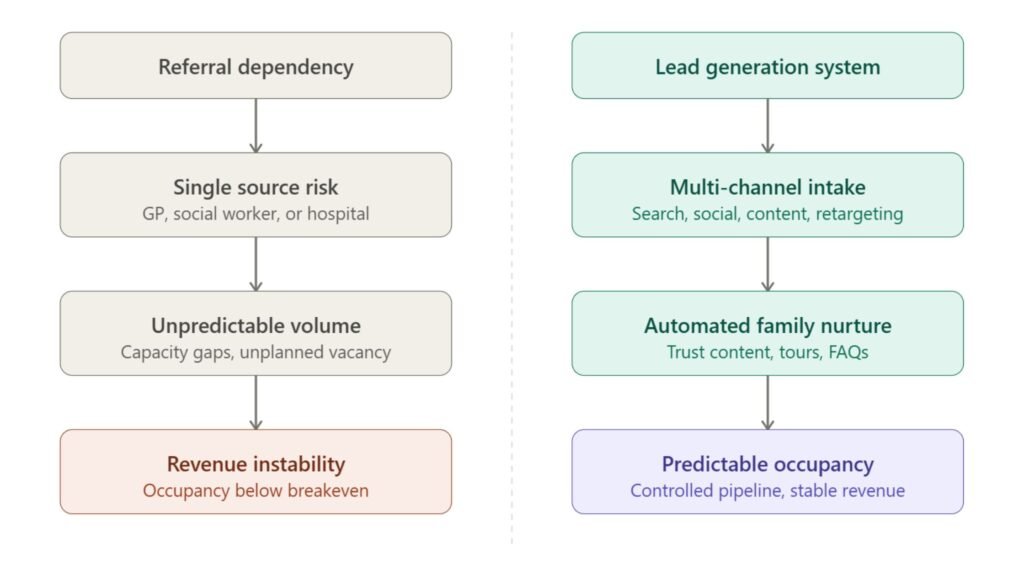
The trap is in confusing the value of the trust relationship with the adequacy of the referral channel as a complete lead generation strategy. A care home with 40 beds that relies on three social workers for 80 percent of its admissions has not built a strong relationship with three trusted professionals.
It has concentrated 80 percent of its occupancy risk into the employment continuity, caseload priorities, and personal preferences of three individuals who have no contractual obligation to continue referring and no financial stake in the provider’s occupancy rate.
A lead generation system does not replace these referral relationships. It ends the dependency on them by ensuring that the provider has multiple independent channels generating placement enquiries simultaneously, so that the loss or disruption of any single source does not create an occupancy crisis.
The Family Decision Journey That Lead Generation Must Intercept
The family members who ultimately make placement decisions for elderly relatives are conducting a research process that begins weeks or months before they contact any care provider directly, and the majority of that research process now takes place online.
A daughter searching for residential dementia care for her mother, a son comparing home care agencies for a parent newly discharged from hospital, or a couple researching assisted living options for an elderly parent who is no longer safe living alone are all conducting this research through search engines, care comparison platforms, review sites, and the social media environments where they spend their personal time.
A provider that is invisible in these digital environments is absent from the family’s consideration set during the research phase that most heavily influences the eventual decision.
By the time the family contacts a social worker or care manager for a professional recommendation, they have already formed preferences, eliminated options, and identified providers they trust.
A lead generation system that places the provider visibly and credibly in front of families during this earlier research phase does not simply generate more enquiries.
It generates enquiries from families who have already self-qualified against the provider’s care offering and are arriving with a higher level of intent and a shorter conversion timeline than a cold referral from a social worker who has not spoken to the family about their specific preferences.
The Four Channels That Build a Referral-Independent Lead Pipeline
A lead generation system for an elderly care provider is not a single channel.
It is an architecture of four interconnected channels that each serve a different stage of the family decision journey and collectively ensure that the provider is visible and accessible regardless of where in that journey the family first goes looking.
The first channel is local search visibility, which means the provider’s Google Business Profile, website, and care comparison platform listings are optimised to appear prominently when families in the catchment area search for the specific care type the provider offers.
A care home that appears in the top three local results for “residential dementia care in [town]” is intercepting families at the highest-intent moment of their search journey, and this visibility costs a fraction of what a single month of occupancy vacancy costs in lost revenue.
The second channel is content-led trust building, which means the provider’s website and social media presence contains genuinely useful, empathetic information that addresses the questions families are asking during their research process.
A guide to understanding dementia care options, a transparent explanation of care home fees and what they cover, or a video walkthrough of the home’s daily life and activities builds the trust that a family needs before they are willing to pick up the phone.
Content that answers real questions converts traffic into enquiries far more efficiently than content that simply describes the provider’s services.
The third channel is paid digital advertising, which allows the provider to place targeted messages in front of families in the local catchment area who are actively searching for care options or who match the demographic and behavioural profile of families at the point of making a placement decision.
Paid search captures families who are actively looking. Paid social, particularly Facebook advertising targeted at adults in their 50s and 60s in the provider’s geographic area, reaches families who are in the early awareness stage before active search has begun.
The fourth channel is reputation management and review generation, which means systematically collecting and displaying testimonials from the families of current and past residents across Google, care comparison platforms, and the provider’s own website.
In a sector where trust is the primary decision variable, a care home with 47 recent, detailed, and positively-worded reviews from real families is producing lead generation collateral that no paid campaign can replicate.
The Nurture Infrastructure That Converts Enquiries Into Admissions
A lead generation system that generates enquiries without a nurture infrastructure to convert them is a pipeline with a hole in it.
The families who enquire about elderly care are rarely ready to make an immediate placement decision.
They are at the beginning of a process that involves multiple family members, financial planning, medical assessments, care needs evaluations, and the emotional weight of accepting that a parent or relative needs a level of care they can no longer provide themselves.
A care provider that responds to an initial enquiry with a phone call and then leaves the family to make contact again when they are ready is not nurturing the relationship.
It is leaving the family to be won by whichever competitor maintains contact through the weeks or months it takes them to reach a decision.
An automated nurture sequence ensures that every family who makes an enquiry receives a structured programme of relevant, empathetic communications that keeps the provider present and credible throughout the decision timeline.
A follow-up email within two hours of the initial enquiry that offers a virtual tour. A weekly email over the following four weeks that addresses the most common concerns families have at each stage of the evaluation process.
An invitation to a family open day. A personal call from the home manager at the six-week mark.
Each touchpoint advances the relationship without requiring a member of staff to manually manage 40 or 50 enquiries simultaneously at different stages of their individual decision journeys.
The Occupancy Stability That a Lead Generation System Produces
The occupancy metric that determines the financial health of an elderly care business is not the admission rate in any given month.
It is the consistency of the admission rate across a 12-month period that eliminates the revenue volatility created by occupancy gaps.
A care home that operates at 92 percent occupancy consistently is a fundamentally different financial proposition than one that averages 92 percent but swings between 75 percent in a slow quarter and full capacity after a run of referrals.
A lead generation system produces occupancy stability by maintaining a consistent flow of enquiries throughout the year rather than the feast-and-famine pattern that referral dependency creates.
When the system is generating ten to fifteen family enquiries per month consistently, the admission team has the pipeline depth to fill vacancies within their average decision timeline rather than scrambling to fill them after they occur.
Vacancies become a managed operational event rather than a financial emergency, and the provider’s relationship with their referral network, freed from the desperation of occupancy pressure, becomes genuinely collaborative rather than transactionally dependent.
Schedule a free consultation to explore what a lead generation system would look like for your elderly care business. You will receive a complete audit of your current enquiry sources and the occupancy risk your referral dependency is creating, a custom multi-channel lead generation architecture built around your care type and catchment geography, and a 90 day roadmap designed to build a consistent, referral-independent enquiry pipeline that stabilises your occupancy rate from the first month of deployment, entirely obligation-free.
– Blog written by Pranit Kamble