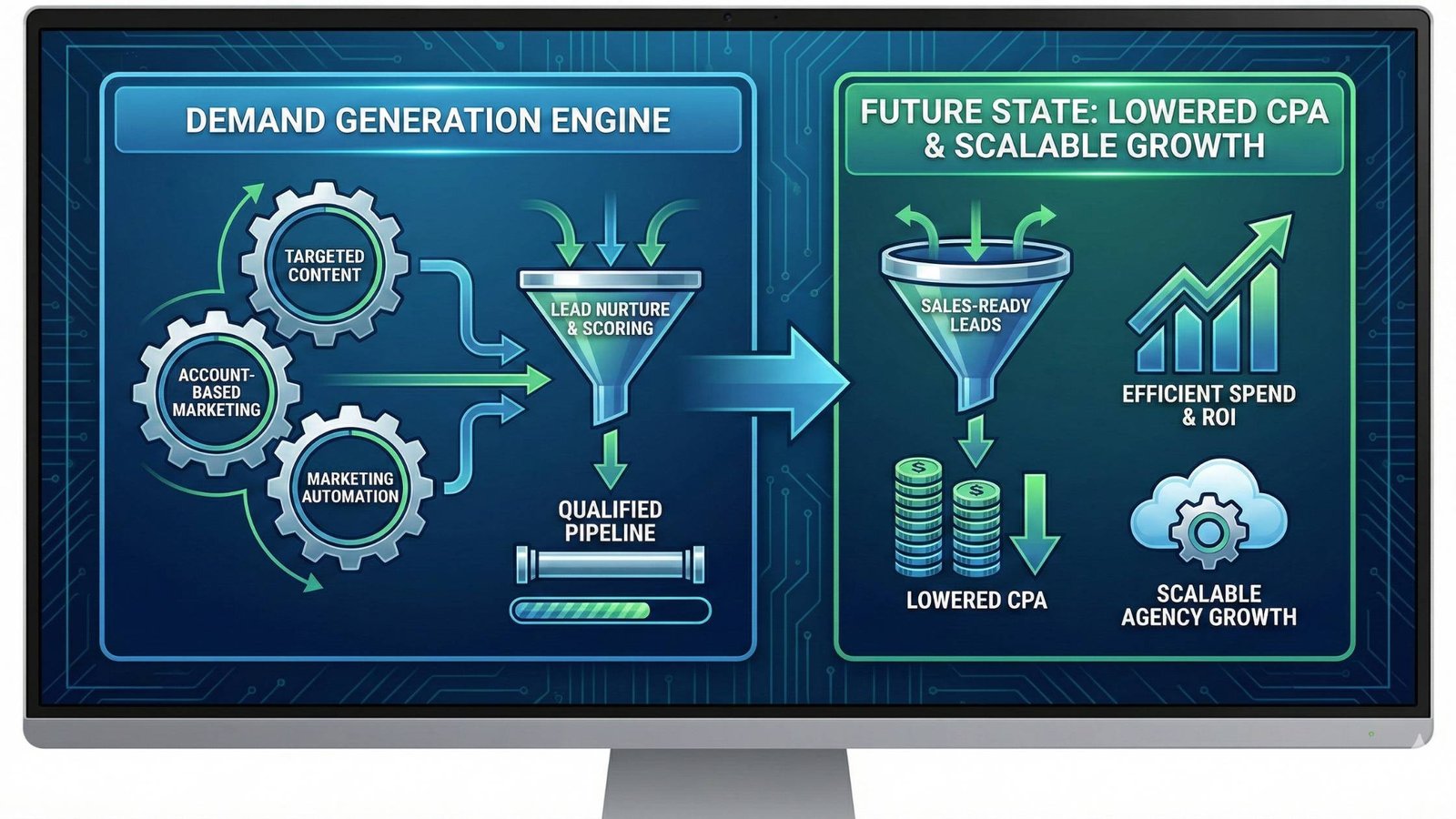
There is a well-known paradox in the B2B services sector: digital marketing agencies, the very entities tasked with driving scalable growth for their clients, frequently struggle to acquire their own.
In an attempt to fill their pipelines, many agencies default to the exact direct-response tactics they employ for e-commerce brands running aggressive, bottom-of-the-funnel lead generation ads pushing “Free Audits” or gated whitepapers.
While this approach might generate a high volume of email addresses, it masks a severe profitability crisis. The Cost-Per-Acquisition (CPA) for a retained agency client is skyrocketing.
When an agency competes solely at the point of capture, they are battling every other firm for the 1% of the market that is actively looking to buy today.
This creates a race to the bottom, resulting in price-shopping, prolonged sales cycles, and remarkably high acquisition costs.
The antidote to this margin-crushing cycle is a fundamental pivot from lead generation to a comprehensive B2B demand generation strategy.
By shifting the focus from frantically capturing existing demand to systematically creating new demand, agencies can dictate their market positioning, eliminate competitive friction, and drastically drive down their CPA.
The Financial Trap of the “Capture-Only” Model
To understand how demand generation lowers CPA, one must first dissect why traditional lead generation is so expensive for B2B service providers.
When an agency relies on capturing demand for example, bidding on Google Ads for keywords like “SEO agency in New York” or sending cold LinkedIn outreach pitching web design they are entering a highly commoditized arena.
The prospect on the other end is likely evaluating three to five other agencies simultaneously.
Because the agency has done no prior work to establish unique authority or trust, the prospect views the service as a commodity.
The sales team is then forced to spend dozens of non-billable hours crafting custom proposals, conducting multiple discovery calls, and defending their pricing.
If the agency spends $5,000 on ads to generate 50 leads, but only closes one client because the rest chose a cheaper competitor, the CPA is a staggering $5,000.
The cost is not just in the ad spend; it is in the immense labor required to convert cold, skeptical traffic.
Engineering the Buyer’s Epiphany Through Un-Gated Value
Demand generation solves the CPA crisis by moving the battleground. Instead of fighting for the 1% of the market ready to buy, it focuses on educating the 99% of the market that is unaware they even have a solvable problem.

A robust demand generation strategy requires an agency to give away its best insights for free, without the friction of a lead capture form.
This means publishing deep-dive case studies, technical teardowns, and strategic frameworks directly on platforms like LinkedIn, YouTube, or industry podcasts.
For instance, an agency specializing in B2B SaaS might publish a detailed breakdown of how they restructured a client’s onboarding email sequence to reduce churn by 14%.
The goal is to trigger a “buyer’s epiphany.” When a SaaS founder reads that un-gated teardown, they realize their own onboarding sequence is flawed.
The agency has just created demand where none previously existed. More importantly, because the agency was the source of the epiphany, they are the only logical vendor to fix it.
This eliminates the competitive bidding process entirely.
Reducing the Labor Cost of Acquisition
The most immediate impact a demand generation strategy has on an agency’s CPA is the reduction of pipeline friction.
When leads are generated through gated content or cold outreach, they enter the pipeline “cold.”
They require convincing. Conversely, when a prospect has spent three months consuming an agency’s un-gated thought leadership, listening to the founder’s podcast, and reading their strategic breakdowns, they enter the pipeline “warm.”
They already know the agency’s methodology, they agree with their worldview, and they understand their pricing tier.
The initial sales call shifts from a defensive pitch into a collaborative onboarding discussion.
This drastically increases pipeline velocity the speed at which a lead turns into a paying client.
By cutting the sales cycle in half and doubling the close rate, the labor costs associated with acquisition plummet, driving the overall CPA down to highly profitable levels.
The Paid Ads Accelerator: Amplifying and Capturing Demand
While demand generation relies heavily on high-value content, organic distribution is often too slow for an agency looking to scale aggressively.
This is where Paid Ads across Meta, LinkedIn, and Google act as the ultimate accelerator.
However, in a demand generation framework, the paid strategy looks vastly different from traditional lead capture.
Content Distribution over Lead Forms
Instead of running LinkedIn Ads that force users to fill out a Lead Gen Form to download a PDF, a demand generation architecture puts ad budget behind un-gated content.
The agency might run a video ad featuring their Head of Strategy explaining a complex algorithm update. The goal is not an immediate click; the goal is in-feed consumption.
By paying to guarantee that target accounts see this expertise, the agency builds massive psychological authority at a fraction of the cost of acquiring a formal lead.
Retargeting the Consumption Layer
Once the demand has been distributed, the paid ad architecture utilizes sophisticated retargeting to move engaged prospects down the funnel.
If a B2B marketing director watches 75% of an educational video on Meta, they are algorithmically tagged as a high-intent user.
The agency then deploys a sequential retargeting campaign. The next ad they see is a verified client testimonial, followed days later by an invitation to book a strategic consultation.
Because the prospect was pre-educated by the initial video, the conversion rate on the consultation ad is exponentially higher, driving down the Cost-Per-Lead (CPL).
Branded Search Takeover on Google Ads
The ultimate indicator of a successful demand generation strategy is a spike in branded search volume.
When an agency successfully creates demand, prospects do not go to Google and search for “PPC agency.”
They go to Google and search for the specific name of the agency they have been learning from.
A comprehensive paid strategy ensures that the agency is aggressively bidding on its own brand name and the names of its proprietary frameworks.
These branded clicks are the cheapest and highest-converting keywords in the entire Google Ads ecosystem.
Capturing this self-generated demand ensures that competitors cannot intercept the prospect at the final moment of the buyer’s journey.
The Shift from Chasing to Attracting
For a digital marketing agency, growth should not feel like an endless, expensive grind.
Relying on outdated lead capture tactics guarantees a future of high turnover, margin compression, and exhausting sales cycles.
By transitioning to a B2B demand generation strategy, agencies can stop fighting for commoditized attention and start building a predictable pipeline of high-value clients who arrive pre-sold, educated, and ready to scale.
Are you ready to stop battling for expensive, low-intent clicks and build a predictable pipeline of high-value agency clients?
Schedule a free consultation call to disucuss a custom B2B Demand Generation Audit tailored specifically to your agency’s service offerings.
You will get a detailed breakdown of your current funnel friction points and a strategic blueprint to shift from expensive lead capture to profitable demand creation completely obligation free.
Blog written by Pranit Kamble