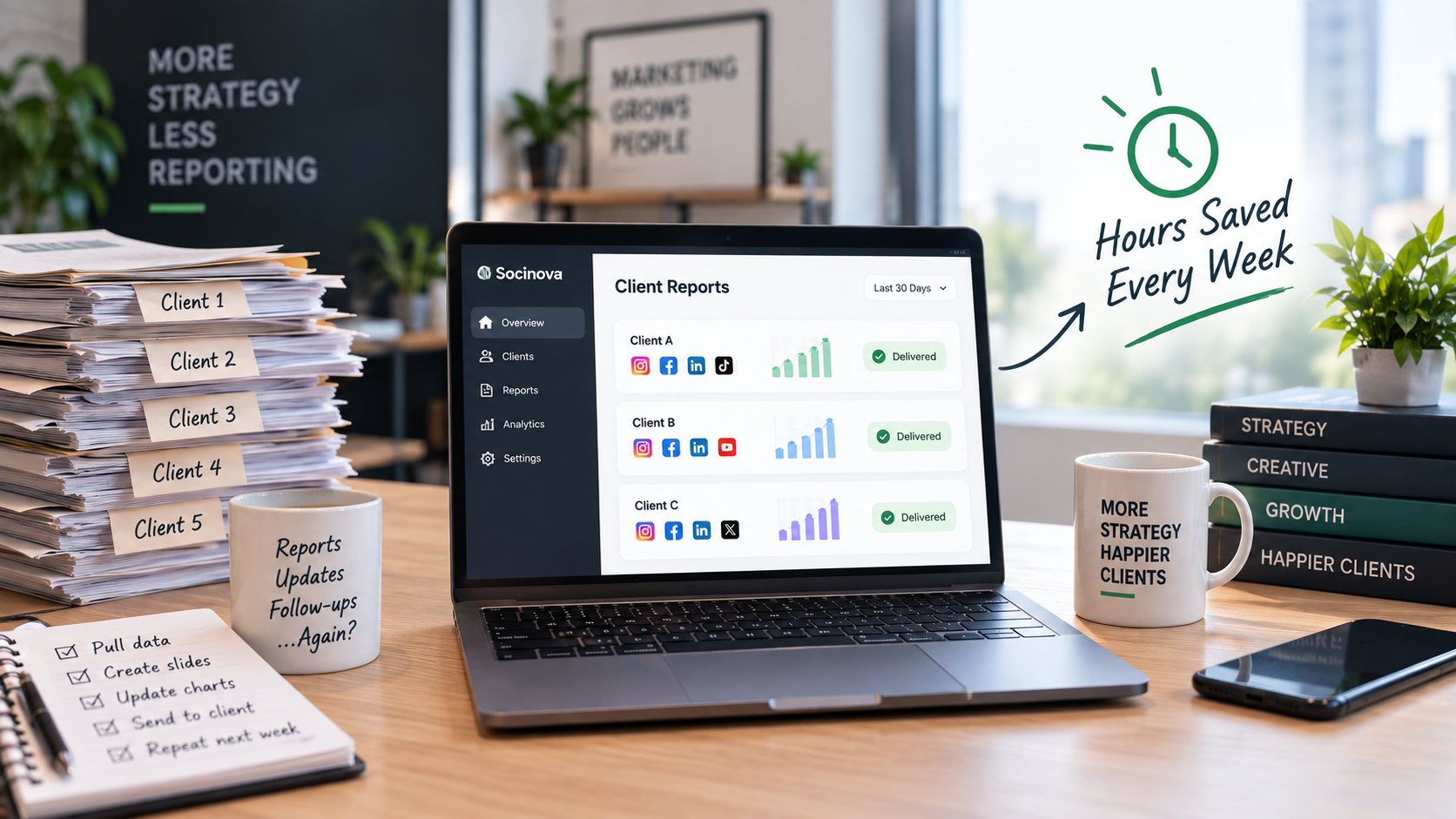
It is Friday afternoon. The account manager logs into Meta Business Suite, screenshots the reach and engagement numbers, then does the same in Instagram Insights. Next comes TikTok, then LinkedIn. Everything gets pasted into a branded template.
The formatting breaks and gets fixed. A summary paragraph explaining what happened gets written. The email intro gets personalised. Send. Then the whole process repeats for the next client. And the next.
This is the agency reporting treadmill. For any agency running weekly social media updates across a roster of clients, it consumes an enormous amount of skilled staff time on work that produces no new value. The data was already there. The insights were already known. Hours went into assembling and formatting documents, not into the strategy or the campaigns that actually grow client results.
Automated social media reporting eliminates that treadmill. Here is what the time cost actually is, why weekly reporting compounds the problem, and how automation gives agencies back the hours that manual reporting quietly consumes.
The Real Cost of Manual Social Media Reporting
The time cost of manual reporting is higher than most agency owners have measured, precisely because it is spread across the week in small increments that never get tracked as a single line item.
According to ReportsMate’s 2026 agency reporting analysis, producing a manual report takes 45 to 60 minutes per client per report. For an agency with 20 social clients on weekly reporting, that adds up to 15 to 20 hours per week spent on copy-paste work. That is half a full-time role dedicated entirely to producing documents that took skill to assemble but required none to read.
Furthermore, a 2024 Databox State of Agency Reporting survey of 450 digital agencies cited by US Tech Automations found that agencies spend an average of 12 to 15 hours per week on client report preparation. Additionally, the same analysis found that manual reporting at an agency with 20 or more clients consumes 40 to 80 staff-hours per month.
Automation reduces per-client monthly reporting time from two to three hours down to just 15 to 20 minutes of review.
The overhead this represents is significant. According to the Agency Management Institute’s 2024 financial benchmark cited in the same research, non-billable overhead including reporting, account management admin, and internal meetings averages 34% of total agency staff time. Reporting automation is one of the highest-ROI ways to reduce that overhead percentage directly.
Why Weekly Reporting Compounds the Problem
Monthly reporting is demanding. Weekly reporting multiplies that demand by four.
An agency that reports monthly produces each client report 12 times a year. An agency reporting weekly produces the same report 52 times a year. The per-report time cost is similar, but the annual burden is more than quadrupled. For agencies that have committed to weekly client updates as a service differentiator, the reporting load becomes one of the largest single consumers of non-billable staff time in the business.
Furthermore, weekly reporting creates a consistency pressure that manual processes struggle to meet. A monthly report can absorb a busy week. A weekly report cannot. When the reporting deadline arrives every Friday regardless of what else is happening, the manual process becomes a recurring source of stress and a frequent cause of rushed, lower-quality output.
The account manager who is buried in campaign work still has to stop and produce the report, or the client relationship suffers.
This is exactly where automation delivers the most value. The weekly cadence that makes manual reporting so burdensome is the same cadence that makes automated reporting so valuable. Once the system is built, it produces every weekly report on schedule regardless of how busy the team is. This frees the account manager to focus on the work that actually moves client results.
What Automated Social Media Reporting Actually Does
Automated social media reporting is a system that pulls performance data from every platform a client uses, compiles it into a branded report, and delivers it on a set schedule without manual intervention.
The system connects directly to Meta, Instagram, TikTok, LinkedIn, and any other platforms the client uses. It pulls reach, engagement, follower growth, spend, and results automatically. There is no logging into each platform separately, no screenshotting, and no copy-pasting into a template. The data flows directly from the platforms into the report.
Furthermore, modern automated reporting goes beyond assembling numbers. According to ReportsMate’s analysis, the write-up was always the hard part of reporting, not the numbers. AI-powered reporting now reads the actual performance data for the period and writes the narrative summary automatically, explaining what improved, what dropped, and what the cross-channel picture looks like.
The senior team member who used to spend time interpreting the data and explaining it in plain English now reviews an automatically generated summary instead.
White-label branding ensures the report looks like the agency produced it by hand. The agency logo sits in the header, the client’s branding appears alongside it, and the reporting tool’s name appears nowhere. As far as the client is concerned, the report is the agency’s own work.
Our social media management service at Socinova and marketing automation infrastructure at Trigacy build these automated, branded reporting systems for agencies and multi-client operations.
What Automated Reports Should Include to Actually Serve Clients
Automation handles the assembly. The value of the report still depends on what it contains and how it communicates.
The metrics that matter to the client, not just the ones that are easy to pull. A report should lead with the metrics tied to the client’s actual goals. If the client cares about lead generation, the report leads with leads and cost per lead, not follower count. Follower growth is easy to report and often meaningless. The metrics that reflect business value are what retain clients.
A narrative that explains the numbers. A report showing “engagement rate: 4.2%” tells the client little. A report explaining “engagement rose 0.8% this week following the shift to video content” tells them something actionable. The narrative context is what turns raw data into insight, and it is exactly what AI-generated summaries now produce automatically.
Consistent format and timing. Clients value predictability. A report that arrives every Friday in the same clear format builds trust and reduces the client’s anxiety about whether their investment is working. Inconsistent reporting, in contrast, signals disorganisation regardless of how well the campaigns are actually performing.
Anomaly flagging. The most useful reports do not just show what happened. They highlight what is unusual. A sudden drop in reach, an unexpected spike in engagement, or a change in cost per result all deserve attention. Automated anomaly detection ensures nothing important slips past between reporting periods.
Why Reporting Is Actually a Retention Driver
Agencies often treat reporting as a back-office chore. The data suggests it is one of the most important retention levers available.
According to SoDA’s 2024 Digital Outlook Report cited by US Tech Automations, the average client tenure at digital agencies is 22 months. Retention is a constant pressure, and reporting directly affects it. Agencies that send clear, consistent reports on time retain clients longer. Agencies where reporting is an afterthought lose clients to competitors who make the data easy to read.
This reframes the entire value of reporting automation. It is not just about saving staff hours, though those savings are substantial. It is about delivering the consistent, professional, on-time reporting that keeps clients confident in the agency’s value. A client who receives a clear, branded, insightful report every single week without fail experiences the agency as reliable, transparent, and worth continuing to pay.
Consequently, the hours automation saves get reinvested in the strategic work that improves client results, while the reporting itself becomes more consistent and more professional. Both effects strengthen retention simultaneously.
What Most Agencies Get Wrong
Reporting on vanity metrics. Follower counts and impressions are easy to pull and impressive-looking, but they rarely reflect the business value the client actually cares about. Reports built around leads, conversions, and cost per result serve clients far better and retain them longer.
Inconsistent delivery. An agency that reports reliably for two months and then goes quiet during a busy period undermines the trust that consistent reporting builds. Automation removes this risk by delivering every report on schedule regardless of team workload.
Over-reporting. Some agencies assume more frequent, more detailed reports are always better. In practice, clients want the right information at the right frequency in a format they can quickly understand. A clear weekly summary with the option to dig deeper usually serves better than an overwhelming data dump.
Manual reporting that steals strategic time. Every hour an account manager spends assembling a report is an hour not spent on strategy, optimisation, or client relationship building. This is the hidden cost that never appears on any invoice but directly limits the agency’s capacity to grow client results.
Not using reporting data internally. Reports serve clients, but the underlying data should also inform the agency’s own strategy. When automated reporting surfaces patterns across clients, such as which content types consistently outperform, that intelligence should feed back into how the agency approaches campaigns. Our demand generation approach at Trigacy uses this kind of cross-client performance intelligence as a standard input.
How We Handle Reporting Across 1,200+ Client Accounts
At Socinova and Trigacy, we manage social media and marketing for over 1,200 businesses worldwide. The reporting challenge this blog describes is one we faced directly and had to solve, because the manual approach simply does not scale to that volume of clients.
Managing reporting for that many accounts through manual screenshots and copy-paste templates would be impossible at a quality level that retains clients. It would consume the entire capacity of the team and leave no time for the strategy and campaign work that actually produces results. The only viable path was to build reporting systems that run automatically.
Our reporting workflows are built on automated data consolidation, standardised but customisable branded templates, and scheduled delivery. Data is pulled directly from each client’s platforms. Reports are generated on a consistent cadence. Account managers review an assembled report rather than building one from scratch.
The result is that our team spends its time on strategy, optimisation, and client communication rather than data extraction and formatting.
This is not a sophisticated technical achievement. It is a systematic one.
The tools matter less than the judgment behind how you use them. Here is what a decade of running our own agency taught us about building systems that scale
The tools to automate reporting exist and are widely available. The discipline of building the right workflow around those tools, so that reporting runs reliably without consuming skilled staff time, is what makes the difference at scale.
For any agency feeling the weekly reporting load across a growing client roster, this is the shift that frees the team to grow. Book a call with our team to discuss how we would approach reporting automation for your specific agency.
The Bottom Line
Weekly social media reporting is one of the largest hidden consumers of agency staff time. The work requires skill to assemble but produces no new value in the assembling. Every hour spent screenshotting metrics and formatting templates is an hour not spent on the strategy and campaign work that actually grows client results.
Automated social media reporting ends that waste. The data flows directly from every platform. Narrative summaries get written automatically. Branded reports deliver on schedule every week without anyone stopping their real work to produce them. Those saved hours get redirected to billable, strategic work, and the reporting itself becomes more consistent and more professional in the process.
For agencies running weekly client updates across multiple accounts, this is one of the highest-return operational investments available. It saves significant staff time, improves client retention through consistent professional reporting, and frees the team to focus on the work that grows the business.
That is exactly the kind of operational infrastructure we help agencies and multi-client operations build through our social media management service, marketing automation, demand generation programs, retargeting campaigns, and sales funnels.
Let us talk about what this looks like for your agency.
– Blog written by Sarah Joshi