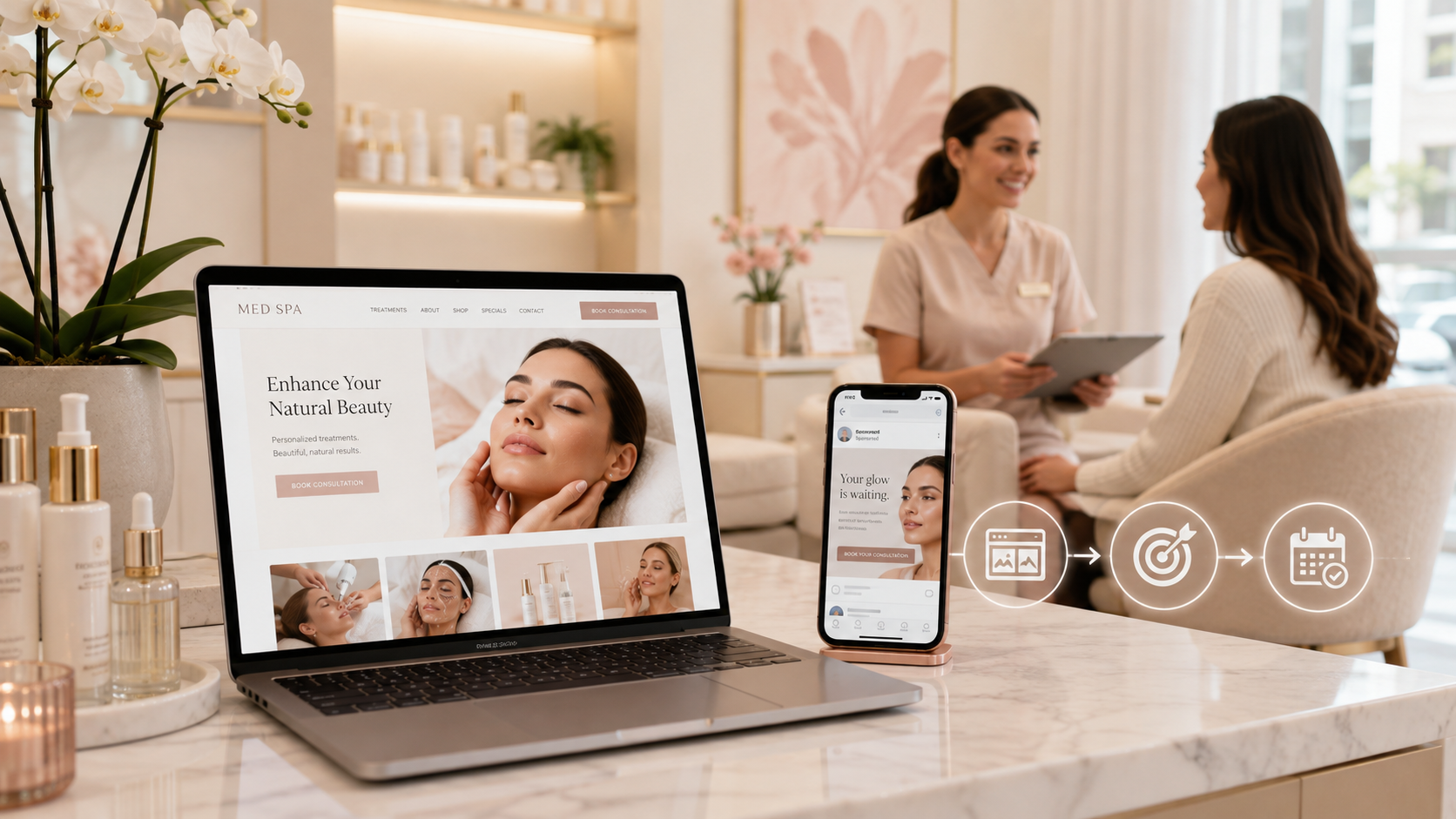
Ninety-seven people visited a med spa’s website today. They browsed the Botox page, looked at the before-and-after gallery, and checked the pricing section. Then they left. Without a retargeting system, those 97 people are gone. The med spa spent money on the ads or SEO that brought them in and received nothing in return.
This is the default outcome for most med spas running paid social. Traffic arrives, browses, and leaves. Money was spent. No booking was made.
According to Pronk’s 2026 med spa retargeting guide, 97% of med spa website visitors leave without booking. Furthermore, the gap between that first visit and an eventual booking is not a disinterest problem. It is a follow-up problem. Aesthetic services involve significant consideration.
Most patients research across multiple sessions before they feel ready to commit. Meta retargeting keeps the med spa present and relevant throughout every one of those sessions.
Here is how retargeting funnels work specifically for med spas, how to segment audiences by intent level, and what creative actually converts browsers into booked clients.
Why Med Spas Lose So Many Visitors Before They Book
Aesthetic treatments are not impulse purchases. A prospective patient considering Botox, laser treatments, or body contouring is weighing cost, downtime, results, and trust simultaneously. Research happens first. Comparisons follow. Reviews get checked. Most patients come back to a website multiple times before they feel ready to book.
The challenge for med spas is that patient acquisition costs have risen sharply. According to Web Tonic’s 2026 landing page statistics, patient acquisition cost climbed 56% from 2022 to 2025 across healthcare specialties. For med spas, fully loaded CAC runs between $200 and $650. At those costs, allowing 97% of acquired traffic to leave without any follow-up mechanism is a significant financial drain.
Furthermore, Kōvly Studio’s med spa marketing data confirms that the US med spa industry now includes over 9,500 practices competing for the same patients in most metro markets. In a market that competitive, the practice with the most persistent, relevant follow-up system consistently wins the appointment over one that relied on a single ad impression.
The Numbers Behind Meta Retargeting for Aesthetics
The performance data for retargeting in the aesthetics space is consistently strong.
Rank and Rejuvenate’s 2025 med spa social trends analysis found that med spas using a full-funnel approach reduced booking friction by 73% and increased conversion rates by 47%. Additionally, Facebook Business Intelligence data shows that aesthetic practices using conversational commerce tools see 59% higher conversion rates than those using traditional website-based funnels.
Response speed is also a critical variable in retargeting performance. According to Messenger Business Report data cited in the same analysis, med spas that respond to enquiries within five minutes convert at 3.1 times the rate of those that respond within 24 hours. A retargeting ad that generates an enquiry only produces a booking when the follow-up system is as fast as the ad itself.
Moreover, Web Tonic’s data shows that treatment-specific landing pages convert at 4 to 8%, compared to just 1 to 2% for generic med spa website pages. This means a retargeting campaign sending traffic to the right landing page is producing two to four times the conversion rate of one sending traffic to the homepage. The funnel structure matters as much as the ad itself.
What a Meta Retargeting Funnel Actually Looks Like for Med Spas
A med spa Meta retargeting funnel is not a single ad shown to everyone who visited the website. It is a layered system of audience segments, each receiving creative matched to their specific level of intent.
The funnel typically has three layers.
Layer 1: Awareness retargeting. This layer reaches visitors who spent less than 30 seconds on the site or only visited the homepage. These are people who showed minimal intent. The creative here is brand-building rather than conversion-focused. Before-and-after galleries, patient testimonials, and educational content about specific treatments build familiarity and keep the med spa top of mind.
Layer 2: Consideration retargeting. This layer reaches visitors who viewed a specific treatment page, spent significant time on the site, or visited multiple pages in a session. These visitors have demonstrated meaningful interest. The creative becomes more specific and action-oriented.
A visitor who spent three minutes on the laser hair removal page receives retargeting ads specifically about laser hair removal, featuring results, pricing ranges, and a direct booking CTA.
Layer 3: High-intent retargeting. This layer reaches visitors who reached the booking or contact page without completing the action. These are the highest-value retargeting prospects available. They were seconds away from booking. The creative for this audience uses urgency, social proof, and a frictionless booking path. A limited-time consultation offer or a specific availability prompt can be enough to convert this segment.
Our retargeting campaigns at Trigacy build these three-layer systems for healthcare and aesthetic practices, ensuring every audience segment receives creative that reflects their demonstrated intent rather than generic med spa messaging.
How to Segment Retargeting Audiences by Intent Level
Audience segmentation is where most med spa retargeting systems either succeed or fail. A well-segmented retargeting system reaches the right person with the right message at the right moment. A poorly segmented one wastes budget showing high-urgency CTAs to people who just discovered the brand.
Website visitors by page type. Visitors to treatment-specific pages are separated from general website visitors. A visitor who viewed the CoolSculpting page is a warmer prospect than one who visited the blog. Consequently, they receive treatment-specific creative rather than general brand awareness content.
Time-on-site segments. Visitors who spent more than two minutes on the site showed stronger engagement than those who bounced quickly. Longer dwell time signals higher purchase consideration. Additionally, visitors who scrolled to pricing sections on treatment pages have already shown cost awareness, making them good candidates for value-focused creative.
Video viewers from paid social. Visitors who watched 50% or more of a treatment explainer video on Facebook or Instagram are warm leads even if they never visited the website. Adding these viewers to retargeting audiences extends the funnel beyond the website and captures engaged social traffic that a pixel-only approach would miss.
Past patients. Uploading a patient email list to Meta creates a custom audience for re-engagement campaigns. Past patients already trust the practice. According to Pronk’s analysis, retargeting past patients with new treatment offers and seasonal promotions is one of the highest-conversion retargeting strategies available to med spas, because the trust barrier has already been overcome.
Lookalike audiences from converters. Once the retargeting system has generated bookings, those converted patients become a seed audience for lookalike targeting. A lookalike built from booked patients finds new prospects with similar characteristics, effectively expanding the top of the funnel with higher-quality traffic.
The Creative That Actually Converts Med Spa Retargeting Audiences
Creative is where many med spa retargeting campaigns underperform despite having solid audience segmentation. One-size-fits-all creative does not work when audiences are at different intent levels.
For awareness audiences: Patient journey videos, before-and-after carousels, and educational content about specific treatments. The messaging is informational rather than promotional. The goal is to move the prospect from curious to interested, not from interested to booked.
For consideration audiences: Treatment-specific social proof. A carousel showing multiple before-and-after results for the exact treatment the visitor viewed. A video testimonial from a patient who had that specific procedure. A direct comparison of what the treatment addresses versus alternatives. These formats answer the questions a mid-funnel prospect is actively asking.
For high-intent audiences: Urgency and frictionless action. A direct booking offer, limited appointment availability, a consultation incentive, or a simple question like “Still thinking about Botox? Book your free consultation this week.” The creative length should be short. This audience already knows what they want. Education is not needed at this stage. What moves them is a clear reason to act now.
According to Rank and Rejuvenate’s analysis, content that feels overly produced now actively harms conversion rates for med spas. Authentic patient experience content consistently outperforms studio-produced ad creative in the aesthetics category. Real results from real patients, shown in natural lighting with honest captions, generate stronger engagement and higher booking intent than polished promotional content.
What Most Med Spas Get Wrong With Retargeting
More ad spend without the right funnel behind it rarely produces better results. Here is why the conversion infrastructure matters more than the budget.
Treating all website visitors as one audience. Running a single retargeting campaign to everyone who ever visited the site produces mediocre results across the board. The segmentation described above is not an optional optimisation. It is the foundational architecture that makes retargeting cost-effective.
Sending retargeting traffic to the homepage. A visitor who saw a retargeting ad for laser treatments and clicks through to the homepage faces the same friction that caused them to leave the first time. Retargeting traffic must go to treatment-specific landing pages that continue the narrative of the ad. Web Tonic’s data confirms a 4 to 8% conversion rate for treatment-specific pages versus 1 to 2% for generic pages.
That difference in destination explains a significant portion of retargeting underperformance.
No server-side tracking. Apple’s ATT changes and browser cookie restrictions have reduced the tracking accuracy of standard Meta pixels significantly. Pronk’s retargeting guide notes that server-side tracking through the Meta Conversions API recovers 30 to 50% of the conversion data lost to browser-level blocking. Without server-side tracking, retargeting audiences are smaller, less accurate, and more expensive to reach.
Our marketing automation infrastructure at Trigacy includes server-side tracking setup as a standard component of any paid campaign system for healthcare clients.
No follow-up system for retargeting enquiries. A retargeting ad that drives an enquiry produces a booking only when the follow-up is immediate. Wellness MD Group’s 2026 research confirms that the conversion rate drops dramatically after five minutes of response delay.
Our sales funnel buildouts at Trigacy connect retargeting campaigns to automated response sequences so every enquiry generated by a retargeting ad receives a personalised response within minutes.
Evaluating retargeting on last-click attribution. Retargeting operates as a mid-funnel influence, not a last-click converter. A patient who books after seeing the retargeting ad four times over two weeks will be attributed to whatever they clicked last.
However, without those four impressions, the booking likely would not have happened. Evaluating retargeting solely on direct last-click conversions consistently undervalues its contribution and leads to premature campaign termination.
How Targeted Paid Campaigns Generated 25 Qualified Leads Per Month for a Healthcare Brand
CGA Weight Loss operates in a healthcare category with purchase psychology nearly identical to med spa patient acquisition. The decision is personal, emotionally significant, and financially considered. Patients research extensively across multiple sessions.
Trust must be established before a consultation is requested. Generic campaigns that reached broad audiences produced volume without quality and cost more per qualified lead than the practice could sustain.
The retargeting component of the system we built was central to the performance improvement. Rather than relying on a single ad impression to drive immediate booking, campaigns were structured to reach people who had already shown interest at progressively higher levels of intent.
Creative matched the stage of consideration the prospect was likely in. Follow-up automation ensured that every inbound enquiry generated by retargeting received an immediate, personalised response.
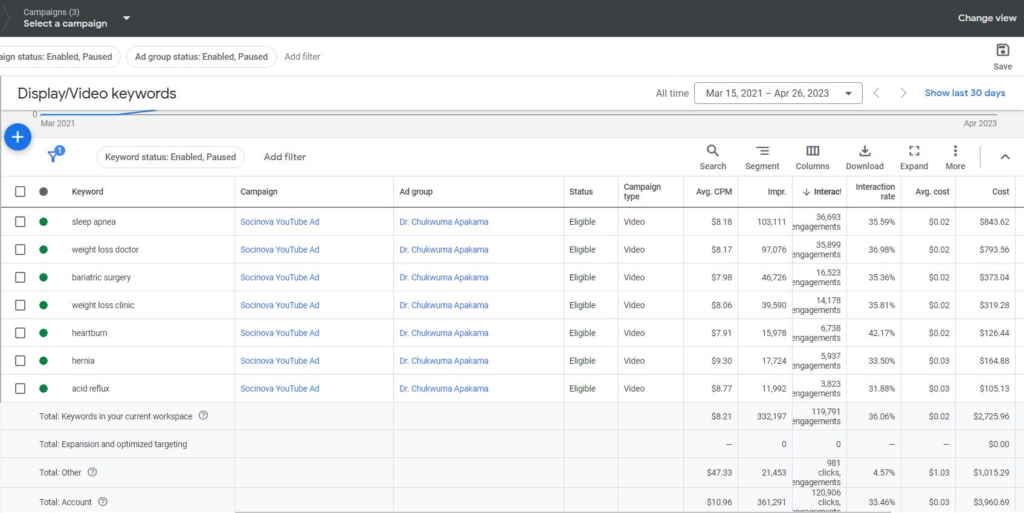
The result was 25 or more qualified leads per month at a consistently lower cost per acquisition. The retargeting layer was specifically responsible for converting the warm audience of people who had previously encountered the brand but not yet committed. Without it, those prospects would have continued researching alternatives until a competitor’s retargeting campaign reached them first.
Book a call with our team to discuss how a Meta retargeting funnel would work for your specific med spa and treatment offering.
The Bottom Line
The 97% of med spa visitors who leave without booking are not lost. Many of them are actively considering the treatments offered. They simply need more time and more touchpoints before they feel ready to commit.
Meta retargeting funnels provide those touchpoints systematically. Segmented by intent level, matched to the right creative, and connected to a fast follow-up system, they convert the warm traffic that a first-impression-only ad strategy leaves behind.
In a market where patient acquisition costs have risen 56% in three years, recovering that warm traffic is not a nice-to-have optimisation. It is the most cost-efficient patient acquisition strategy available.
That is the infrastructure we help med spas and aesthetic practices build through our retargeting campaigns, sales funnels, marketing automation, social media advertising, and healthcare marketing programs.
Let us build your retargeting funnel.
– Blog written by Sarah Joshi